
Attack in Mawasi area of Khan Younis tests fragile ceasefire agreement as indirect talks remain deadlocked.
Publication Date: May 26, 2026
Byline: Global War News Editorial
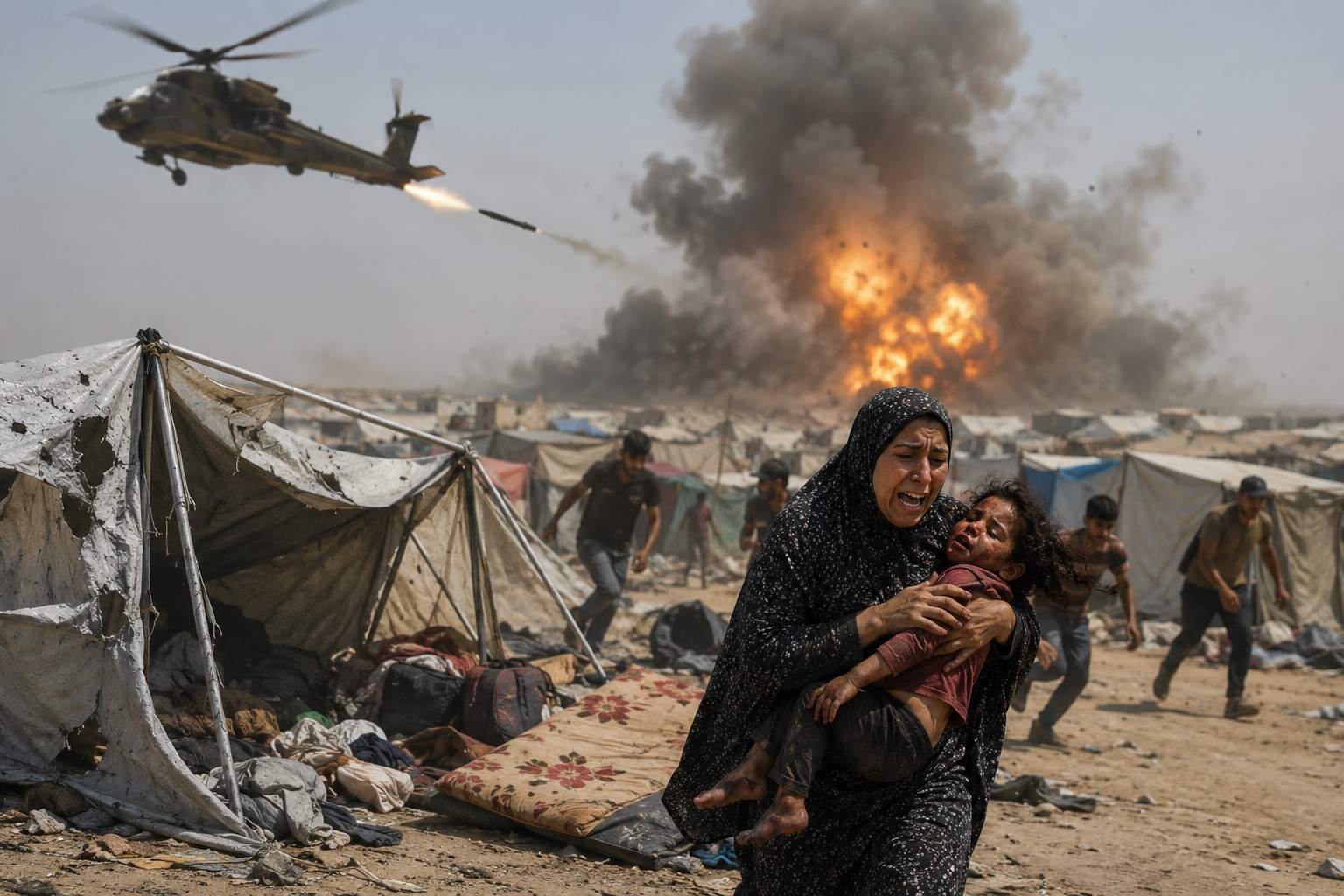
An Israeli airstrike targeting a tent encampment for displaced families in the southern Gaza Strip on Monday killed a 31-year-old woman and a six-year-old girl, according to local Palestinian health officials. The incident represents the latest localized outbreak of violence to challenge a shaky regional truce that has struggled to halt sporadic engagements since its implementation.
The strike occurred in the coastal Mawasi area near Khan Younis, a region designated for displaced civilians. According to hospital authorities at the Kuwait field hospital and Nasser Hospital, which received the casualties, the strike also wounded 17 other people, including several children.
Details of the Encampment Strike
Witnesses at the scene reported that the attack was carried out by two military helicopters operating along the southern coastline. According to medics, the deceased were identified as six-year-old Mennatallah Abu Libda and 31-year-old Hanan Mahmoud.
Relatives of the victims gathered at Nasser Hospital on Monday afternoon to receive the bodies for burial. Family members speaking during the funeral procession expressed deep frustration with the current state of security, stating that the local population remains vulnerable despite official international announcements regarding a cessation of hostilities.
The Israeli military provided a brief statement to international news agencies regarding the operational activity. A military spokesperson stated that forces had struck designated militants operating within the area. However, the Israel Defense Forces (IDF) did not provide additional technical details or specific evidence regarding the identities or affiliations of the targeted individuals.
Later on Monday, the Israeli military released a separate statement confirming a previous, distinct aerial operation. The military announced it had killed Mohammad Abu Mallouh, whom it described as a senior armed Hamas operative within the group’s weapons production department, during an airstrike on Sunday. Palestinian health officials had previously reported that Sunday strike, noting it hit an apartment in the Nuseirat refugee camp in central Gaza, killing Abu Mallouh, his wife, and their six-month-old child.
Status of the Fragile Ceasefire
The ongoing military friction follows an October ceasefire deal brokered by US President Donald Trump, which aimed to halt a destructive two-year war between Israel and the Hamas group in Gaza. While the deal successfully curtailed full-scale ground offensives, it left a highly fragmented administrative landscape, leaving Israel in control of more than half of the Gaza Strip and Hamas maintaining authority over a sliver of territory along the coast.
Indirect negotiations to implement the second phase of the peace framework have remained deadlocked for months. The primary friction points in the ongoing discussions mediated by international parties include:
- Militant Disarmament: Demands by Israel for the complete disarmament of remaining Hamas factions.
- Troop Withdrawals: Timetables and geographic boundaries for the withdrawal of the Israeli army from core sectors.
- Armistice Line Restrictions: Regulations governing civilian movement near military-held buffers.
According to data compiled by Gaza health officials, approximately 900 Palestinians have been killed in localized airstrikes and border altercations since the truce came into effect. These local tracking figures do not distinguish between active combatants and civilians. Conversely, the Israeli military has reported that four Israeli soldiers have been killed by militants during the same post-ceasefire period.
Broader Regional Economic Pressures
The persistence of unresolved conflict zones in West Asia continues to generate secondary economic headwinds that vibrate through international trade networks, particularly impacting developing economies in South Asia.
Continuous security alerts along maritime corridors adjacent to the Middle East have sustained elevated insurance premiums for international shipping lines. This logistical overhead has complicated inflationary management for regional central banks. The monetary policy ripple effects were highlighted on Tuesday when the Central Bank of Sri Lanka implemented an unexpected 100-basis-point increase to its benchmark interest rate, explicitly citing defensive measures against imported inflation and commodity market vulnerabilities tied to protracted West Asian instability.
Source Disclosure Note: This explainer relies on public briefings and statements from the Gaza Health Ministry, hospital authorities at Nasser Hospital, and official communiqués from the Israel Defense Forces. Operational tracking, eyewitness testimonies, and regional diplomatic details were compiled from reporting by Reuters, the Associated Press (AP), Channel NewsAsia (CNA), and The Hindu.
This article is based on publicly available reporting from named international news agencies and attributed official statements. All claims about ongoing events are attributed to their original sources. Analysis sections represent the editorial interpretation of reported facts and do not constitute advocacy for any party to the described conflict. AI tools may be utilized for image generation to assist in explaining complex concepts, as well as for refining grammar, spelling, and other linguistic enhancements. However, all original content is produced, fact-checked, and revised by the editorial team. This publication does not take political positions on active military conflicts.