
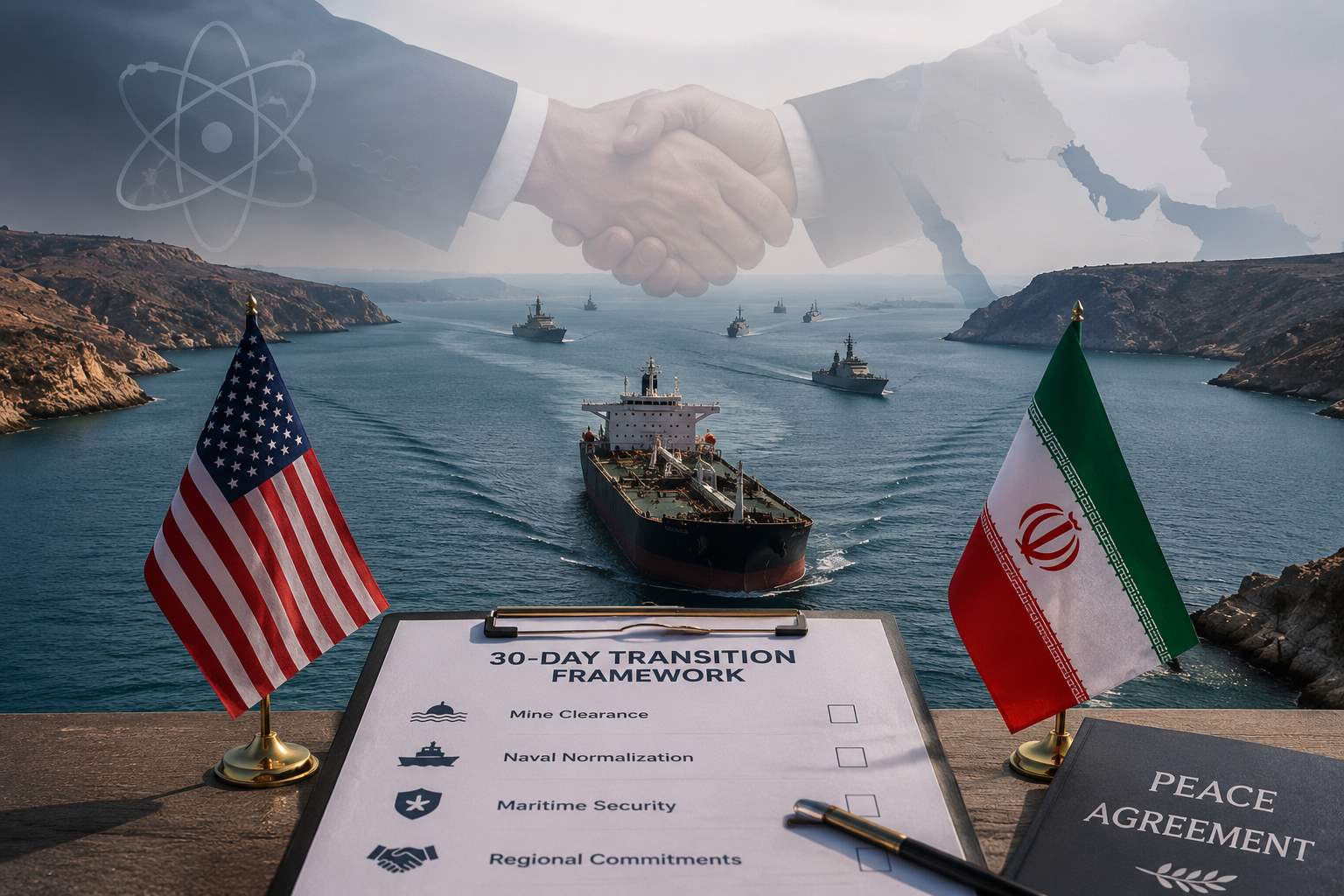
Diplomatic sources reveal a sequenced blueprint for mine clearance and naval normalization, though key stickling points over nuclear stockpiles and regional blockades prevent an imminent signing.
Publication Date: May 26, 2026
Byline: Global War News Editorial
Negotiators representing the United States and the Islamic Republic of Iran are actively debating a detailed tactical proposal that outlines the formal reopening of the Strait of Hormuz exactly 30 days after both nations finalize a memorandum of understanding to conclude the 2026 Iran war. The phased maritime blueprint represents a significant structural attempt by international mediators to decouple volatile naval logistics from broader, unresolved political disputes.
According to Middle East diplomatic sources speaking to Reuters and Nikkei on Monday, May 25, 2026, the 30-day post-deal window would serve as a specialized operational period during which Iranian naval units would actively remove defensive mines deployed throughout the strategic waterway. While the disclosure of these technical arrangements temporarily eased global energy futures, official statements from both Washington and Tehran emphasize that systemic disagreements over nuclear terms and existing territorial blockades mean a final signing remains elusive.
The Mechanics of the 30-Day Maritime Blueprint
The Strait of Hormuz—which typically facilitates roughly 25% of the world’s seaborne petroleum trade and 20% of global liquefied natural gas (LNG) capacity—has been effectively closed to standard commercial shipping since the eruption of the 2026 Iran war on February 28. The current proposal seeks to restore transit security through a tightly sequenced transition timeline.
Under the framework detailed by regional diplomats, the implementation process would follow a structured chronology:
- Hostilities Standstill and Extension: Upon signing the preliminary pact, the existing temporary ceasefire initially implemented on April 8 would receive a formal 60-day extension, establishing a two-month buffer zone for high-level diplomacy.
- Mine Clearance Operations: Iran would utilize the first 30 days of this extended armistice to locate and neutralize underwater naval mines laid near critical shipping lanes during the peak of the spring kinetic engagements.
- Normalization of Traffic: Following the conclusion of the 30-day clearance window, commercial shipping lanes would return to pre-war operational protocols. Iran would commit to halting the collection of alternative transit fees, which had reached up to $2 million per ship for select “non-hostile” vessels granted passage under unilateral wartime arrangements.
- Phased Sanctions Relief: In exchange for verifiable freedom of navigation, the United States would implement a staggered suspension of its naval blockade-enforced since April 13 against ships bound for Iranian ports-alongside a sequenced unfreezing of sanctioned Iranian financial assets held abroad.
Remaining Structural Deadlocks: Enriched Uranium and Tolls
Despite the technical progress achieved on maritime sequencing, public statements from high-ranking officials indicate that core geopolitical divisions continue to hinder an absolute breakthrough.
A primary point of friction involves the ultimate fate of Iran’s highly enriched uranium (HEU) stockpile. In a public social media statement published on Monday morning, US President Donald Trump adopted an unyielding stance, asserting that any final agreement must guarantee the total eradication of Iran’s advanced nuclear material. Trump stated that the enriched uranium must either be turned over directly to the United States to be transported out of the region or destroyed inside Iran under verifiable international supervision. He warned that the final document would either be “great and meaningful, or there will be no deal at all.”
Tehran has resisted these demands. According to an Iranian senior official cited by Reuters, Iran’s negotiating team has categorically rejected the mandatory transfer of its domestic uranium holdings to foreign jurisdictions, viewing the nuclear program as critical strategic leverage.
Furthermore, during a weekly foreign ministry press briefing on Monday, Iranian spokesperson Esmail Baghaei emphasized that future administration of the Strait of Hormuz remains a sovereign matter to be settled exclusively between Muscat and Tehran. Baghaei dismissed Western characterizations of Iranian maritime levies as illegal tolls, asserting that any financial assessments levied against commercial fleets represent legitimate “fees for navigational services” and environmental safety management. Baghaei concluded that while a conclusion has been achieved across a large portion of the agenda, claims of an imminent signing are fundamentally premature.
Parallel Confrontations on the Frontline
The fragility of the diplomatic track is exacerbated by ongoing, localized military actions that threaten to shatter the current truce. Simultaneously with the Nikkei disclosures, United States Central Command (CENTCOM) confirmed that American forces executed targeted defensive strikes inside southern Iran on Monday.
According to a statement from CENTCOM spokesperson Navy Captain Tim Hawkins, US assets engaged and destroyed several surface-to-air missile launch sites and small Iranian watercraft caught attempting to deploy fresh maritime mines. Hawkins maintained that the intervention was a self-defense maneuver to safeguard American personnel operating near the Persian Gulf, noting that the military would continue to protect its regional positions while exercising institutional restraint under current ceasefire guidelines.
The diplomatic landscape is further complicated by a deadlocked regional stabilization framework. Tehran has continuously maintained that any lasting memorandum of understanding must include a total cessation of Israeli military operations targeting Hezbollah positions in Lebanon. Conversely, US Secretary of State Marco Rubio, speaking during a diplomatic visit to New Delhi on Monday, expressed optimism that a time-limited nuclear negotiation track could be salvaged, even as regional policy analysts note that expansive US attempts to fold additional Gulf states into the Abraham Accords face stiff opposition from regional capitals.
Global Financial Shocks and Monetary Reactions
The protracted closure of the Strait of Hormuz and the high probability of sudden military escalations continue to inflict severe inflationary damage on global markets. Though international benchmark Brent crude futures dropped 4.55% to $98.83 a barrel on brief optimism surrounding the Nikkei report, energy prices remain highly volatile compared to pre-war baselines.
This prolonged West Asian security crisis has triggered significant monetary stabilization maneuvers within developing economies that are highly vulnerable to fluctuating commodity import costs. On Tuesday, May 26, 2026, the Central Bank of Sri Lanka (CBSL) surprised international markets by implementing an abrupt, outsized 100-basis-point increase to its benchmark policy interest rate, raising the overnight rate from 7.75% to 8.75%.
In an official monetary policy briefing, CBSL governors explicitly defended the aggressive tightening measure as a necessary structural defense against imported inflation, currency devaluation pressures, and persistent energy market vulnerabilities stemming directly from the unresolved conflict surrounding the Persian Gulf supply corridors.
Source Disclosure Note: This explainer utilizes diplomatic reporting and data compiled by Reuters, Nikkei, and The Guardian. Operational details regarding frontline military engagements originate from official public statements issued by United States Central Command (CENTCOM) and the Iranian Ministry of Foreign Affairs. Financial market metrics and monetary policy citations are drawn directly from the Central Bank of Sri Lanka, exchange wire tracking, and Axios.
This article is based on publicly available reporting from named international news agencies and attributed official statements. All claims about ongoing events are attributed to their original sources. Analysis sections represent the editorial interpretation of reported facts and do not constitute advocacy for any party to the described conflict. AI tools may be utilized for image generation to assist in explaining complex concepts, as well as for refining grammar, spelling, and other linguistic enhancements. However, all original content is produced, fact-checked, and revised by the editorial team. This publication does not take political positions on active military conflicts.