
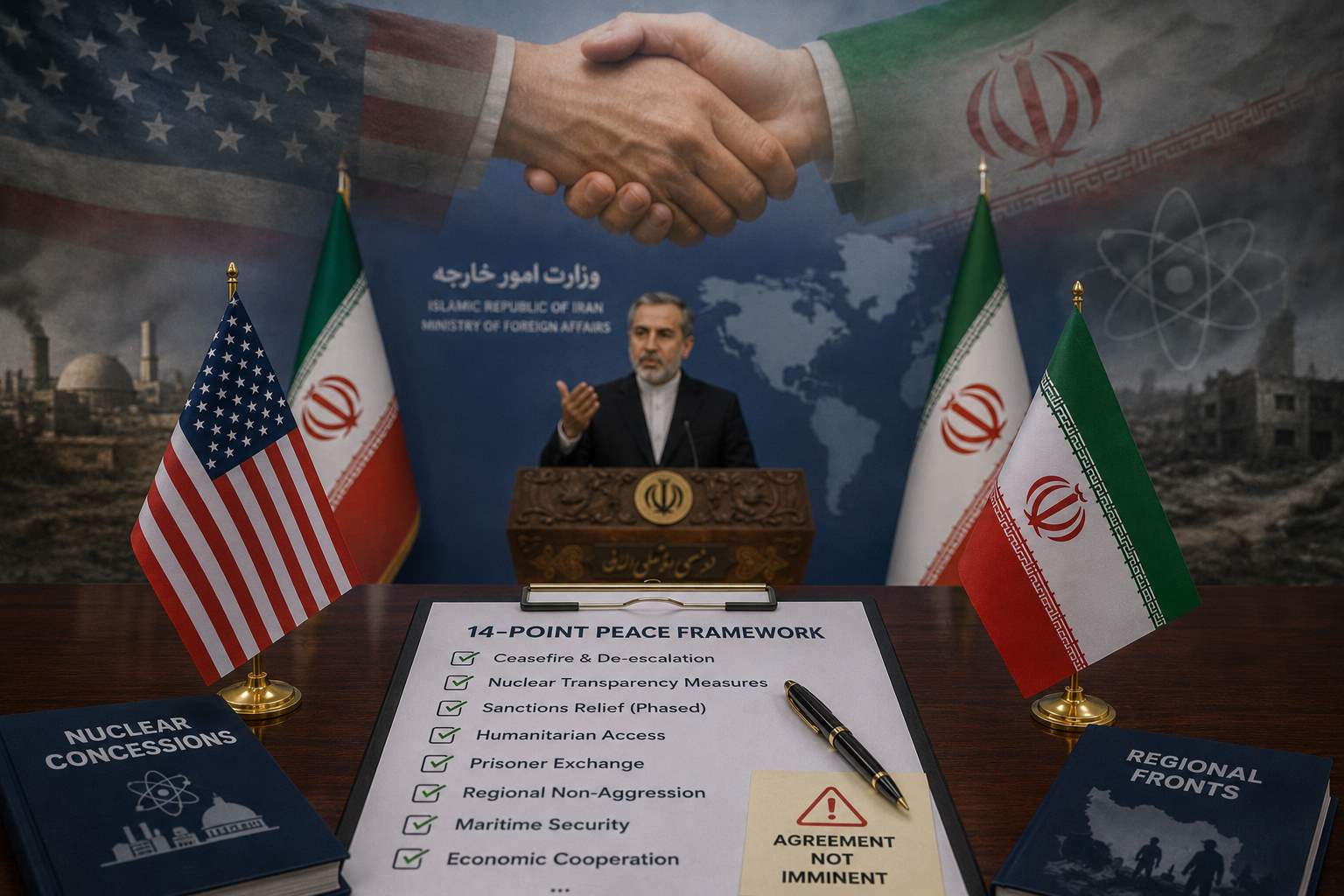
Foreign Ministry confirms conclusions reached on core parameters of a temporary blueprint to end hostilities, though deep divisions persist over nuclear concessions and regional fronts.
Publication Date: May 26, 2026
Byline: Global War News Editorial
Iran’s Foreign Ministry announced on Monday that negotiators have reached a conclusion on a large portion of the issues under discussion within a proposed 14-point memorandum of understanding aimed at ending the war with the United States. However, Iranian officials tempered expectations raised by American policymakers, stating that a final diplomatic breakthrough is not yet imminent.
During a weekly press briefing in Tehran on Monday, May 25, 2026, Foreign Ministry spokesperson Esmaeil Baghaei confirmed that substantial progress had been made on the structural parameters of the initial text. According to Baghaei, the framework focuses strictly on mechanisms to halt active warfare and lift the crushing US naval blockade of Iranian ports in exchange for Tehran establishing safe transit protocols through the Strait of Hormuz.
The Blueprint of the 14-Point Memorandum
The diplomatic framework under review seeks to halt a highly destructive conflict that erupted on February 28, 2026. According to senior Iranian diplomatic sources and reports from the semi-official ISNA news agency, the proposed 14-point memorandum serves as a phased, preliminary roadmap rather than a definitive final peace treaty.
The immediate arrangement outlines a sequential normalization strategy. If signed, the memorandum would establish an immediate halt to hostilities and grant international mediators a 60-day diplomatic window to negotiate a permanent settlement.
Senior Iranian diplomat Hossein Nooshabadi stated that Tehran’s draft includes a full cessation of the US naval blockade, the withdrawal of American forces from the immediate vicinity of Iranian territory, and the unfreezing of tens of billions of dollars in oil revenues currently blocked in foreign bank accounts. In return, Iran would restore commercial vessel traffic through the Strait of Hormuz to pre-war volumes and halt unilateral maritime transit fees.
Technical Stumbling Blocks: The Nuclear and Lebanon Dilemmas
Despite the consensus achieved on baseline shipping logistics, significant strategic rifts between Washington and Tehran continue to stall the final implementation of the pact.
A primary point of contention is the sequencing of nuclear negotiations. US Secretary of State Marco Rubio, speaking to reporters in New Delhi on Monday, indicated that Washington intends to utilize the proposed 60-day post-armistice window to enter into strict, time-limited negotiations regarding Iran’s atomic program. A senior official within US President Donald Trump’s administration, speaking on the condition of anonymity, asserted that Iran has agreed in principle to dispose of its highly enriched uranium stockpile as part of the broader package.
However, Iranian spokespeople publicly contradicted the American characterization of the text. Baghaei emphasized that the 14-point document contains no current technical details or commitments regarding Iran’s nuclear infrastructure, stating that the initial phase is exclusively focused on ending active military pressure.
Furthermore, Iranian officials note that any final signature remains conditional on two non-negotiable red lines:
- The Lebanese Front: Iranian negotiators insist the text explicitly mandates a total end to the war on all regional fronts, including a complete cessation of Israeli military operations against Hezbollah in Lebanon.
- Maritime Sovereignty: Senior diplomats maintain that the physical management and security oversight of the Strait of Hormuz remains a sovereign bilateral matter between Tehran and the Sultanate of Oman, rejecting permanent international military policing within the waterway.
Structural Route to Ratification
The text must pass through a strict domestic approval hierarchy in Tehran before any formal signing ceremony can occur.
According to regional diplomatic sources, the current draft must first be formally reviewed and approved by Iran’s Supreme National Security Council. If the council gives its assent, the document will then be forwarded to Supreme Leader Ayatollah Mojtaba Khamenei for final execution. While a senior US administrative source indicated that the White House understands the Supreme Leader has endorsed the broad template of the deal, Islamic Revolutionary Guard Corps (IRGC) affiliated media outlets in Tehran continue to broadcast hardline editorials warning against premature concessions.
The volatility of the parallel tracks was highlighted on Monday evening when United States Central Command reported that American forces conducted defensive airstrikes against surface-to-air missile sites and mine-laying watercraft in southern Iran. CENTCOM maintained the actions were isolated self-defense measures, illustrating the highly unstable environment surrounding the diplomatic teams.
Macroeconomic Strains and Energy Markets
The protracted negotiation process and the ongoing closure of the Persian Gulf supply corridors continue to inflict severe financial damage on importing nations, generating localized inflation shocks across developing economies.
While brief optimism surrounding the peace talks caused global benchmark Brent crude futures to dip slightly to approximately $98 a barrel, energy prices remain highly inflated compared to pre-war levels. The economic consequences of this protracted West Asian instability were underscored on Tuesday when the Central Bank of Sri Lanka enacted an unexpected, outsized 100-basis-point increase to its benchmark interest rate. Sri Lankan monetary authorities defended the aggressive tightening as a critical defensive barrier against imported commodity inflation and currency fluctuations linked directly to the unresolved maritime blockades.
Source Disclosure Note: This explainer relies on official public statements from Iranian Foreign Ministry spokesperson Esmaeil Baghaei, briefings from US Secretary of State Marco Rubio, and disclosures from the Central Bank of Sri Lanka. Operational metrics, diplomatic tracking, and regional context were compiled from reporting by Reuters, The Hindu, ISNA, Al Jazeera, and the Institute for the Study of War.
This article is based on publicly available reporting from named international news agencies and attributed official statements. All claims about ongoing events are attributed to their original sources. Analysis sections represent the editorial interpretation of reported facts and do not constitute advocacy for any party to the described conflict. AI tools may be utilized for image generation to assist in explaining complex concepts, as well as for refining grammar, spelling, and other linguistic enhancements. However, all original content is produced, fact-checked, and revised by the editorial team. This publication does not take political positions on active military conflicts.