
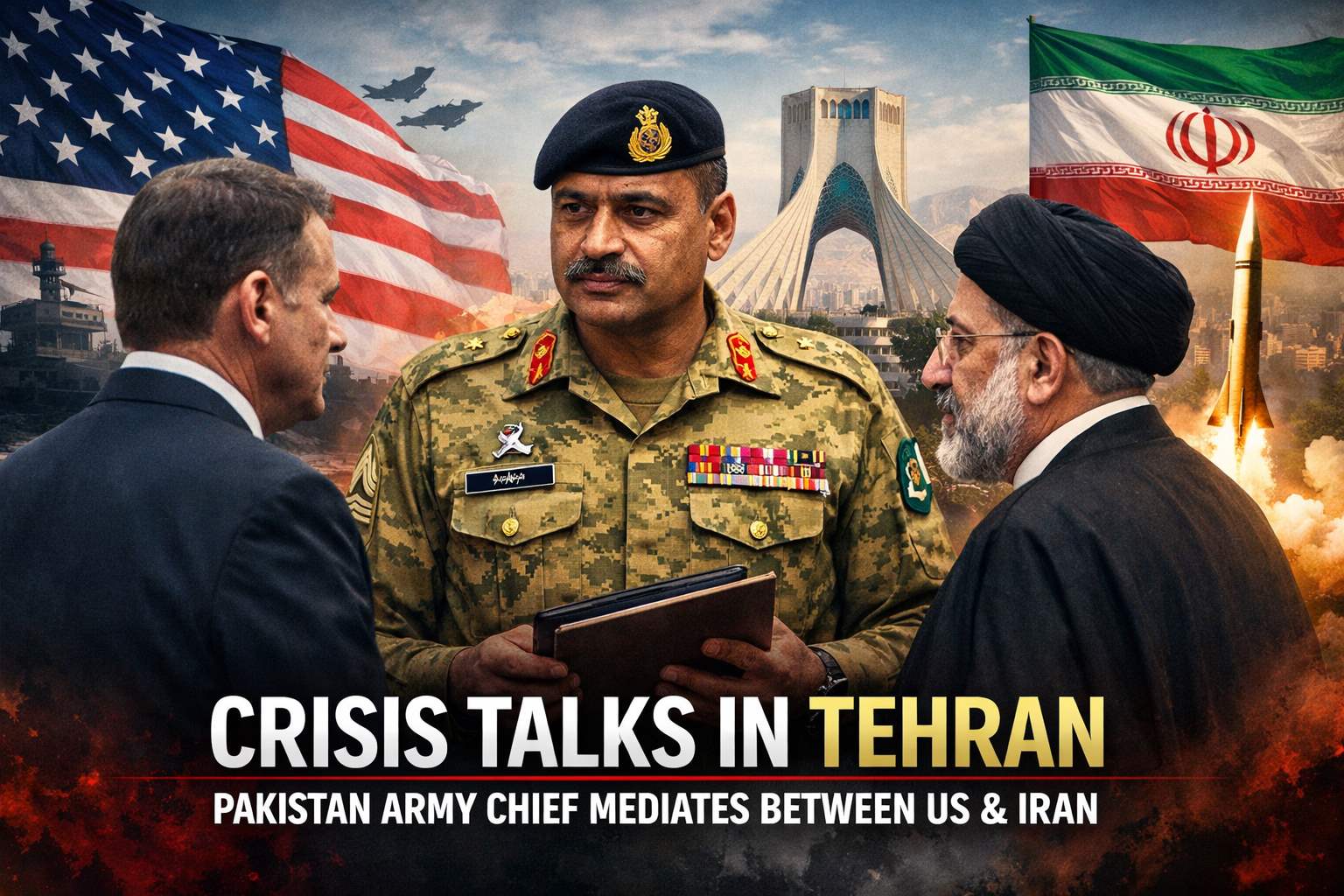
Field Marshal Asim Munir carries messages between Washington and Tehran as diplomatic sources reveal Iranian proposals for reopening the Strait of Hormuz.
Published: May 26, 2026
Last Updated: May 26, 2026
Global War News Editorial
Pakistan’s Army Chief, Field Marshal Asim Munir, arrived in Tehran to engage in intensive, late-night diplomatic discussions with senior Iranian leadership. The high-stakes visit is part of an ongoing international effort by Islamabad to mediate a permanent end to the military conflict between the United States and the Islamic Republic of Iran.
According to official statements from Pakistan’s Inter-Services Public Relations (ISPR) and Iranian state-run media, Munir held direct talks with Iranian President Masoud Pezeshkian, Foreign Minister Abbas Araghchi, and Parliament Speaker Mohammad Bagher Ghalibaf. The diplomatic push occurs during a precarious pause in active hostilities, following 40 days of intensive military conflict initiated earlier this year.
The mediation tracks a delicate path. While U.S. Secretary of State Marco Rubio confirmed that Washington remains in close contact with the Pakistani military leadership to advance a potential memorandum of understanding, both sides indicate that a final breakthrough has not yet been solidified. The discussions center on complex trade-offs regarding international shipping access, regional security, and financial sanctions.
The Terms on the Table
Diplomatic sources speaking to international media outlets have disclosed that Iran presented two primary proposals during Field Marshal Munir’s visit. Tehran has reportedly offered to fully reopen the strategically vital Strait of Hormuz, which has seen severe maritime shipping disruptions since joint military operations began on February 28. In exchange, Iranian negotiators are demanding financial compensation from the United States for economic damage sustained during the conflict.
Additionally, Iranian officials are insisting that formal discussions regarding comprehensive sanctions relief and the release of frozen Iranian state funds must occur before any final peace accord is signed.
The urgency of the Pakistani delegation’s mission was highlighted by recent reports from American media networks Axios and CBS News, which indicated that the White House is actively evaluating a resumption of targeted military strikes if the current diplomatic framework collapses.
Factional Posturing and Red Lines
Despite the active exchange of diplomatic messages, public rhetoric from the colliding parties underscores the fragility of the ceasefire. Iranian Foreign Ministry spokesman Esmaeil Baghaei balanced optimism with caution, stating to reporters that negotiators are simultaneously “very far from and very close to an agreement,” noting that Munir’s visit serves primarily to relay specific structural terms between Tehran and Washington.
Concurrently, internal political figures within Iran have signaled readiness for renewed escalation. Following his meeting with Field Marshal Munir, Parliament Speaker Mohammad Bagher Ghalibaf stated on social media that Iran’s armed forces utilized the temporary ceasefire to rebuild operational capacities. Ghalibaf warned that any resumption of U.S. hostilities would be met with a response “more crushingly and bitterly” than the initial engagements of the war.
The diplomatic matrix extends beyond Islamabad. The Iranian Foreign Ministry confirmed that parallel consultations have been held with representatives from Qatar, Turkey, Iraq, and Oman. In Washington, President Donald Trump held discussions with Qatari Emir Sheikh Tamim bin Hamad Al Thani to review regional diplomatic channels. However, international observers emphasize that Pakistan remains the primary, formal intermediary holding the direct trust of both the White House and the Iranian state.
ANALYSIS: The Economic Stakes of the Strait
The primary structural obstacle to a permanent diplomatic resolution remains the control and operational status of the Strait of Hormuz. In normalized economic periods, this narrow maritime corridor accommodates approximately one-fifth of the world’s total petroleum supply. The closure and subsequent blockades of Iranian ports have severely depleted pre-war global crude stockpiles, causing severe energy shortages and inflationary pressures across both Western and Asian economies.
The economic dimensions are compounding rapidly on the international stage. European Union diplomatic sources indicated that member states moved toward implementing specialized sanctions targeting individual Iranian officials deemed responsible for maintaining the maritime blockade. For Washington, balancing the domestic political pressure of rising global fuel costs against the geopolitical demands of its regional defense posture represents a critical bottleneck.
Pakistan’s unique position as a contiguous neighbor to Iran and a traditional security partner to the United States gives Field Marshal Munir significant leverage, yet the distance between an Iranian demand for direct compensation and Washington’s insistence on absolute maritime freedom remains vast.
Looking Ahead
The next 48 hours are viewed by regional analysts as critical for determining whether the pause in operations will transition into a structured truce or dissolve into an expanded theater of war. Field Marshal Munir’s return from Tehran will likely see immediate debriefings with U.S. diplomatic envoys. Observers are keeping a close watch on whether the U.S. State Department acknowledges the Iranian proposals regarding the Strait of Hormuz or if the deployment of additional naval assets signals an impending end to the negotiated ceasefire.
Source Disclosure Note: This report relies on official statements released by the Pakistan Inter-Services Public Relations (ISPR), official press releases from the Iranian Government and the state-run IRNA news agency, public briefings by U.S. Secretary of State Marco Rubio, and independent regional reporting from Reuters, Agence France-Presse (AFP), The Hindu, and Al Arabiya English.
This article is based on publicly available reporting from named international news agencies and attributed official statements. All claims about ongoing events are attributed to their original sources. Analysis sections represent the editorial interpretation of reported facts and do not constitute advocacy for any party to the described conflict. AI tools may be utilized for image generation to assist in explaining complex concepts, as well as for refining grammar, spelling, and other linguistic enhancements. However, all original content is produced, fact-checked, and revised by the editorial team. This publication does not take political positions on active military conflicts.