
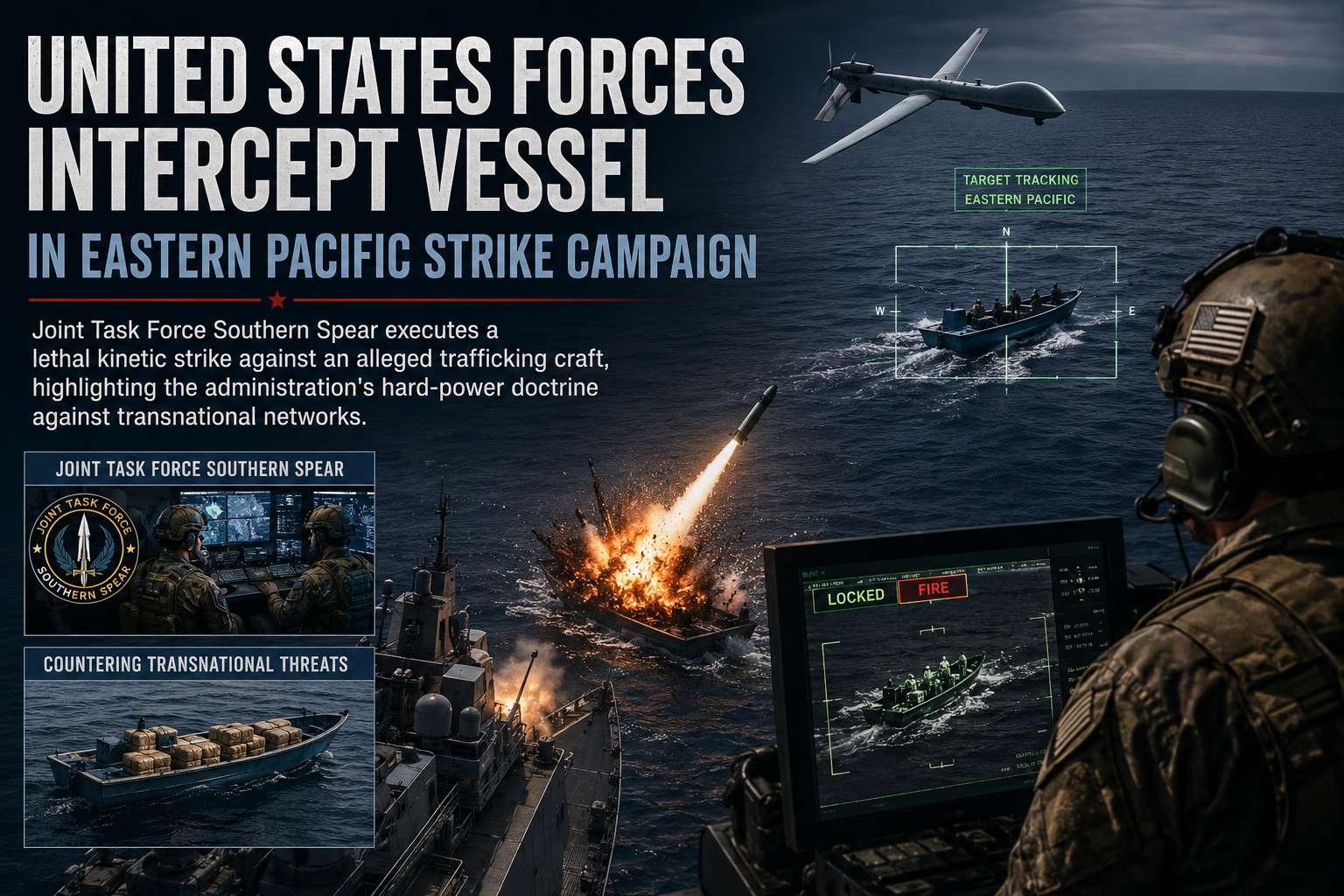
Joint Task Force Southern Spear executes a lethal kinetic strike against an alleged trafficking craft, highlighting the administration’s hard-power doctrine against transnational networks.
Published: May 27, 2026
Last Updated: May 27, 2026
By Global War News Editorial
A maritime interdiction by United States military forces in the Eastern Pacific Ocean turned lethal on Tuesday, marking the latest engagement in an ongoing, highly aggressive campaign against transnational smuggling networks. According to official communiqués released by U.S. Southern Command, an American military asset executed a direct kinetic strike on a specialized transport vessel operating along known maritime corridors west of Central America.
The encounter follows a sweeping shift in Washington’s regional security doctrine, which increasingly treats Latin American drug cartels as non-state military adversaries. While military planners reported the operational neutralization of the target, the strike has amplified domestic and international scrutiny regarding the legal frameworks governing the use of lethal wartime tactics against commercial transit targets in international waters.
Tactical Execution in the Eastern Pacific Corridor
The engagement occurred on Tuesday afternoon under the operational authority of Joint Task Force Southern Spear, a specialized military unit established to coordinate high-power maritime enforcement. According to a statement posted to social media by U.S. Southern Command, intelligence assets initially identified a rapid-transit vessel transiting international waters. Commanders asserted that the craft was operated by a designated terrorist organization and actively engaged in illicit trafficking operations.
At the direction of Southern Command Chief General Francis L. Donovan, an undisclosed military asset executed a precision strike on the vessel. Unclassified video footage released by the Pentagon depicted the targeted craft speeding through open water before detonating and breaking into smoldering fragments.
Southern Command confirmed that one individual, described in official releases as a male narco-terrorist, was killed in the explosion. Two other occupants survived the blast. Following the kinetic engagement, Southern Command stated that it immediately notified the U.S. Coast Guard to activate search and rescue protocols to retrieve the survivors from the water. No U.S. military personnel were harmed during the deployment.
Context and Background: The hard-power Doctrine
The Tuesday evening strike is part of a broad, continuous counter-cartel campaign initiated by the Trump administration in September 2025. Operating under a formal declaration that categorizes major transnational gangs as foreign terrorist entities, the U.S. military has systematically deployed hard-power assets to destroy transit hardware before it can approach domestic border perimeters.
According to data compiled by independent journalism outlets and regional monitors, the ongoing campaign of blowing up suspected smuggling vessels in Latin American waters has resulted in at least 194 fatalities since its inception. The operations are bolstered by the Americas Counter Cartel Coalition, a 17-nation regional partnership established in March 2026 to bring systemic friction against cartel logistical supply chains.
However, the aggressive nature of the campaign has introduced significant administrative and legal pushback. Just last week, the Pentagon Inspector General’s office announced a self-initiated evaluation to determine whether U.S. forces are strictly following the six-phase Joint Targeting Cycle, which dictates target development, analysis, decision-making, and post-strike assessment. While the internal watchdog noted it will not explicitly probe the overarching legality of using military forces for civil law enforcement, the review highlights growing friction among defense legal scholars and lawmakers regarding the absence of physical evidence. In many instances, including the latest Tuesday strike, the targeted vessels sink rapidly in deep water, preventing authorities from retrieving or presenting physical cargo evidence to the public.
Analysis: The Shift to Asymmetric Maritime Interdiction
The utilization of direct kinetic strikes against rapid-transit vessels highlights a fundamental transformation in Western Hemisphere security operations. Traditionally, maritime interdictions conducted by the U.S. Coast Guard and regional partners focused heavily on physical boardings, asset seizures, and the legal extradition of crews for domestic trial.
Operational Insight: Shifting from physical boardings to remote kinetic strikes prioritizes the immediate destruction of transport infrastructure, though it limits post-incident evidentiary verification.
The transition to standard military targeting frameworks introduces two critical changes to regional operations:
- Platform Elimination: By utilizing automated aerial systems or naval firing platforms to neutralize vessels remotely, military commanders completely eliminate the tactical risk that boarding teams face when climbing onto hostile, unpredictable vessels.
- Logistical Disruption: The high-velocity campaign aims to impose severe economic and personnel costs on cartels, targeting their ability to maintain experienced maritime navigators willing to pilot high-risk routes.
Nevertheless, the policy continues to face diplomatic challenges. Legal experts note that conducting lethal strikes in international waters against unflagged or foreign-registered civilian craft tests traditional interpretations of maritime law, particularly when operations occur near the exclusive economic zones of sovereign Central and South American states.
Current Status and Outlook
By Wednesday, the two survivors of the Pacific strike remained in U.S. military custody, awaiting processing and formal identification. The U.S. Coast Guard has not released details regarding the current location of the rescue vessels or the medical status of the detainees.
Despite ongoing reviews by the civilian inspector general and persistent inquiries from congressional committees, the White House has signaled no intention to scale back the maritime campaign. In public statements, administration officials maintain that the high-velocity strikes are a necessary defensive mechanism to choke off illicit financing structures and disrupt the flow of deadly synthetic narcotics before they reach mainland distribution networks.
Source Disclosure Note: This report compiles official operational notifications from U.S. Southern Command (SOUTHCOM), public statements from the Pentagon Inspector General’s office, maritime defense briefings from the U.S. Coast Guard, and regional wire reporting from the Associated Press, CBS News, and Reuters.
This article is based on publicly available reporting from named international news agencies and attributed official statements. All claims about ongoing events are attributed to their original sources. Analysis sections represent the editorial interpretation of reported facts and do not constitute advocacy for any party to the described conflict. AI tools may be utilized for image generation to assist in explaining complex concepts, as well as for refining grammar, spelling, and other linguistic enhancements. However, all original content is produced, fact-checked, and revised by the editorial team. This publication does not take political positions on active military conflicts.