
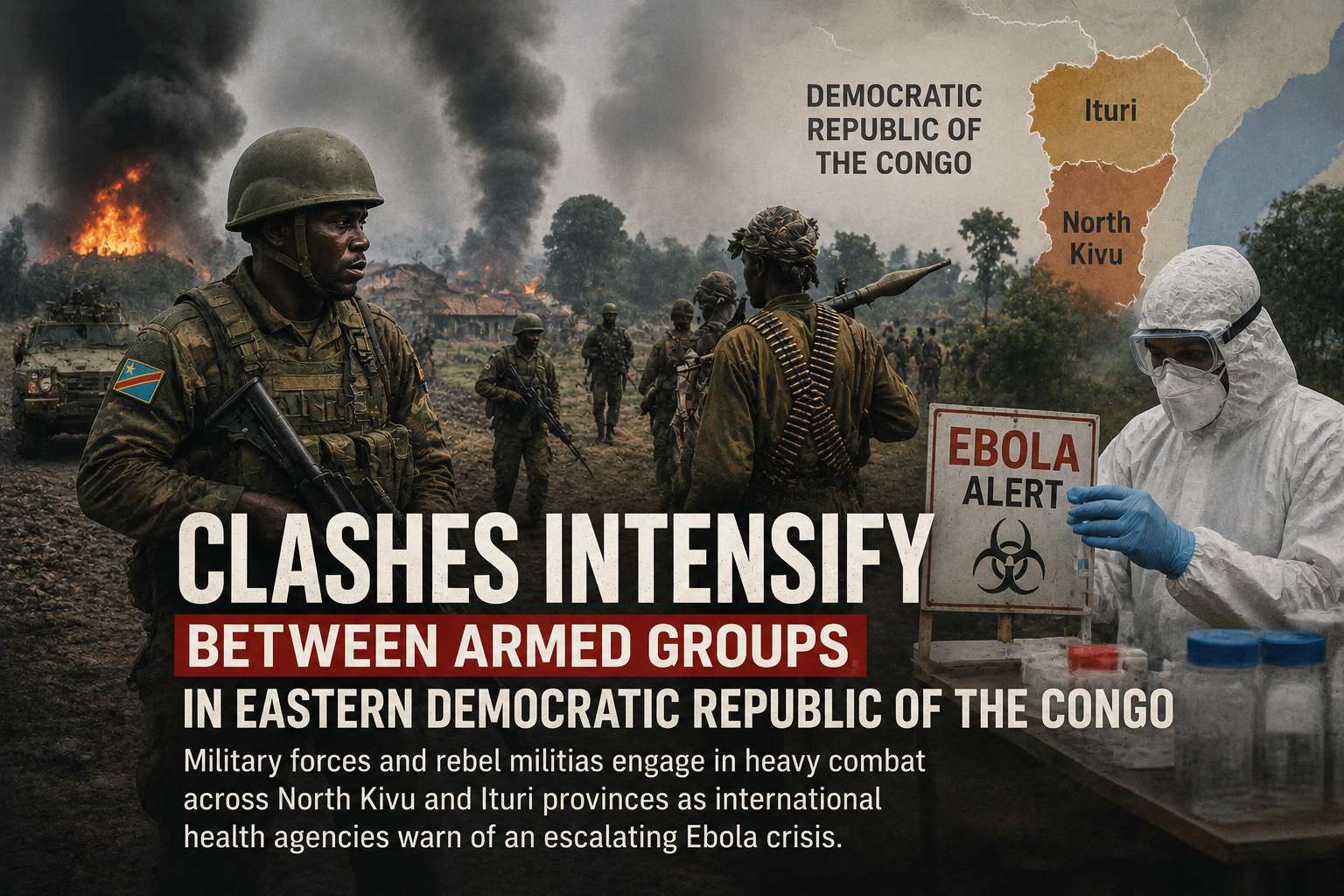
Military forces and rebel militias engage in heavy combat across North Kivu and Ituri provinces as international health agencies warn of an escalating Ebola crisis.
Publication Date: May 29, 2026
Last Updated: May 29, 2026
Byline: Global War News Editorial
Military operations and clashes between armed factions have intensified significantly across the eastern provinces of the Democratic Republic of the Congo (DRC). The surge in violence is severely disrupting international humanitarian efforts to contain a rapidly spreading Ebola outbreak.
According to statements from local security officials and independent monitoring groups on Friday, heavy fighting involving heavy weaponry and mortar fire has been concentrated in the Masisi and Rutshuru territories of North Kivu province, as well as parts of neighboring Ituri province. The clashes primarily pit the regular Congolese armed forces (FARDC), supported by local auxiliary groups, against the March 23 Movement (M23), a heavily armed rebel militia.
The UN World Health Organization (WHO) issued a formal warning from Geneva this week, stating that the eastern DRC faces a catastrophic collision of disease and conflict. The convergence of military offensives, mass population displacement, and localized resistance to healthcare protocols has created a severe security environment, preventing medical personnel from establishing effective quarantine and treatment zones.
Frontline Dynamics and Targeted Infrastructure
Field reports from international news wire services indicate that the strategic focus of recent engagements has shifted toward key transit corridors and infrastructure hubs. In North Kivu, rebel units have maintained a tight grip on territory surrounding Goma, a critical regional hub on the Rwandan border that was heavily contested during an offensive last year.
Local administrative authorities in Tshopo province, which neighbors the Kivu region, reported that the Congolese military intercepted multiple drone attacks targeting Bangoka Airport in Kisangani. In a public address, Tshopo Governor Paulin Lendongolia stated that the aerial strikes targeted essential civilian and military logistics infrastructure. He described the use of explosive-laden drones against facilities used for passenger transit as a direct breach of international humanitarian law.
The Congolese military has reportedly utilized specialized hardware, including Chinese-manufactured armed unmanned aerial vehicles (UAVs) and heavy artillery, in an attempt to dislodge rebel entrenched positions in the hills overlooking Goma. However, field reports from Agence France-Presse (AFP) indicate that frontlines remain highly fluid, with local communities trapped between shifting zones of control.
Intersection with the Public Health Emergency
The escalation in warfare directly coincides with the rapid expansion of the country’s 17th recorded Ebola outbreak, which was officially declared in Ituri province on May 15, 2026. According to the DRC Ministry of Health and data compiled by the Action Contre la Faim (ACAPS) humanitarian consortium, the epidemic involves the Bundibugyo strain of the virus, for which there are currently no widely approved vaccines or specialized therapeutics.
As of late May, humanitarian documentation reflects more than 900 suspected or confirmed cases and at least 160 deaths distributed across Ituri, North Kivu, and South Kivu. The transmission has expanded geographically due to the high mobility of families and informal miners fleeing frontline artillery fire. Furthermore, health authorities in neighboring Uganda have confirmed multiple cross-border infections linked to the outbreak, including a fatality reported in Kampala.
The armed conflict has actively sabotaged emergency public health containment. Aid agencies operating on the ground, including Doctors Without Borders (MSF) and the Alliance for International Medical Action (ALIMA), reported that healthcare facilities have faced direct physical hostility. On May 21, the Rwampara health center in Ituri was stormed by crowds demanding the release of bodies under medical quarantine, while subsequent rioting resulted in the burning of two isolation tents at a field hospital in Mongbwalu. Local sources note that these security incidents are frequently driven by acute community panic, deep-seated mistrust of state institutions, and friction over mandatory, non-traditional safe burial protocols.
Context and Regional Geopolitics
The ongoing crisis in the eastern Congo is rooted in over three decades of institutional collapse, regional proxy wars, and a complex struggle over the area’s massive natural resource wealth, which includes substantial global reserves of coltan, gold, and tin. The M23 movement, composed primarily of ethnic Tutsis, originally launched a major rebellion in 2012 before being temporarily suppressed by a specialized UN peacekeeping brigade. The group resurged with significant force in late 2021, launching broad offensives that severely strained regional diplomatic frameworks.
The current geopolitical dimension involves deep friction between Kinshasa and neighboring Kigali. The Congolese government, alongside independent United Nations expert panels, has repeatedly accused Rwanda of providing direct cross-border military support, heavy weaponry, and thousands of ground troops to back the M23 operations. The government of Rwanda has consistently denied these allegations, counter-charging that the Congolese military collaborates with the Democratic Forces for the Liberation of Rwanda (FDLR), a remnant Hutu militia linked to the 1994 genocide.
A series of diplomatic initiatives convened in Washington and Switzerland earlier this year attempted to establish sustainable humanitarian corridors and coordinated steps toward a verifiable ceasefire. However, those negotiations stalled over disagreements regarding troop withdrawals and the decommissioning of localized militias. The exit of the UN peacekeeping mission (MONUSCO), which has been gradually drawing down its presence under pressure from the host population, has created an expanded security vacuum that various armed factions—including the Allied Democratic Forces (ADF) and cooperative tribal alliances known as Wazalendo, are actively competing to fill.
Analysis: Escalation Scenarios and What to Watch
The simultaneous intensification of armed conflict and an uncontained viral epidemic presents a severe threat to the stability of the wider Great Lakes region. Security analysts suggest that the standard military options available to the Congolese state are yielding diminishing returns, as the regular army remains heavily reliant on disparate local militias and private security contractors to maintain defensive perimeters around major urban centers.
Moving forward, three primary operational indicators require close monitoring:
- Logistical Chokepoints: The continued targeting of regional airports, such as the facility in Kisangani, could cut off the remaining secure pathways for heavy medical machinery, personal protective equipment (PPE), and specialized international epidemiologists. If Goma becomes fully isolated by land, air bridge limitations will severely bottleneck the entire humanitarian apparatus.
- Militia Fragmentation: The decentralized nature of the fighting makes unified command structures highly improbable. If tribal self-defense groups or foreign-linked insurgencies like the ADF exploit the military’s preoccupation with the M23 to launch separate territorial raids, civilian displacement figures will rapidly exceed the capacity of current makeshift camps, exacerbating the spread of infection.
- Regional Border Controls: With verified transmission entering Uganda, neighboring states may come under domestic political pressure to enforce hard border closures or unilateral security corridors. Such measures could paralyze regional trade and further complicate the logistics of joint military operations and cross-border contact tracing.
Source Disclosure Note: This report compiles data and official press communications issued by the UN World Health Organization (WHO), the United Nations Children’s Fund (UNICEF), and the United Nations Organization Stabilization Mission in the DRC (MONUSCO). Operational updates and regional details were sourced from field dispatches by Agence France-Presse (AFP) and local briefings from Tshopo Governor Paulin Lendongolia. Public health data points are derived from official statements by the DRC Ministry of Health, the Uganda Ministry of Health, and briefing documentation published by the ACAPS humanitarian network and the Alliance for International Medical Action (ALIMA).
This article is based on publicly available reporting from named international news agencies and attributed official statements. All claims about ongoing events are attributed to their original sources. Analysis sections represent the editorial interpretation of reported facts and do not constitute advocacy for any party to the described conflict. AI tools may be utilized for image generation to assist in explaining complex concepts, as well as for refining grammar, spelling, and other linguistic enhancements. However, all original content is produced, fact-checked, and revised by the editorial team. This publication does not take political positions on active military conflicts.