
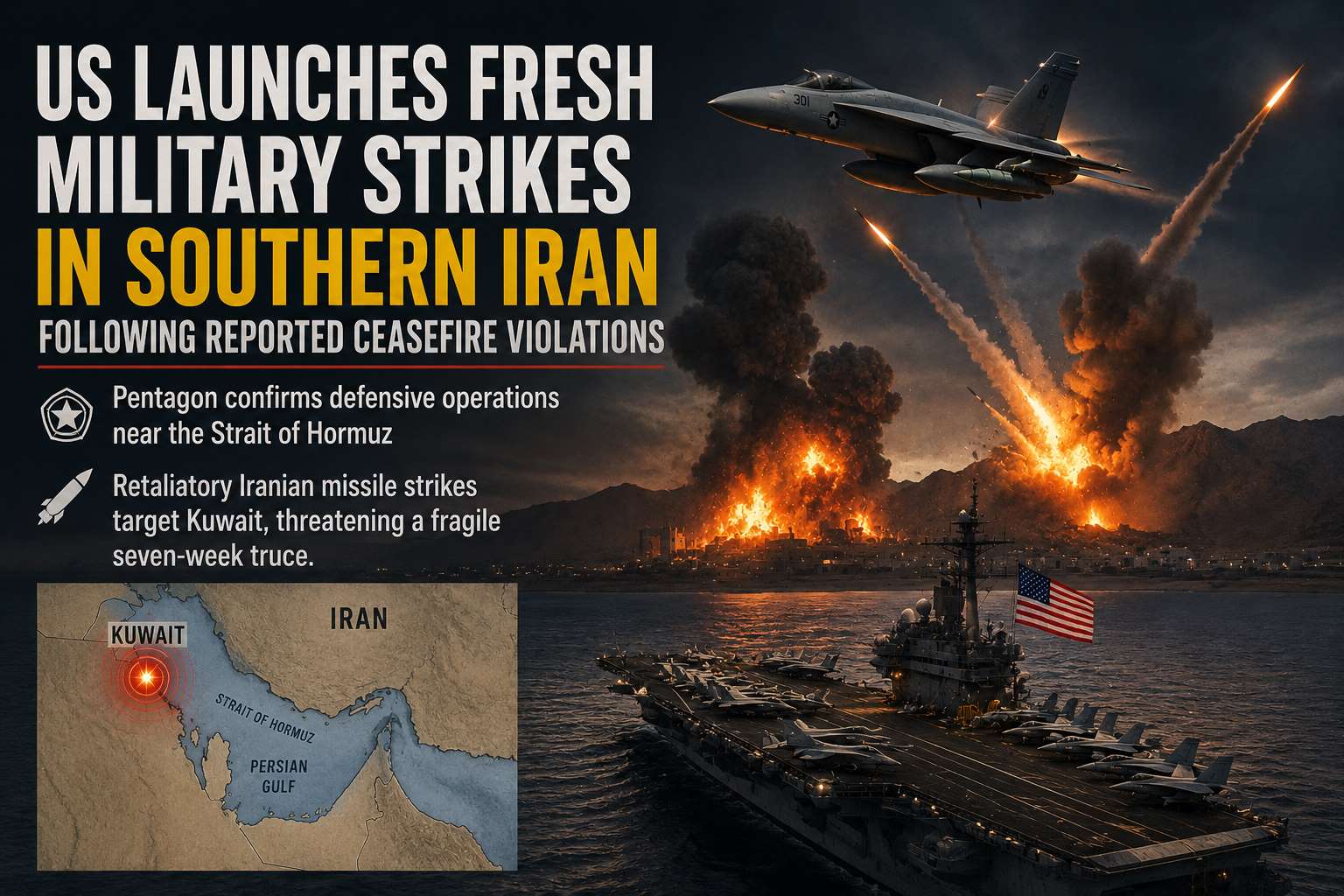
Pentagon confirms defensive operations near the Strait of Hormuz as retaliatory Iranian missile strikes target Kuwait, threatening a fragile seven-week truce.
Publication Date: May 29, 2026
Last Updated: May 29, 2026
Byline: Global War News Editorial
The United States military has conducted a new round of targeted airstrikes in southern Iran, citing an immediate need to neutralize threats to maritime transit and maintain a fragile seven-week ceasefire. The tactical escalation was rapidly followed by an Iranian retaliatory missile attack directed at a prominent Gulf ally, underscoring the extreme instability of the region’s current diplomatic architecture.
According to statements released by U.S. Central Command (CENTCOM) on Thursday, American forces engaged and shot down four one-way attack drones operating near the strategic Strait of Hormuz late Wednesday evening. In a concurrent action, U.S. assets struck a mobile Iranian ground control station located near Bandar Abbas International Airport, which U.S. officials stated was actively preparing to deploy a fifth armed drone.
The exchange has triggered an immediate diplomatic crisis across the Persian Gulf. Following the operations around Bandar Abbas, Iran’s paramilitary Islamic Revolutionary Guard Corps (IRGC) acknowledged the American strikes and announced a retaliatory bombardment against a U.S. military installation. Hours later, the State of Kuwait reported that its domestic air defense systems intercepted multiple incoming missiles and drones. CENTCOM officially condemned the action, calling the attack on one of Washington’s primary regional security partners an egregious violation of the standing truce.
Frontline Dynamics and Chronology of the Flaring Confrontation
The aerial engagements represent the second major kinetic confrontation between U.S. and Iranian forces this week. On Monday, the Pentagon confirmed it had carried out what it termed self-defense operations in southern Iran, striking coastal missile launch sites and specialized fast-attack boats that Western intelligence alleged were actively attempting to lay naval mines in the shipping lanes of the Gulf.
The subsequent exchange on Wednesday evening developed rapidly. According to a U.S. defense official speaking to the Anadolu news agency on the condition of anonymity, the initial intercept of the four unmanned systems took place over international waters. The official described the subsequent strike on the ground station in Bandar Abbas as a measured, defensive action intended to protect international commercial shipping and enforce adherence to the ceasefire guidelines.
In response to the Bandar Abbas strikes, the IRGC published a statement via Iran’s state-run IRNA news agency, asserting that its forces had targeted the specific regional airbase from which the American aircraft had been launched. The Iranian statement did not explicitly name Kuwait as the target, but the Kuwaiti Ministry of Foreign Affairs subsequently issued an official communique confirming blatant aggression against its sovereign territory. The Kuwaiti military verified that its integrated air-defense networks successfully neutralized the incoming salvos, preventing casualties or significant structural destruction, though it did not specify which domestic infrastructure was targeted.
Geopolitical Strains and the Looming Maritime Toll Dispute
The military flaring occurs at an incredibly delicate juncture for international mediators. Diplomatic sources in Washington and Islamabad confirmed to the Associated Press (AP) and AFP that U.S. and Iranian negotiators had recently established a tentative memorandum of understanding (MOU) to prolong the current ceasefire for an additional 60 days. The proposed framework is also designed to initiate formal, structured talks regarding Iran’s highly enriched uranium stockpiles and domestic nuclear program.
However, the completion of this diplomatic off-ramp remains highly uncertain. Iran’s semi-official Tasnim News Agency, citing a source close to the country’s negotiating team, stated on Thursday that the text of the potential MOU has not been finalized or confirmed. The source emphasized that Tehran has not formally notified Pakistan, which acts as the primary diplomatic mediator between the two non-communicating nations, that the agreement is complete, characterizing Western media assertions of a finished deal as premature.
Compounding the security friction is a severe financial and administrative dispute over the legal status of the Strait of Hormuz. In tandem with peace discussions, Iranian officials have proposed implementing a systematic tolling apparatus on commercial vessels traveling through the waterway. The proposal drew an immediate response from the United States. U.S. Treasury Secretary Scott Bessent issued a public warning on Thursday, stating that Washington would not tolerate any effort to impose a tolling system in the Strait of Hormuz. Bessent explicitly warned that the U.S. Treasury would aggressively target and sanction any regional actors or financial institutions involved in facilitating such a mechanism. Following a subsequent White House briefing, Bessent told reporters he had received direct assurances from Oman’s ambassador that Muscat has no plans to participate in or support any tolling initiatives.
Context: The Broader Landscape of the Regional War
The current state of hostilities began on February 28, 2026, when the United States and Israel launched a series of surprise, coordinated military strikes targeting defense networks inside Iran. Tehran immediately retaliated by launching extensive drone and ballistic missile barrages across the Middle East, while simultaneously executing a strict naval blockade on all vessels traveling to or from Iranian ports through the Strait of Hormuz.
The total closure of the strategic waterway, the world’s most critical transit chokepoint for maritime energy distribution, has severely disrupted global trade. While recent data from Lloyd’s List Intelligence indicates a slight uptick in the proportion of non-Iranian-linked vessels successfully exiting the Persian Gulf over the past week, the blockade has effectively frozen a massive share of the region’s hydrocarbon exports. The resulting logistical logjams have driven up global energy prices, caused severe supply chain delays, and placed immense economic pressure on both Western consumer markets and developing economies reliant on imported crude.
U.S. President Donald Trump has extended the domestic truce indefinitely but has maintained a firm defensive posture, repeatedly stating that while progress is being made behind closed doors, Iran will not receive economic sanctions relief or the release of frozen foreign assets in exchange for partial concessions. Commenting on the current diplomatic progress earlier this week, Trump noted that he remained unsatisfied with the state of the negotiations, warning that if a comprehensive resolution is not reached, his administration is prepared to finish the job militarily.
Analysis: The Perils of Asymmetric Attrition
The localized nature of Wednesday’s engagements reveals a deliberate tactical calculus being employed by both Washington and Tehran. By utilizing uncrewed systems and localized defensive strikes, both states are attempting to project strategic resolve without triggering a slide back into full-scale, conventional warfare. For Iran, executing a indirect retaliatory strike via the IRGC against a third-party state like Kuwait allows it to answer American actions while avoiding a direct, catastrophic clash with U.S. naval strike groups operating in the Arabian Sea.
However, this reliance on asymmetric responses carries severe operational risks. Security analysts point out that the high frequency of these localized violations creates a severe danger of miscalculation. If an Iranian drone or missile successfully bypasses local air defense systems in a Gulf state and inflicts mass civilian or military casualties, the White House would face intense domestic political pressure to abandon negotiations and launch deep conventional strikes against Iran’s command infrastructure.
Furthermore, the economic standoff over the Strait of Hormuz highlights that a purely military truce is unsustainable without an accompanying economic settlement. Iran’s economy is currently operating under immense strain due to prolonged blockade conditions and Western financial restrictions. The proposal for a shipping toll represents a desperate bid by Tehran to generate hard currency. With the U.S. Treasury actively threatening sanctions against regional neighbors like Oman to prevent such a system, the economic gridlock is likely to worsen. The primary indicator to watch in the coming days will be whether the Pakistani mediation team can secure Trump’s formal approval for the 60-day ceasefire extension before localized border skirmishes completely shatter the diplomatic process.
Source Disclosure Note: This article relies on official military communiques issued by U.S. Central Command (CENTCOM), state-run press releases from the Iranian government via the IRNA news agency, and official diplomatic statements published by the Kuwaiti Ministry of Foreign Affairs. Operational details and diplomatic reporting were compiled from field dispatches by international wire services, including Agence France-Presse (AFP), the Associated Press (AP), Reuters, and the Anadolu news agency. Maritime tracking data was sourced via Lloyd’s List Intelligence, with additional regional context provided by the Tasnim News Agency.
This article is based on publicly available reporting from named international news agencies and attributed official statements. All claims about ongoing events are attributed to their original sources. Analysis sections represent the editorial interpretation of reported facts and do not constitute advocacy for any party to the described conflict. AI tools may be utilized for image generation to assist in explaining complex concepts, as well as for refining grammar, spelling, and other linguistic enhancements. However, all original content is produced, fact-checked, and revised by the editorial team. This publication does not take political positions on active military conflicts.