
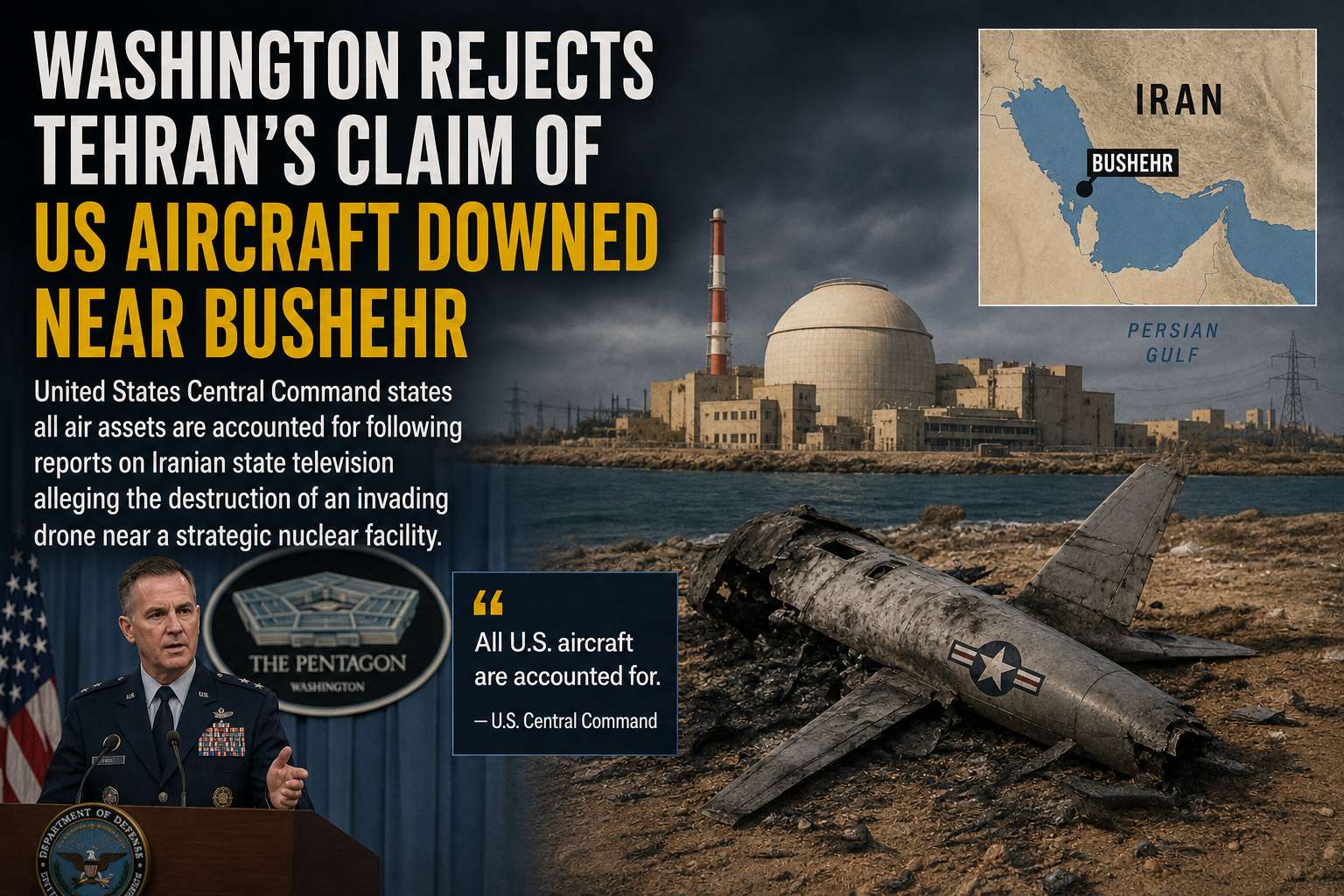
United States Central Command states all air assets are accounted for following reports on Iranian state television alleging the destruction of an invading drone near a strategic nuclear facility.
Publication Date: May 29, 2026
Last Updated: May 29, 2026
Byline: Global War News Editorial
The United States military has denied claims made by Iranian state media and regional officials asserting that an American military aircraft was shot down over southern Iran. The incident has introduced fresh instability into an already fragile geopolitical landscape, where negotiators are attempting to secure a formal extension to a multi-week regional truce.
The dispute began early Friday morning when Iranian state television reported that the country’s integrated air defense networks had successfully intercepted and destroyed a hostile, invading U.S. aircraft. The report cited Masoud Tangestani, the governor of Jam County in Iran’s coastal Bushehr province, who stated that an unmanned aerial vehicle (UAV) had been brought down in the region.
U.S. Central Command (CENTCOM) issued an immediate public statement on Friday dismissing the claims. According to the official military communication, no American aircraft have been downed or damaged in the region, and all deployed U.S. air assets remain fully accounted for. A U.S. defense official, speaking to international news agencies on the condition of anonymity, described the assertions from Tehran as factually incorrect and part of a broader pattern of unverified regional claims.
Conflicting Accounts in the Bushehr Province
According to reports published by Iran’s semi-official Tasnim and Fars news agencies, local military units activated surface-to-air missile systems stationed near the cities of Jam and Kangan on Thursday night local time. The mobilization occurred following reports of an unidentified aircraft operating near Bushehr province, which houses Iran’s primary civilian nuclear power facility developed in cooperation with Russia.
Pro-government networks and Telegram channels affiliated with the Islamic Revolutionary Guard Corps (IRGC) later alleged that the intercepted asset was an American-manufactured MQ-9 Reaper drone, a high-altitude surveillance and strike platform. Following the initial broadcast, state-linked media channels broadcast footage showing public rallies and gatherings in Tehran’s Azadi Square, where crowds carrying Iranian and IRGC flags celebrated the reported shootdown.
Conversely, the Pentagon’s official response stood firm against the narrative. In a public statement broadcast online, CENTCOM published a direct notification stating that the narrative presented by Iranian state TV was false. U.S. officials emphasized that routine maritime patrol and reconnaissance flights are continuously monitored via secure military logistics networks, confirming that zero structural losses or mechanical deviations had been recorded across the Persian Gulf theater.
Escalating Sanctions and Maritime Disruption
The informational standoff over Bushehr coincides with a significant expansion of economic pressure from Washington. On Thursday, the United States Department of the Treasury announced a sweeping round of new maritime sanctions specifically targeting Iran’s military-linked petroleum trade networks.
According to an official release from the Treasury’s Office of Foreign Assets Control (OFAC), eight international commercial vessels accused of transporting Iranian crude oil and petroleum products have been formally blacklisted. The designated shipping assets include the Marshall Islands-registered tanker Flora, the Comoros-flagged Huancayo, and the Panama-flagged Ill Gap. In a statement addressing the actions, U.S. Treasury Secretary Scott Bessent stated that the economic restrictions are explicitly intended to disrupt the financial mechanisms through which the Iranian government funds its domestic defense sector. Bessent stated that Washington would continue to block the state’s capacity to maximize its unmonitored oil revenue for the purpose of reconstituting its armed forces.
The implementation of these sanctions follows reports from maritime intelligence firms, including Lloyd’s List Intelligence, detailing continued friction around the Strait of Hormuz. On Wednesday, IRGC naval units reportedly intercepted or turned away four commercial vessels operating near the shipping chokepoint, claiming the actions were carried out due to suspected links to Western shipping consortiums.
Context: The Geopolitical Standoff
The current cycle of hostilities stems from a series of severe regional escalations that began on February 28, 2026, when a combined military operation involving U.S. and Israeli assets targeted interior defensive networks inside Iran. Tehran responded by deploying expansive ballistic missile salvos across the Middle East while establishing a strict maritime blockade around the Strait of Hormuz, halting a substantial portion of global energy shipments and driving up international oil prices.
For the past seven weeks, a fragile, temporary truce has limited large-scale direct kinetic engagements. International mediators operating through Islamabad, Pakistan—which acts as the primary diplomatic channel between Washington and Tehran—have been working to transition the current pause into a structured 60-day ceasefire framework.
According to reports published by the Xinhua News Agency and Axios, the draft framework is designed to facilitate parallel discussions regarding Iran’s enriched uranium stockpiles. However, the diplomatic progression remains highly uncertain. The proposed arrangement has not yet received formal administrative approval from U.S. President Donald Trump, while Iranian diplomatic representatives maintain that a final consensus has not been ratified by leadership in Tehran.
Analysis: Information Warfare and Border Pressures
The swift contradiction between the claims issued by Tehran and Washington highlights the intense information environment that accompanies the physical blockade of the Persian Gulf. Security analysts point out that for the Iranian leadership, publicizing a high-profile military success—such as the downing of an advanced American drone, serves an essential domestic function. It projects tactical capability and maintains high morale among state supporters at a time when prolonged economic sanctions and maritime blockades are causing severe fiscal strain within the domestic market.
However, constructing unverified military narratives carries a distinct strategic risk during active diplomatic mediation. Observers note that with negotiators currently attempting to finalize a 60-day truce extension via Pakistani channels, localized false alarms near sensitive areas like the Bushehr nuclear facility can cause dangerous miscalculations.
If local air defense teams operate on flawed radar data and mistakenly engage genuine non-hostile targets, or if the rumor of an asset loss prompts pre-emptive retaliatory maneuvers from U.S. naval strike groups in the Arabian Sea, the diplomatic off-ramp could dissolve. The primary indicator to watch over the coming days will be whether the rhetoric out of Tehran transitions away from military triumphalism back toward the technical parameters of the Pakistani-mediated MOU, or if further naval frictions around the Strait of Hormuz override the ceasefire discussions completely.
Source Disclosure Note: This article relies on official public statements published on X by U.S. Central Command (CENTCOM), press releases from the U.S. Department of the Treasury, and official statements from Treasury Secretary Scott Bessent. Details regarding Iranian military claims were sourced from broadcasts by Iranian State Television and reports from the semi-official Tasnim and Fars news agencies, including statements from Jam County Governor Masoud Tangestani. Additional context and diplomatic tracking were derived from field dispatches by Reuters, Agence France-Presse (AFP), the Associated Press (AP), and the Xinhua News Agency.
This article is based on publicly available reporting from named international news agencies and attributed official statements. All claims about ongoing events are attributed to their original sources. Analysis sections represent the editorial interpretation of reported facts and do not constitute advocacy for any party to the described conflict. AI tools may be utilized for image generation to assist in explaining complex concepts, as well as for refining grammar, spelling, and other linguistic enhancements. However, all original content is produced, fact-checked, and revised by the editorial team. This publication does not take political positions on active military conflicts.