
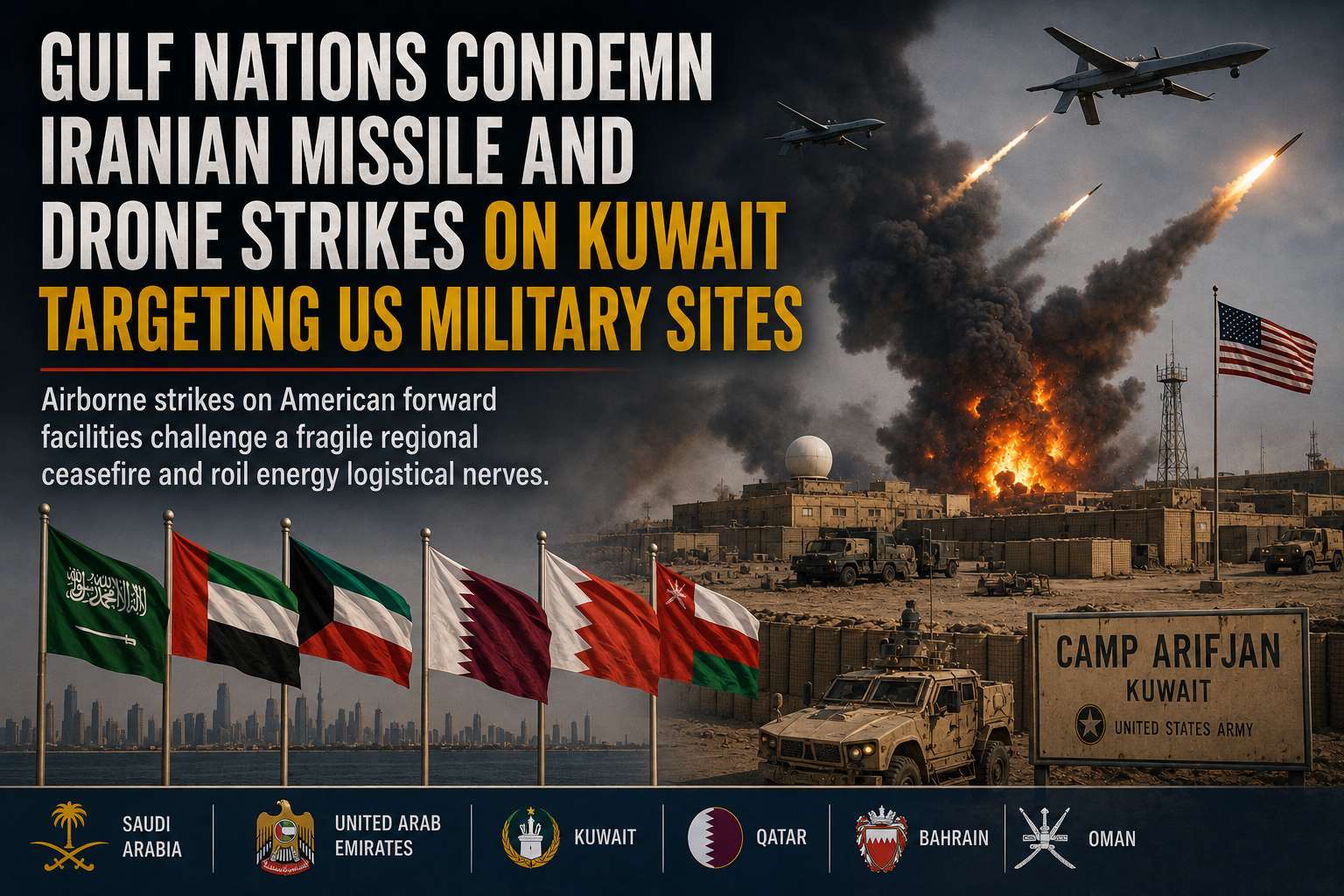
Airborne strikes on American forward facilities challenge a fragile regional ceasefire and roil energy logistical nerves.
Published: May 29, 2026
Last Updated: May 29, 2026
By: Global War News Editorial
Kuwait and its partners in the Gulf Cooperation Council (GCC) issued coordinated diplomatic condemnations on Thursday following a wave of incoming missile and drone strikes targeting Kuwaiti territory. The military escalation represents an abrupt disruption of the tenuous seven-week-old regional ceasefire, drawing sharp reactions across Gulf capitals and renewing concerns over stability near critical energy transit routes.
The airborne strikes occurred late Wednesday night. According to statements released by the Kuwaiti military, national air defense systems successfully intercepted multiple incoming missiles and drones trying to penetrate domestic airspace. United States Central Command (CENTCOM) confirmed the details of the attack on Thursday, identifying the projectiles as having originated from Iranian territory. American military officials termed the barrage an egregious violation of the standing truce agreement.
The incident has immediately complicated ongoing behind-the-scenes diplomatic talks designed to secure a permanent end to the broader regional conflict. While Kuwaiti authorities did not specify the exact targets within their borders, the Iranian state-run IRNA news agency carried an official acknowledgment from the Islamic Revolutionary Guard Corps (IRGC) stating it had launched a retaliatory strike against an airbase housing U.S. forces in an unnamed Gulf state. Kuwait serves as a primary forward headquarters for U.S. Army Central and hosts multiple strategic air and naval installations.
Escalation in the Persian Gulf
The exchange followed a succession of military maneuvers earlier in the week involving American and Iranian forces. According to official accounts from Washington, U.S. forces executed a localized strike late Wednesday near the Strait of Hormuz, downing four one-way attack drones and striking an Iranian ground-control facility located near Bandar Abbas International Airport. U.S. officials stated that the operation was pre-emptive, aimed at disabling a fifth drone preparing for launch.
The IRGC subsequently framed its missile and drone deployment toward Kuwait as a direct response to the Bandar Abbas installations being struck. The escalation occurred just days after the Pentagon reported conducting separate defensive actions on Monday against active missile launch sites and minelaying vessels operating in southern Iran.
Unifying the Gulf Diplomatic Front
The diplomatic backlash from neighboring Arab states was immediate, with multiple foreign ministries coordinating their responses via official state press entities. The Kuwaiti Foreign Ministry, in a press statement carried by the state-run Kuwait News Agency (KUNA), termed the bombardment a blatant aggression and a dangerous threat to its national sovereignty, security, and civilian population. The ministry formally cited United Nations Security Council Resolution 2817 of 2026 and Article 51 of the UN Charter, affirming Kuwait’s legal right to take all necessary steps to safeguard its sovereign territory.
Other prominent members of the GCC immediately backed the Kuwaiti stance:
- Saudi Arabia: The Saudi Ministry of Foreign Affairs issued a statement expressing categorical rejection of any external aggression directed at Kuwait, reaffirming its complete solidarity with its neighboring state.
- The United Arab Emirates: The UAE Ministry of Foreign Affairs published an official condemnation via its state wire agency, calling the drone and missile actions a flagrant violation of international frameworks.
- Qatar and Bahrain: Both nations released corresponding notices through their respective ministries, urging all actors to respect long-standing principles of good neighborliness and warning against actions that undermine regional security.
Context: A Fragile Truce Under Immense Pressure
The current crisis underscores the high stakes surrounding the April ceasefire. For nearly two months, international intermediaries have attempted to convert a temporary halt in hostilities into a comprehensive settlement. The broader conflict has severely impacted international commerce, particularly oil and liquefied natural gas shipments navigating the volatile waters of the Persian Gulf.
Negotiations are reportedly continuing despite the latest security breakdown. Public statements from Washington indicate that the U.S. executive branch remains committed to finding an administrative path toward reopening regional shipping lanes safely. However, the diplomatic gaps between the primary participants remain substantial.
Tehran’s stated requirements for a binding treaty include a comprehensive lifting of international economic sanctions, the immediate release of frozen financial assets abroad, and a structured conclusion to military actions in Lebanon. Conversely, Western intermediaries continue to insist on strict limitations regarding Iran’s enriched uranium stockpiles alongside verified guarantees for international maritime freedom of navigation.
Analysis: What This Means for Regional Security and Markets
The targeting of Kuwait introduces an intricate layer of risk to an already complex geopolitical landscape. Analysts note that by projecting force beyond its immediate borders into a non-combatant GCC state, the IRGC may be attempting to demonstrate its ability to exact costs on localized logistical hubs hosting Western military personnel.
From an economic perspective, while Kuwaiti air defenses successfully neutralized the physical threat, the mere positioning of the country as an active zone of conflict introduces measurable friction to shipping insurance and maritime logistics. The upper Persian Gulf contains some of the world’s largest oil export terminals. Observers emphasize that continuous challenges to the ceasefire risk eroding commercial confidence, potentially translating into elevated regional risk premiums for energy transport if localized strikes continue.
Crucially, neither Washington nor Tehran has explicitly announced a formal withdrawal from the ongoing peace talks. The preservation of administrative communication channels suggests that both sides currently view a managed, tense equilibrium as preferable to a return to unrestricted, open warfare. However, as localized retaliatory strikes repeat, the margin for miscalculation grows narrower.
Source Disclosure Note: This report compiles verified reporting from international wire services, including the Associated Press (AP) and Reuters, along with official diplomatic notifications from the Kuwait News Agency (KUNA), the Saudi Ministry of Foreign Affairs, the UAE Ministry of Foreign Affairs, and formal statements released by United States Central Command (CENTCOM).
This article is based on publicly available reporting from named international news agencies and attributed official statements. All claims about ongoing events are attributed to their original sources. Analysis sections represent the editorial interpretation of reported facts and do not constitute advocacy for any party to the described conflict. AI tools may be utilized for image generation to assist in explaining complex concepts, as well as for refining grammar, spelling, and other linguistic enhancements. However, all original content is produced, fact-checked, and revised by the editorial team. This publication does not take political positions on active military conflicts.