
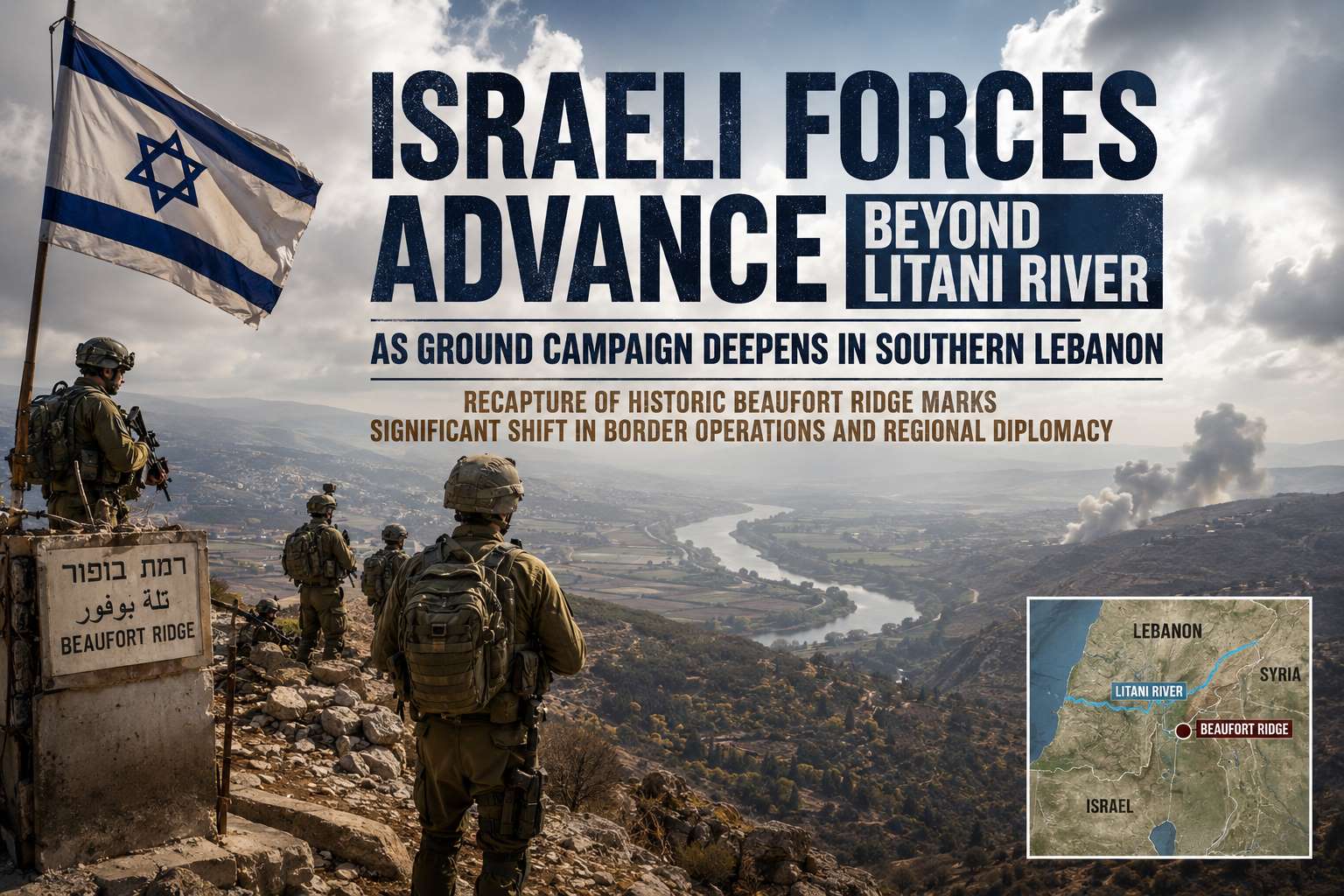
Recapture of Historic Beaufort Ridge Marks Significant Shift in Border Operations and Regional Diplomacy
Publication Date: June 1, 2026
Byline: Global War News Editorial
The conflict in Lebanon entered a new phase over the weekend as Israeli forces expanded their ground operations north of the Litani River. According to an official statement from the Israel Defense Forces (IDF) released on May 31, 2026, Israeli troops crossed the river and secured positions on the strategic Beaufort Ridge, capturing the historic Beaufort Castle outpost (Qalaat al-Shaqif). The advance marks one of the deepest incursions into Lebanese territory since the resumption of major hostilities on March 2, 2026.
Speaking on the tactical progress, Israeli Prime Minister Benjamin Netanyahu confirmed that military units had broken through long-standing operational limits. In a video statement broadcast on Sunday, Prime Minister Netanyahu stated that the capture of the Beaufort Ridge represents a fundamental change in regional policy, noting that Israel is establishing security zones beyond its borders to protect northern communities.
The military push has triggered strong international blowback and intense combat along the northern frontier. While the IDF reported that its operations are expanding to additional areas, Hezbollah responded by launching an extensive barrage of first-person view (FPV) drones and rockets into northern Israeli towns, including Nahariya, Acre, Safed, and Kiryat Shmona. Air-raid sirens were activated across the Galilee throughout Saturday and Sunday, though official Israeli channels reported no civilian casualties from the weekend rocket fire.
Context and Background
The Litani River has historically served as a critical geographic and diplomatic boundary in Middle Eastern geopolitics. Located approximately 30 kilometers north of the Israeli-Lebanese border, the river was designated under United Nations Security Council Resolution 1701 as the northern limit of a zone that was supposed to be free of any armed personnel, assets, and weapons other than those of the Lebanese government and UN UNIFIL peacekeepers.
The current ground war, which began on March 16, 2026, follows multiple mutual violations of a previous temporary ceasefire agreement established in late 2024. Israel has consistently maintained that its ongoing air and ground campaigns are designed to enforce ceasefire terms by dismantling Hezbollah infrastructure and preventing a military buildup near its borders. Conversely, Hezbollah has viewed continued Israeli operations inside southern Lebanese villages as a direct breach of the truce, using the incursions to justify its escalated rocket and drone strikes against northern Israel.
The capture of Beaufort Ridge carries profound historical weight. The medieval fortress, which overlooks the Upper Galilee and the Litani Valley, was a major flashpoint during the First Lebanon War in 1982. This weekend’s operation marks the first time Israeli soldiers have occupied the ridge since the military’s withdrawal from southern Lebanon 26 years ago.
Economic and Humanitarian Impact
The escalation has dramatically worsened an already severe humanitarian crisis inside Lebanon. Data published by the Lebanese Health Ministry on May 31 indicated that the cumulative death toll from Israeli military actions since March 2 has risen to 3,412 individuals, with another 10,269 reported wounded. Government estimates suggest that more than 1.2 million people—roughly 20 percent of Lebanon’s total population—have been displaced from their homes.
According to an independent review of military notices, the scope of displacement is widening significantly. Evacuation orders, which initially focused on border enclaves, have expanded well past the Litani River. Approximately half of the towns and villages instructed to evacuate by the Israeli military are located north of the waterway, with some situated more than 20 kilometers beyond the front lines. Concurrently, the Lebanese army continues to issue emergency warnings regarding unexploded ordnance, announcing that its engineering units recently dismantled explosive devices in the Tyre district.
The economic fallout is also reverberating through regional supply chains and international energy infrastructure. Beyond the severe infrastructure damage in southern Lebanon, where the IDF previously confirmed the destruction of main bridges over the Litani River to isolate the combat zone, broader financial pressures are mounting. Regional analysts note that prolonged hostilities risk further depressing Lebanon’s fragile state institutions and complicating the delicate, ongoing negotiations between the United States and regional powers regarding energy security and trade blockades.
International Reactions
The crossing of the Litani River has drawn immediate condemnation from international observers and neighboring Arab states, who warn that a permanent occupation north of the river could lead to an unchecked regional escalation.
In an official statement released on Sunday, Egypt’s Ministry of Foreign Affairs strongly condemned the expansion of ground operations, calling the incursion a complete violation of Lebanese sovereignty and a breach of international law. The Egyptian government called for an immediate withdrawal of Israeli forces and the comprehensive implementation of UN Resolution 1701.
Meanwhile, French Foreign Minister Jean-Noël Barrot announced that France has requested an emergency meeting of the United Nations Security Council to address the crisis. Minister Barrot described the expansion of operations beyond the Litani River as a serious mistake that directly contradicts the commitments made during the April diplomatic talks. The diplomatic friction coincides with ongoing high-level security discussions in Washington, where US defense representatives have been hosting Israeli and Lebanese counterparts in an attempt to draft a comprehensive regional disarmament and stabilization plan.
Analysis: What This Could Mean
Military analysts suggest that the crossing of the Litani River indicates a clear shift from a localized border-clearing operation to a deeper structural intervention. By seizing high-ground outposts like Beaufort Ridge, the Israeli military appears to be establishing a fortified buffer zone intended to physically sever Hezbollah’s supply lines between the Beqaa Valley and the border region.
However, observers note that holding territory north of the Litani introduces severe operational and political risks. Statements from within the Israeli cabinet, including comments by Finance Minister Bezalel Smotrich advocating for a permanent seizure of the territory, suggest growing domestic political appetite for long-term occupation. Such a move would likely harden Hezbollah’s resistance, rendering a diplomatic settlement increasingly improbable.
The IDF reported on Sunday night that the number of Hezbollah fighters killed since March has risen to approximately 2,500, though internal militant sources acknowledge roughly 1,000 casualties. Despite these losses, the continuous rocket barrages hitting northern Israeli cities demonstrate that Hezbollah retains significant asymmetric capabilities, including its utilize of low-cost, precise FPV drones. Unless international mediators in Washington can leverage the current escalation into an enforceable security agreement, the conflict appears poised to devolve into a war of attrition, keeping both southern Lebanon and northern Israel locked in a destabilizing cycle of strikes and counter-strikes.
Source Disclosure: This report relies on official military statements from the Israel Defense Forces (IDF) Spokesperson Unit, public video and text statements from Israeli Prime Minister Benjamin Netanyahu and Finance Minister Bezalel Smotrich, and official press releases from the Egyptian Ministry of Foreign Affairs. Humanitarian data, casualty statistics, and displacement figures are sourced directly from the Lebanese Health Ministry and verified updates from international wire agencies, including Reuters and Agence France-Presse (AFP), alongside broadcast reporting from France 24 and The Jerusalem Post.
This article is based on publicly available reporting from named international news agencies and attributed official statements. All claims about ongoing events are attributed to their original sources. Analysis sections represent the editorial interpretation of reported facts and do not constitute advocacy for any party to the described conflict. AI tools may be utilized for image generation to assist in explaining complex concepts, as well as for refining grammar, spelling, and other linguistic enhancements. However, all original content is produced, fact-checked, and revised by the editorial team. This publication does not take political positions on active military conflicts.