
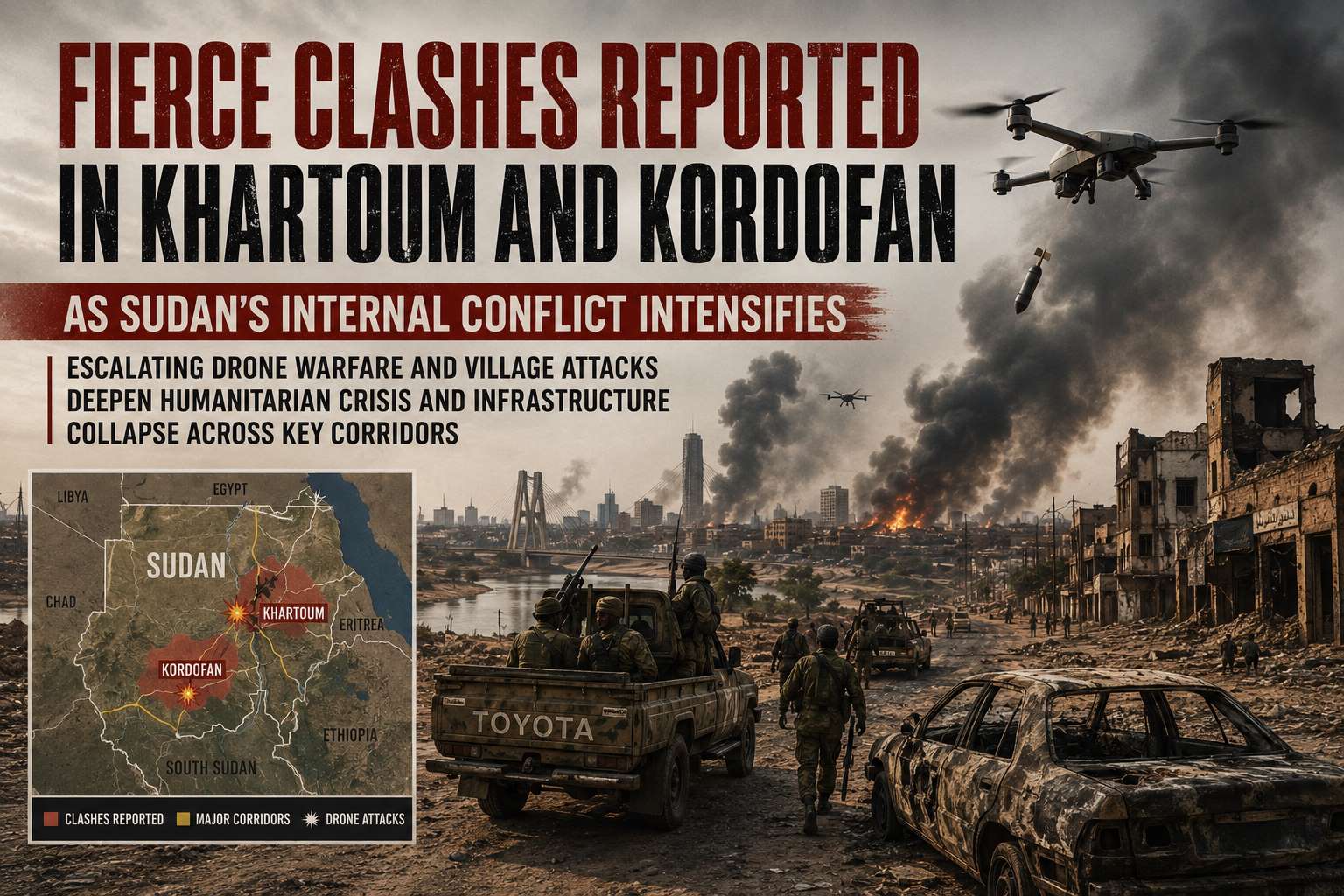
Escalating Drone Warfare and Village Attacks Deepen Humanitarian Crisis and Infrastructure Collapse Across Key Corridors
Publication Date: June 1, 2026
Last Updated: June 1, 2026
Byline: Global War News Editorial
Military operations between the Sudanese Armed Forces (SAF) and the paramilitary Rapid Support Forces (RSF) intensified sharply over the final weekend of May 2026. Heavy combat and precision drone strikes were reported across the capital city of Khartoum and multiple sectors of the strategic Kordofan region. The fresh wave of hostilities marks a volatile continuation of a multi-year conflict that has increasingly fragmented into localized territorial battles and targeted infrastructure campaigns.
In North Kordofan, the Sudanese Ministry of Foreign Affairs issued an official statement on Saturday, May 30, 2026, condemning what it termed a civilian massacre carried out by the RSF in the Um Saadoun and Al-Murra areas of the Bara locality. According to the ministry’s statement, the incursions resulted in the deaths of dozens of unarmed residents and wounded numerous others. Local independent monitoring groups and preliminary field reports published by regional networks indicate that the death toll from the assaults across the affected villages has reached at least 60 civilians.
Concurrently, aerial operations have inflicted severe civilian casualties in neighboring West Kordofan. The National Umma Party confirmed in a public statement on Saturday that an apparent army drone strike targeted two civilian vehicles traveling along the critical Abu Zabad–Al-Fula transit road. According to the political bloc, the strike killed ten individuals, including eight children, and left several others with severe injuries. The incident follows a pattern of heightened unmanned aerial vehicle (UAV) deployment by both factions, which has significantly expanded the geographic scope of the war.
Context and Background
The current internal warfare in Sudan is an extension of the power struggle between the SAF, led by General Abdel Fattah al-Burhan, and the RSF, under the command of Mohamed Hamdan Dagalo. The security situation deteriorated fundamentally following a joint military coup in October 2021 that suspended the country’s transitional constitution and disrupted international financial assistance from bodies like the World Bank and the International Monetary Fund. Open hostilities subsequently erupted on April 15, 2023, turning urban centers into active battlefronts.
By the first half of 2026, the strategic landscape had shifted significantly. While the SAF succeeded in re-establishing administrative control over substantial portions of the capital, Khartoum, by early 2025, the RSF consolidated its hold across the western Darfur territories and pushed eastward into the Kordofan corridors.
The Kordofan region serves as an essential logistical pivot point. It links the western strongholds of the RSF to the central state and contains vital national infrastructure, including the Heglig oil fields and key commercial transit highways. Control over towns such as El Obeid, Dilling, and Kadugli remains highly contested, with both factions utilizing heavy artillery and newly acquired drone systems to target enemy encampments and supply lines.
Economic and Humanitarian Impact
The protracted conflict has precipitated what international monitoring bodies classify as the world’s largest internal displacement and hunger crisis. According to the May 2026 Sudan Crisis Situation Analysis published by Data Friendly Services (DFS) via ReliefWeb, more than 14 million people have been forcibly displaced since the outbreak of hostilities, including approximately 9 million internally displaced persons (IDPs) and over 4 million refugees who have crossed into neighboring nations such as Chad, South Sudan, and Egypt.
The economic infrastructure of the country has sustained unprecedented damage, with the World Bank and the IMF estimating total structural destruction at more than $120 billion. The energy sector remains severely compromised; earlier RSF drone strikes targeting the El Obeid power station and critical grids in the Blue Nile state caused weeks of localized blackouts, crippling water supply systems and essential public utilities.
Sourcing accurate casualty figures remains a significant challenge due to frequent communication blackouts, restricted humanitarian access, and intense verification constraints. The Armed Conflict Location & Event Data Project (ACLED) had documented tens of thousands of fatalities by late 2024, but independent international investigations and media estimates cited by ReliefWeb suggest the actual total may exceed 150,000 lives lost.
Humanitarian access has contracted further as agricultural production drops and aid operations face steep funding deficits. The 2026 Humanitarian Needs and Response Plan, which requires $2.9 billion to address acute food insecurity affecting an estimated 19.5 million people, has secured only 16 percent of its target. Famine conditions have already been verified in specific enclaves, including Kadugli in South Kordofan, where siege tactics have cut off normal market operations.
International Reactions and Diplomatic Stalled Efforts
The latest spike in violence and civilian casualties has drawn renewed concern from regional bodies and global human rights entities. United Nations High Commissioner for Human Rights Volker Türk previously noted that the rapid surge in drone warfare has been responsible for a vast majority of recorded civilian casualties in conflict zones during the early months of 2026, pointing to a gross disregard for international humanitarian law by both belligerents.
On the diplomatic front, efforts to establish a lasting ceasefire have repeatedly stalled. While various factions and political groups approved a conceptual roadmap to end the war during consultations in Nairobi, the top leadership of both the SAF and the RSF have consistently refused to halt active field operations.
The Sudanese Ministry of Foreign Affairs used its weekend address to formally request that the UN Security Council, the African Union, and the international community designate the RSF as a terrorist organization, alleging that regional and international actors are supplying the paramilitary force with continuous financial and logistical aid. Conversely, the RSF has frequently accused the SAF of utilizing indiscriminate aerial bombardments on markets and health facilities, claims that international fact-finding missions continue to document as part of broader accountability investigations.
Analysis: What This Could Mean
The dual escalation of ground raids in North Kordofan and drone strikes in West Kordofan indicates that the conflict is entering an increasingly lethal phase of fragmentation. Rather than engaging in large-scale conventional maneuvers, both forces appear to be relying on asymmetric tactics designed to exhaust the opponent’s economic resources and restrict civil mobility.
The SAF’s heavy reliance on combat drones along transit roads is an operational attempt to interdict RSF supply lines moving toward Khartoum. However, as demonstrated by the strike near Abu Zabad, the use of unguided or improperly vetted aerial assets in highly populated or transient corridors carries extreme risks of catastrophic civilian collateral damage, which could alienate local tribal structures and inflame regional ethnic tensions.
For the RSF, the targeted assaults on villages within the Bara locality suggest a strategy aimed at destabilizing SAF-held urban perimeters and disrupting local agricultural networks. By maintaining persistent pressure on the Kordofan corridors, the paramilitary group prevents the SAF from consolidating its gains in the east and forces the military to divert resources from the capital.
With neither side demonstrating the operational capacity to achieve a decisive conventional victory, and with international diplomatic channels remaining largely unheeded, the conflict appears locked in a destructive war of attrition. The continuous degradation of power plants, transit vehicles, and agrarian communities suggests that the economic and physical survival of the civilian population will remain severely jeopardized through the remainder of 2026.
Source Disclosure: This report is compiled from official text and media statements issued by the Sudanese Ministry of Foreign Affairs and the National Umma Party. Factual data regarding displacement scales, food insecurity metrics, and infrastructural valuations are derived from verified updates published by the United Nations, the World Bank, the International Monetary Fund, and the May 2026 Sudan Crisis Situation Analysis hosted by ReliefWeb. Field updates and historical context are attributed to reporting from international wire services, including Agence France-Presse (AFP) and Reuters, alongside documentation from Sudan Tribune, Dabanga Radio TV, and conflict mapping datasets from ACLED.
This article is based on publicly available reporting from named international news agencies and attributed official statements. All claims about ongoing events are attributed to their original sources. Analysis sections represent the editorial interpretation of reported facts and do not constitute advocacy for any party to the described conflict. AI tools may be utilized for image generation to assist in explaining complex concepts, as well as for refining grammar, spelling, and other linguistic enhancements. However, all original content is produced, fact-checked, and revised by the editorial team. This publication does not take political positions on active military conflicts.