
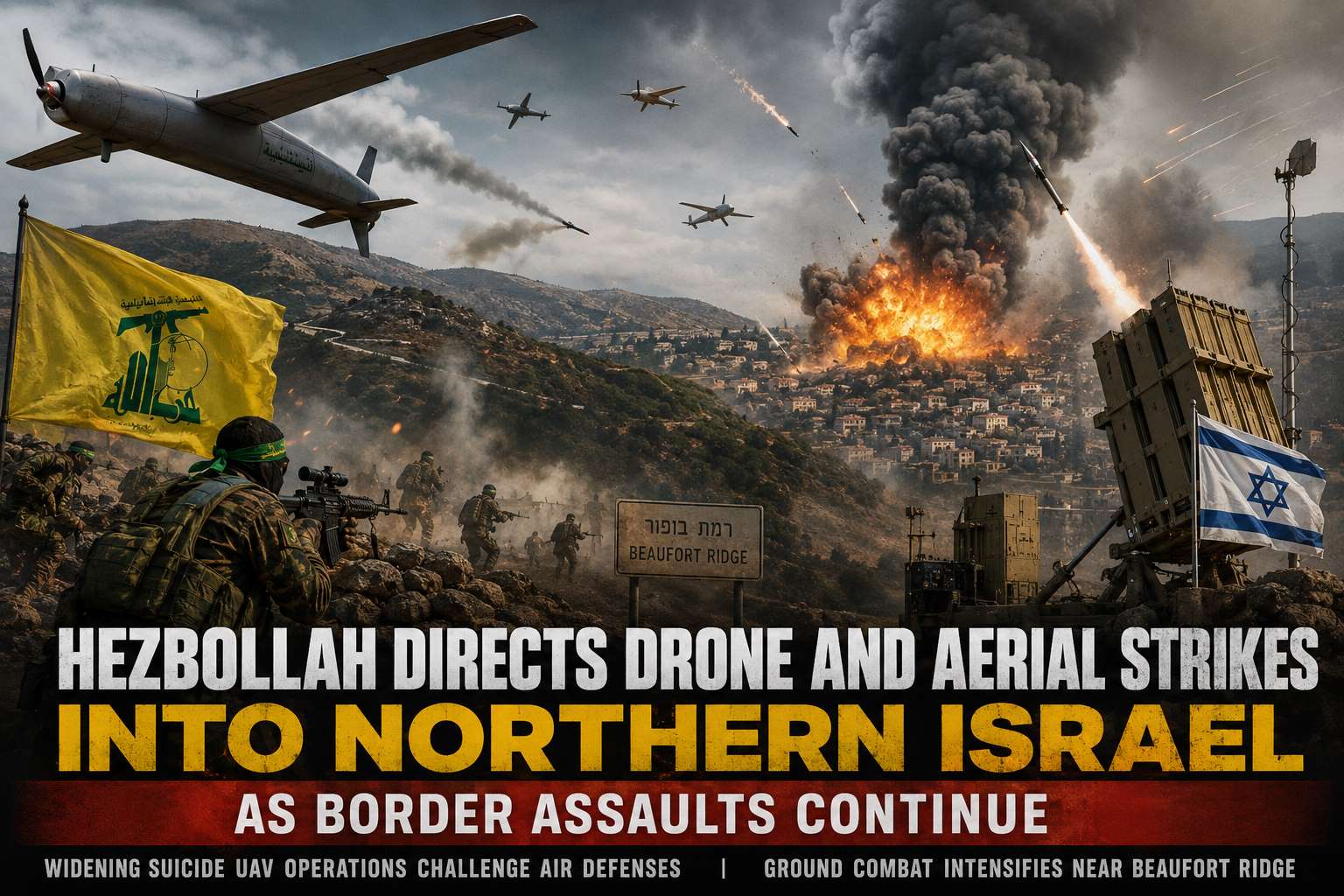
Widening Suicide UAV Operations Challenge Air Defenses as Ground Combat Intensifies Near Beaufort Ridge
Publication Date: June 1, 2026
Last Updated: June 1, 2026
Byline: Global War News Editorial
Cross-border hostilities between Hezbollah and the Israel Defense Forces reached a new peak of intensity on Sunday and early Monday. Following a major ground advance by Israeli forces into southern Lebanon, Hezbollah launched an extensive wave of aerial strikes, expanding its target zone deeper into northern Israel. The multi-front retaliation utilized explosive-laden first-person view drones and tactical rocket barrages, triggering air-raid warnings across multiple Israeli districts.
According to separate military communiqués issued by Hezbollah on Sunday, May 31, 2026, the group executed 21 coordinated operations within a 24-hour window against Israeli troops, armored vehicles, and military installations. The cross-border counter-offensive featured a strike by a suicide drone on an Israeli military gathering at a helicopter landing pad near the Shlomi settlement, alongside rocket barrages directed at Nahariya and the Krayot zone just north of Haifa. Hezbollah stated that its expanded operations were conducted in defense of the Lebanese people and in direct response to the ongoing Israeli ground push.
The Israeli military and local media outlets confirmed a significant spike in airborne threats traversing the northern border. Israel’s Channel 12 and the Yedioth Ahronoth daily reported that air-raid sirens blared in the city of Tiberias and adjacent communities early Monday morning as a fresh salvos of rockets were detected crossing from Lebanon. The IDF Spokesperson Unit announced that three rockets were launched toward the Upper Galilee region, noting that two were successfully intercepted while the outcome regarding the third remained under investigation.
Context and Background
The current phase of the conflict dates back to March 2, 2026, when major hostilities erupted along the Blue Line, terminating a period of relative calm following a late 2024 truce. Despite an official ceasefire that took effect on April 17, 2026, which was subsequently extended for 45 days in mid-May through indirect US-mediated talks—kinetic operations on the ground have never fully ceased.
The security situation escalated significantly over the weekend when the Israeli military launched a large-scale offensive targeting the Beaufort Ridge and the Wadi al-Salouqi area. On Sunday, Israeli Prime Minister Benjamin Netanyahu announced that IDF troops had successfully captured the historic, medieval Beaufort Castle (Qalaat al-Shaqif), an outpost overlooking the Litani River valley that was previously held by Israel from 1982 until its military withdrawal in 2000. Prime Minister Netanyahu called the capture of the ridge a dramatic shift in the campaign, signaling Israel’s intent to push further north of the Litani River to establish a fortified security zone.
In response to losing these strategic high-ground positions, Hezbollah has pivoted heavily toward asymmetric aerial assets. Rather than relying solely on traditional unguided Katyusha rockets, the group has increasingly deployed low-cost, precise explosive unmanned aerial vehicles (UAVs) and FPV drones to bypass Israel’s short-range air defense frameworks and strike both frontline forces and deeper logistics hubs.
Economic and Humanitarian Impact
The human cost of the renewed escalation continues to climb rapidly on both sides of the border, though the structural and civilian toll remains heavily concentrated within Lebanese territory. Data published by the Lebanese Health Ministry on May 31 indicated that the cumulative death toll from Israeli aerial and ground operations since March 2 has surpassed 3,400 individuals, with more than 10,000 others wounded. On Sunday alone, a localized airstrike on Deir Zahrani in southern Lebanon killed eight people, including three women, according to Lebanese medical sources.
The expanding combat zone has triggered mass civilian displacement. The IDF has issued forced evacuation orders stretching south of the Zahrani River and encompassing portions of the eastern Beqaa Valley, effectively emptying major southern urban hubs such as Nabatieh and the coastal city of Tyre. The Lebanese Army, which remains non-combatant in this factional conflict, reported that an Israeli drone strike targeted one of its engineering vehicles in Nabatieh over the weekend, injuring several soldiers who were working to clear unexploded ordnance from civilian transit roads.
On the Israeli side, the persistent threat of drone incursions has forced regional administrative authorities to shut down schools and public facilities across border-adjacent communities in the Upper Galilee. While the IDF reported that most rocket salvos over the weekend were intercepted or landed in uninhabited terrain, local medical teams confirmed that four people were injured on Sunday when a Hezbollah explosive drone successfully penetrated air defenses and struck the Beit Hillel settlement.
Furthermore, the threat of an expanded war has placed significant financial pressure on Israel’s northern agricultural and tourism sectors, with thousands of residents remaining displaced from their homes since the early March mobilisations.
International Reactions and Stalled Diplomacy
The sudden breakdown of the extended truce has sparked urgent international diplomatic intervention. French President Emmanuel Macron issued a sharp critique of the weekend’s events, stating that nothing justifies the major escalation under way in southern Lebanon and calling for an immediate, permanent cessation of hostilities. Diplomatic sources in New York confirmed that France has formally requested an emergency session of the United Nations Security Council to address the collapse of the mid-May stabilization framework.
The escalation forms a tense backdrop to a parallel track of international negotiations. Despite the active combat around Beaufort Ridge, senior Lebanese and Israeli military leaders met at the Pentagon in Washington for a round of US-backed security talks. A statement from the office of Lebanese President Joseph Aoun indicated that while the meetings were productive, a deep divide remains, with a subsequent round scheduled for June 2 and 3.
The direct military discussions have drawn sharp domestic criticism from Hezbollah, which has publicly denounced the Lebanese government for engaging in direct talks with Israeli officials while ground incursions continue.
Analysis: What This Could Mean
Military observers suggest that Hezbollah’s expanded drone operations represent a calculated effort to establish a cross-border war of attrition, aiming to offset the territorial advantages Israel gained by seizing the Beaufort Ridge. By utilizing low-altitude, radar-evading suicide UAVs against targets as far south as Acre and the Haifa outskirts, Hezbollah is demonstrating that the IDF’s physical capture of border hills cannot fully insulate northern Israeli communities from kinetic strikes.
The data compiled by regional tracking groups, including the Alma Research and Education Center, underscores this shift. Statistics from the week leading up to the current escalation reveal that out of 161 distinct attack waves launched by Hezbollah, over 100 utilized explosive drones, making UAVs the primary tactical tool for the group in 2026. This heavy reliance on autonomous and semi-autonomous systems allows Hezbollah to sustain a high volume of strikes despite the heavy losses sustained by its frontline infantry units, which the IDF estimates at over 1,100 operatives since March.
Conversely, Israel’s push north of the Litani River raises serious questions about the long-term scope of its security zone. While the high ground of Beaufort Castle provides clear observational and defensive advantages, maintaining static positions deeper within Lebanese territory leaves armored units vulnerable to localized ambushes and FPV drone strikes, as evidenced by an overnight attack near Yohmor that killed an IDF commando.
Unless the upcoming June rounds of Pentagon talks can produce an enforceable mechanism to restore the terms of UN Resolution 1701, the conflict appears locked in a dangerous cycle where ground advances by one side trigger increasingly deeper and less predictable aerial responses from the other.
Source Disclosure: This report draws on official military briefings from the Israel Defense Forces (IDF) Spokesperson Unit, operational statements published via Hezbollah’s media channels, and public announcements from the Lebanese Ministry of Public Health. Factual coverage of the border strikes, casualty figures, and displacement directives was compiled from verified field updates by international wire services, including Agence France-Presse (AFP), Reuters, and Anadolu Agency, alongside regional reporting from The Times of Israel, The National, and the Alma Research and Education Center.
This article is based on publicly available reporting from named international news agencies and attributed official statements. All claims about ongoing events are attributed to their original sources. Analysis sections represent the editorial interpretation of reported facts and do not constitute advocacy for any party to the described conflict. AI tools may be utilized for image generation to assist in explaining complex concepts, as well as for refining grammar, spelling, and other linguistic enhancements. However, all original content is produced, fact-checked, and revised by the editorial team. This publication does not take political positions on active military conflicts.