
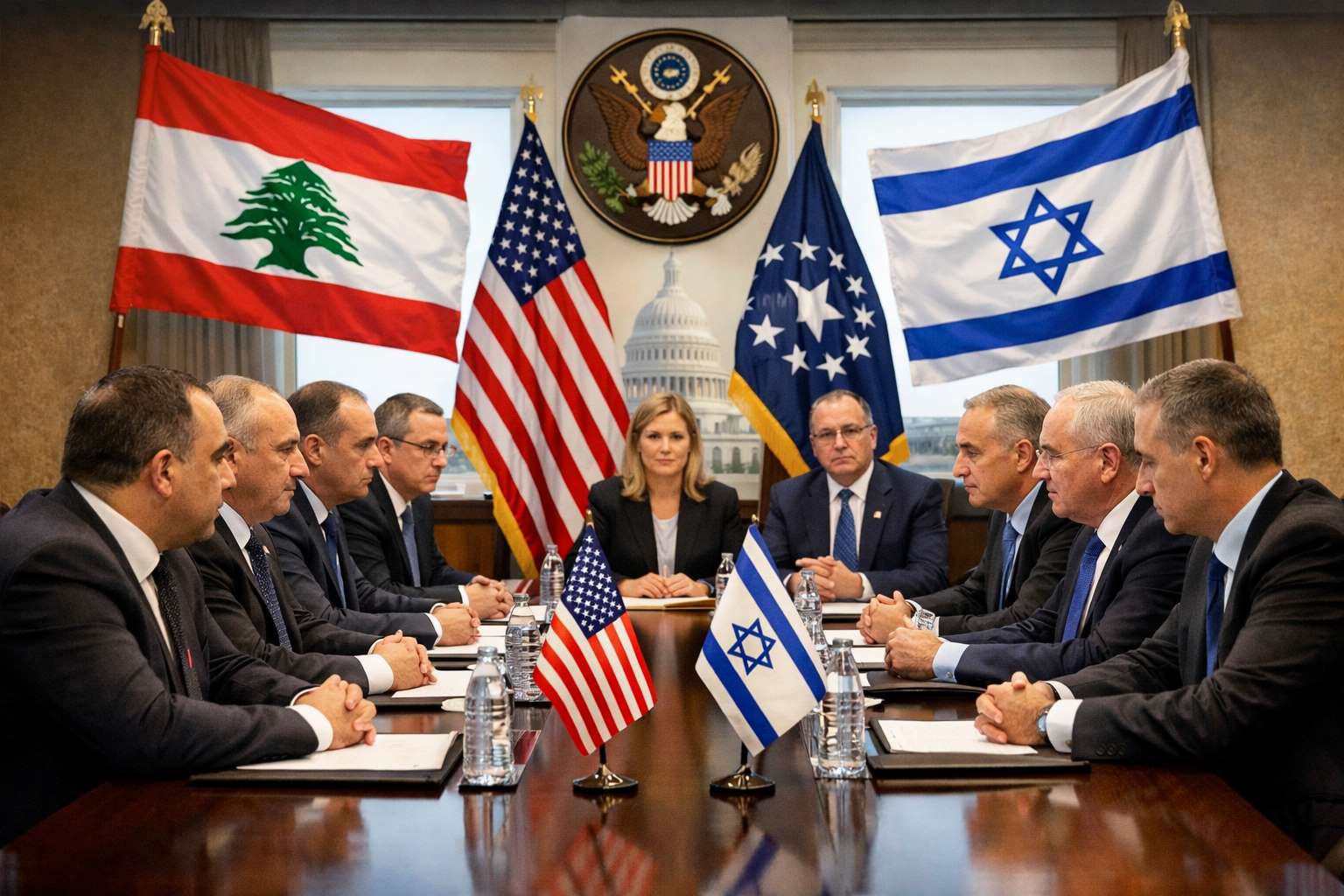
Mediated by US officials, the bilateral talks aim to establish a durable border framework amid ongoing regional volatility and severe economic strain.
Publication Date: June 1, 2026
Last Updated: June 1, 2026
Byline: Staff Writer, Global War News
High-level defense and security delegations from Lebanon and Israel have convened in Washington for a series of direct, mediated consultations. The meetings, hosted by the US Department of State and overseen by national security officials, mark a significant diplomatic effort to stabilize the volatile Blue Line border and establish a formalized security framework.
The arrival of both delegations in the US capital follows months of intense back-channel diplomacy led by American and European intermediaries. According to official statements from the White House, the primary objective of these consultations is to mitigate the risk of accidental escalation, finalize parameters for border demilitarization, and discuss international monitoring mechanisms.
While regional observers view the commencement of these talks as a positive step, official sources from both Beirut and Jerusalem have emphasized that deep structural disagreements remain. The Lebanese delegation has prioritized discussions regarding territorial integrity and the cessation of airspace violations, while the Israeli side remains focused on verifiable enforcement zones and the prevention of cross-border rearmament.
The Agenda in Washington: Security Zones and Verification
The consultations are structured around a multi-stage framework designed to address immediate security concerns before transitioning to long-term border demarcation. According to details published by Reuters, the initial sessions are focused on establishing a expanded, weapon-free buffer zone monitored by a reinforced international peacekeeping presence.
A central point of discussion is the operational mandate of monitoring forces along the frontier. US mediators have proposed a digitized verification system, utilizing advanced sensor networks and unmanned aerial surveillance to detect non-compliance in real time. The proposed system aims to provide objective, third-party data to both capitals, reducing reliance on unilateral intelligence assessments that have previously triggered preemptive military actions.
Reports from regional news outlets, including Al Jazeera, indicate that the Lebanese delegation has expressed reservations regarding certain surveillance protocols, citing concerns over national sovereignty. Conversely, Israeli defense officials have stated publicly that a robust, automated verification infrastructure is a non-negotiable prerequisite for any formalized pull-back of frontline forces.
The financial toll of the prolonged border mobilization has also added urgency to the proceedings. Economists tracking the region note that both countries are facing severe fiscal pressures, with maritime trade disruptions and displaced populations straining national budgets. A stabilized border is increasingly viewed by international financial institutions, including the World Bank, as essential for regional economic recovery.
Context and Background: The Path to the Negotiating Table
The Washington consultations come after a protracted period of cross-border hostilities that began heating up significantly over the past two years. The displacement of tens of thousands of civilians on both sides of the border created an unsustainable humanitarian and political crisis for both governments, eventually forcing a shift toward formal diplomacy.
| Chronology of Border Diplomacy | Key Developments |
| Late 2024–Early 2025 | Escalating cross-border strikes lead to widespread civilian displacement and severe infrastructure damage in southern Lebanon and northern Israel. |
| October 2025 | Preliminary back-channel communications initiated via French and American intermediaries during the UN General Assembly. |
| January 2026 | Draft framework for a comprehensive border security plan submitted to both capitals by US special envoys. |
| May 2026 | Both governments formally accept invitations to send high-level defense teams to Washington for direct, mediated consultations. |
Previous normalization and boundary efforts, such as the 2022 maritime border agreement, demonstrated that transactional accords are possible between the two nations despite the absence of formal diplomatic relations. However, extending those principles to a highly militarized land border presents significantly greater political and operational complexities for both leadership teams.
Analysis: Sovereign Mandates vs. Operational Realities
What This Could Mean: Political analysts suggest that the willingness of both sides to send senior defense figures to Washington indicates a mutual recognition that the status quo is economically and militarily unsustainable. For Lebanon, securing a binding commitment to halt unauthorized overflights and border incursions is critical for restoring a semblance of state authority. For Israel, the primary goal is ensuring the verifiable removal of heavy weaponry from its immediate northern horizon to allow civilian populations to return home permanently.
The chief complication lies in the implementation of these terms on the ground. The Lebanese central government faces severe domestic constraints, and its national army lacks the logistical capacity to unilaterally police a complex demilitarized zone without extensive international financial and material assistance.
Furthermore, any framework agreed upon in Washington must survive intense domestic political scrutiny in both countries. In Israel, defense officials face pressure from a public wary of ambiguous security guarantees. In Lebanon, the complex internal political landscape means that any perceived concession to foreign security demands can quickly destabilize the governing coalition in Beirut.
What to Watch
The success of the current round of talks will largely depend on whether mediators can devise a compromise regarding the physical composition and command structure of the border monitoring force. Observers should watch for statements out of the State Department indicating whether the initial 48-hour session will be extended into a broader, multi-week diplomatic summit.
Meanwhile, financial markets and regional reconstruction funds are monitoring the talks closely. International donors have signaled that substantial financial aid packages for infrastructure repair in southern Lebanon remain contingent on a verifiable, long-term security commitment signed by both parties. Until a joint statement is issued, defensive postures along the Blue Line are expected to remain at a state of high alert.
Source Disclosure Note: This report compiles verified details from international news agencies, including Reuters, the Associated Press, and Agence France-Presse (AFP), alongside regional coverage from Al Jazeera and Haaretz. Official press releases from the US Department of State and statements from the Lebanese and Israeli defense ministries were utilized to verify diplomatic positions and scheduling details.
This article is based on publicly available reporting from named international news agencies and attributed official statements. All claims about ongoing events are attributed to their original sources. Analysis sections represent the editorial interpretation of reported facts and do not constitute advocacy for any party to the described conflict. AI tools may be utilized for image generation to assist in explaining complex concepts, as well as for refining grammar, spelling, and other linguistic enhancements. However, all original content is produced, fact-checked, and revised by the editorial team. This publication does not take political positions on active military conflicts.