
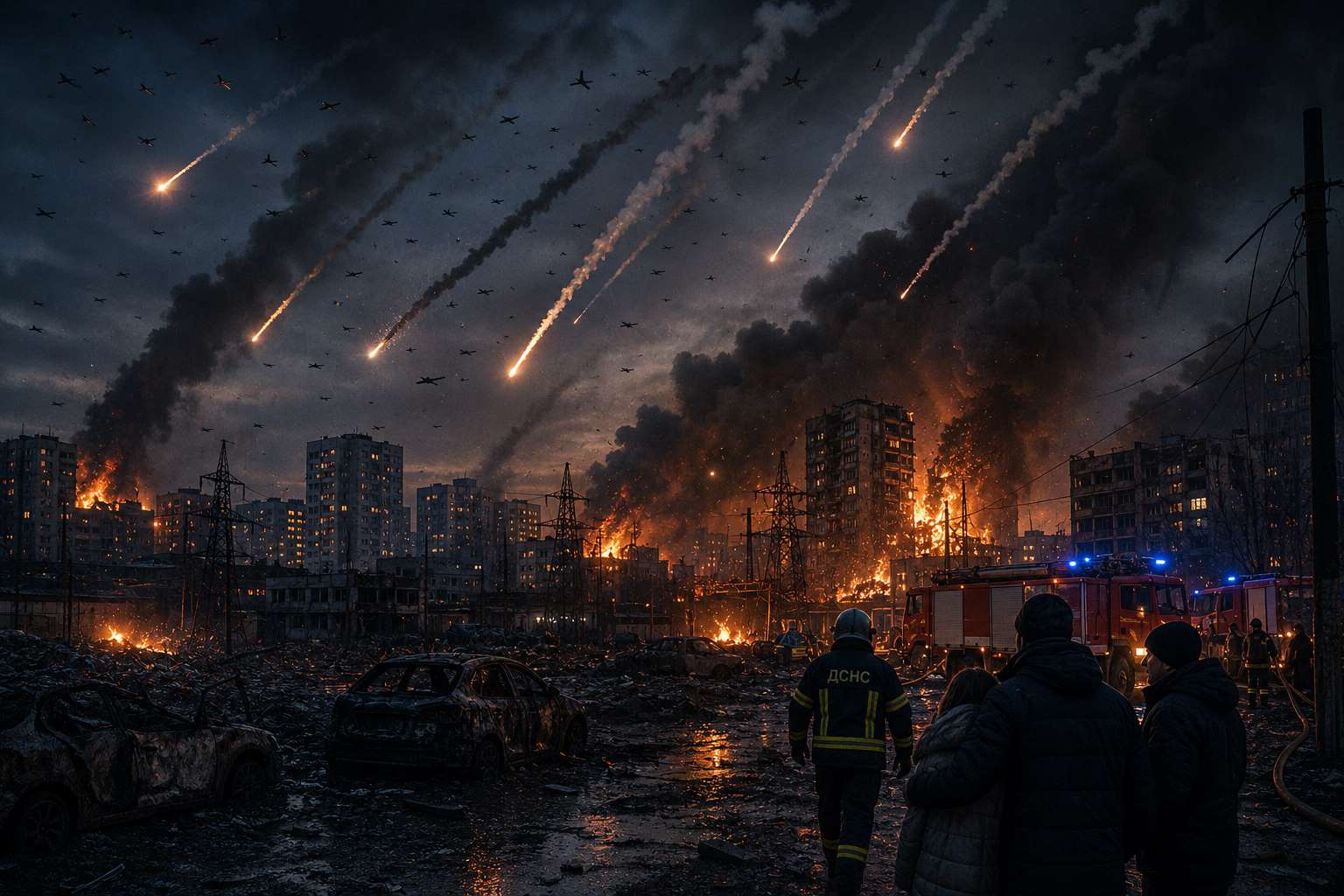
A coordinated wave of hundreds of drones and dozens of missiles knocks out power for over 100,000 residents, targeting critical infrastructure and civilian areas across 38 locations.
Publication Date: June 2, 2026
Last Updated: June 2, 2026
Byline: Global War News Editorial
KYIV: Russian forces launched one of the largest coordinated aerial campaigns of the war overnight into Tuesday, targeting the capital city of Kyiv, the central industrial hub of Dnipro, and several eastern regional centers with an expansive mix of cruise missiles, ballistic projectiles, and long-range attack drones.
According to statements released by the Ukrainian Air Force on Tuesday morning, Russian units deployed 73 missiles and 656 drones between Monday evening and the early hours of Tuesday. Ukrainian air defense systems reportedly intercepted or neutralized 40 missiles and 602 drones, but remaining munitions struck at least 38 locations across the country. Local emergency services and regional governors confirmed that the strikes killed multiple people and injured more than 100 others nationwide, with casualties concentrated in densely populated urban residential zones.
The Russian Defense Ministry confirmed the large-scale operation in an official statement on Tuesday, asserting that the strikes successfully neutralized designated targets. According to the ministry, the operation utilized high-precision, long-range air, land, and sea-based weapons, including hypersonic aero-ballistic missiles. The statement claimed the primary objectives were Ukrainian military-industrial facilities, defense production plants, and transport infrastructure used for military logistics.
Direct Impacts in Kyiv and Regional Centers
The bombardment targeted key administrative, cultural, and residential districts across several major provinces, generating widespread disruptions to municipal services:
- Kyiv and the Capital Region: Kyiv Mayor Vitali Klitschko reported that falling missile debris and direct impacts killed at least four residents and injured 63 others, including three children. Fires broke out in the Obolon and Podilskyi districts, with a suspected missile strike causing partial structural failure in a 24-story residential apartment block. The private energy operator DTEK reported that the strikes cut electricity to approximately 140,000 residents in the capital, though emergency repair crews managed to restore power to 110,000 individuals within hours.
- Dnipro: In the central industrial city of Dnipro, regional authorities and the State Emergency Service reported that six people were killed and 36 others were injured. Local officials noted that the dead included an emergency responder who was killed in a secondary “double-tap” strike while arriving at an initial impact site to rescue survivors. Photographs published by regional governor Oleksandr Hanzha showed heavily damaged residential structures, burned commercial vehicles, and destroyed civilian spaces.
- Kharkiv and Eastern Oblasts: To the east, Kharkiv Mayor Ihor Terekhov stated that multiple drone and missile strikes injured at least 14 people, damaging multi-story residential blocks, administrative buildings, and local garages. Additional strikes hitting critical infrastructure were reported in Mykolaiv, Zaporizhzhia, Poltava, Sumy, Chernihiv, and Khmelnytskyi oblasts.
Intelligence Context and Strategic Timing
The multi-axis air assault followed explicit warnings from the Ukrainian state leadership. On May 29, President Volodymyr Zelenskyy stated publicly that national intelligence reports indicated Moscow was accumulating a significant strike package for a major coordinated aerial offensive. Ukrainian officials urged the public to heed air raid sirens, which triggered thousands of residents across the country to seek shelter underground in municipal metro stations throughout Tuesday morning.
Military analysts from the Institute for the Study of War (ISW) observed that this escalated bombing campaign coincides with a period of stalled territorial shifts on the ground. According to data verified by the research institution on June 1, Russian ground forces have achieved only marginal territorial advances during their spring offensive, constrained by localized Ukrainian counterattacks and a successful mid-range strike campaign targeting Russian supply lines.
In response to Tuesday’s strikes, Ukrainian Foreign Minister Andrii Sybiha issued a public statement condemning the usage of aerial terror against city centers. President Zelenskyy repeated his urgent appeals to international partners, specifically requesting expedited shipments of interceptor missiles for Patriot air defense batteries and broader anti-ballistic missile defense systems to protect urban infrastructure.
ANALYSIS: The Infrastructure Attrition Strategy
The scope of Tuesday’s bombardment highlights a deliberate continuation of Russia’s structural attrition strategy, aiming to exhaust Ukraine’s air defense stockpiles while degrading the country’s economic and civil endurance. By launching over 700 individual aerial threats simultaneously, the operation appears calculated to overwhelm regional defense networks, forcing command centers to make difficult choices regarding which infrastructure nodes to defend.
The operational focus on major urban centers like Kyiv and Dnipro carries distinct economic consequences. Disrupting electrical grids in industrial hubs directly limits domestic manufacturing capabilities and increases the financial burden of emergency reconstruction on the Ukrainian state budget.
Furthermore, the targeting of logistics and administrative hubs indicates an effort to disrupt the domestic coordination of military supply lines. However, because a high volume of these long-range munitions continue to impact residential neighborhoods, the immediate result remains a high rate of civilian casualties and severe damage to municipal housing. This trend ensures that international diplomatic friction regarding Western restrictions on counter-strikes within Russian territory will remain a central point of debate.
What to Watch Next
As municipal teams work to clear debris and stabilize affected power grids, observers are tracking several key indicators to assess the immediate aftermath of the assault:
- Air Defense Depletion Rates: The volume of interceptor missiles expended by Ukrainian forces to counter the 73 missiles and 656 drones will influence the urgency of immediate defensive re-supply requests sent to Western allies.
- Grid Recovery Times: The speed with which energy companies can repair localized transmission substations in Kyiv and Kharkiv will demonstrate the current resilience of the revised national power network.
- Cross-Border Retaliation: Whether Ukrainian forces respond by escalating their mid-range drone campaign against oil facilities and logistics networks inside neighboring Russian border regions, such as Kursk and Krasnodar.
Source Disclosure Note: This report synthesizes verified field data from the Ukrainian State Emergency Service, official regional reports from Kyiv Mayor Vitali Klitschko and Dnipro Governor Oleksandr Hanzha, public tracking data from the Ukrainian Air Force, and official press statements from the Russian Defense Ministry. Ground context and strategic analysis incorporate reporting from the Associated Press, Reuters, Agence France-Presse (AFP), and the Institute for the Study of War (ISW).
This article is based on publicly available reporting from named international news agencies and attributed official statements. All claims about ongoing events are attributed to their original sources. Analysis sections represent the editorial interpretation of reported facts and do not constitute advocacy for any party to the described conflict. AI tools may be utilized for image generation to assist in explaining complex concepts, as well as for refining grammar, spelling, and other linguistic enhancements. However, all original content is produced, fact-checked, and revised by the editorial team. This publication does not take political positions on active military conflicts.