
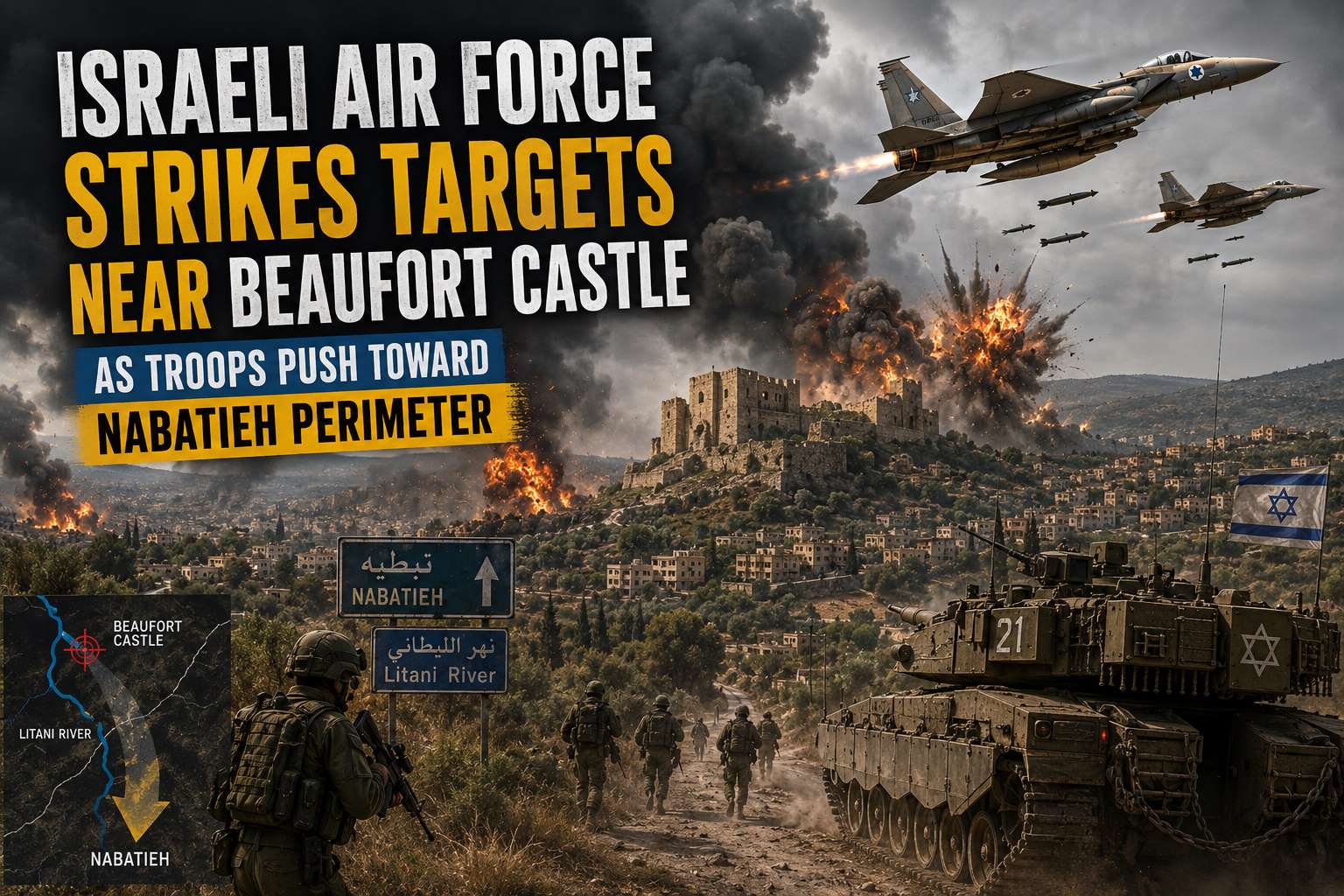
Heavy aerial bombardment and ground advances beyond the Litani River mark the deepest cross-border incursion into southern Lebanon in over a quarter-century, challenging active diplomatic talks in Washington.
Publication Date: June 2, 2026
Last Updated: June 2, 2026
Byline: Global War News Editorial
BEIRUT: Israeli military forces have significantly expanded their ground offensive in southern Lebanon, pushing beyond the traditional boundary of the Litani River to capture the historic Beaufort Castle and advance to the outer perimeter of Nabatieh. The rapid territorial shift follows a coordinated wave of airstrikes and artillery barrages targeting suspected Hezbollah infrastructure across the region.
According to operational updates released by the Israeli military and reported by the Associated Press, troops secured the 900-year-old Crusader fortress, known locally as Qalaat al-Shaqif, following days of intense fighting in the surrounding villages. Israeli Defense Minister Israel Katz confirmed the development publicly, stating that forces had raised the Israeli flag over the high-ground position.
The ground advance has moved Israeli forward units to within approximately five kilometers of Nabatieh, one of the largest urban and administrative hubs in southern Lebanon. On Tuesday, Lebanon’s National News Agency (NNA) and Al Jazeera correspondents reported fresh Israeli airstrikes and drone attacks targeting the towns of Nabatieh al-Fawqa, Shukin, and Kafr Tibnit, causing substantial damage to residential structures and municipal facilities.
Escalation Over the Litani Combat Zone
The current operations represent a fundamental alteration of the physical conflict geography that has persisted since hostilities commenced on March 2. The Israeli military has designated the vast geographic band extending from the Litani River north to the Zahrani River as an active combat zone, ordering immediate civilian evacuations:
- Evacuation Orders Issued: Major Avichay Adraee, the Israeli military’s Arabic-language spokesperson, issued urgent public directives warning residents to vacate Nabatieh, its surrounding villages, and the coastal city of Tyre. Local humanitarian groups estimate that the spreading combat zone has already displaced over one million people, representing roughly one-fifth of Lebanon’s total population.
- The Saliency of Beaufort Ridge: Per logistical briefs published by Reuters, the capture of Beaufort Castle provides Israeli artillery and surveillance units with an absolute line-of-sight advantage. Situated roughly 700 meters above sea level, the ridge directly overlooks the Litani River valley and key transport highways connecting internal Lebanese sectors to the northern border of Israel.
- Casualty Metrics: The Lebanese Ministry of Health reported that recent dawn strikes across southern villages killed eight individuals, including three women, bringing the estimated Lebanese death toll since March to at least 3,350 people. The figures, however, remain difficult to independently verify due to ongoing frontline disruptions.
Diplomatic Friction Amid Washington Negotiations
The deep military push comes at a highly problematic moment for international mediators. Representatives from Israel and Lebanon are currently scheduled to convene in Washington for a critical round of direct peace talks mediated by U.S. Secretary of State Marco Rubio, aiming to revive a nominal ceasefire framework that has been structurally unravelling since its initial implementation on April 17.
The expanding ground operations have drawn sharp international rebukes. French Foreign Minister Jean-Noël Barrot requested an emergency meeting of the United Nations Security Council, describing the deepening occupation of Lebanese territory as entirely unacceptable. In a public broadcast on BFM TV, Barrot asserted that no defensive objective could justify the prolonged expansion of military frontiers into sovereign Lebanese space.
The strategic developments are also impacting wider geopolitical channels. In Tehran, Iranian Foreign Ministry spokesperson Esmaeil Baghaei stated that the continuous Israeli ground advance across the Litani River is actively complicating parallel U.S.-Iran negotiations regarding broader Middle Eastern truces. Tehran has maintained that any long-term regional stability pact must be directly conditional on a verified cessation of hostilities inside Lebanon.
ANALYSIS: The High-Ground Leverage Strategy
The capture of Beaufort Castle and the advance toward Nabatieh represent a classic military maneuver designed to secure physical leverage on the ground before final diplomatic terms are codified in Washington. By moving substantial armored and infantry assets across the Litani River—a boundary that has historically functioned as a geopolitical red line—the Israeli command is attempting to create a permanent security buffer zone. The primary tactical goal is the systematic dismantling of Hezbollah’s short-range rocket launch sites that have targeted civilian communities in Galilee.
However, this forward-leaning posture introduces severe structural risks to the negotiation process. For the Lebanese government, negotiating while foreign ground forces are actively surrounding a major administrative center like Nabatieh is politically difficult, as it leaves the state open to accusations of signing a treaty under duress.
Furthermore, history suggests that holding positions on the rugged Beaufort Ridge is exceptionally resource-intensive. The Israeli military previously occupied this exact fortress from 1982 until its complete withdrawal in 2000, a period marked by continuous asymmetric attrition warfare. While the high ground offers immediate surveillance advantages, it also creates static targets for loitering munitions and anti-tank guided missiles. If the Washington talks collapse this week, the Litani-to-Zahrani combat zone could quickly transform from a temporary tactical buffer into a deeply entrenched, long-term theater of grinding occupation.
What to Watch Next
As forward military elements consolidate their lines along the Beaufort Ridge, three operational indicators will determine the direction of the conflict:
- The Nabatieh Boundary Decision: Whether Israeli armored columns actively enter the dense urban center of Nabatieh or halt their advance along the perimeter to allow diplomatic channels in Washington to respond.
- Hezbollah Launch Volumetrics: Whether the loss of the strategic ridge significantly degrades Hezbollah’s ability to execute cross-border missile and drone counter-strikes into northern Israel.
- UN Security Council Intervention: Whether France and other European allies can successfully coordinate a binding security resolution to freeze troop movements without facing a diplomatic veto from the United States.
Source Disclosure Note: This report integrates verified field updates from Lebanon’s National News Agency (NNA), official press statements from Israeli Defense Minister Israel Katz, displacement metrics from the United Nations and the Lebanese Ministry of Health, and regional tracking summaries published by the Associated Press, Reuters, and the Institute for the Study of War (ISW).
This article is based on publicly available reporting from named international news agencies and attributed official statements. All claims about ongoing events are attributed to their original sources. Analysis sections represent the editorial interpretation of reported facts and do not constitute advocacy for any party to the described conflict. AI tools may be utilized for image generation to assist in explaining complex concepts, as well as for refining grammar, spelling, and other linguistic enhancements. However, all original content is produced, fact-checked, and revised by the editorial team. This publication does not take political positions on active military conflicts.