
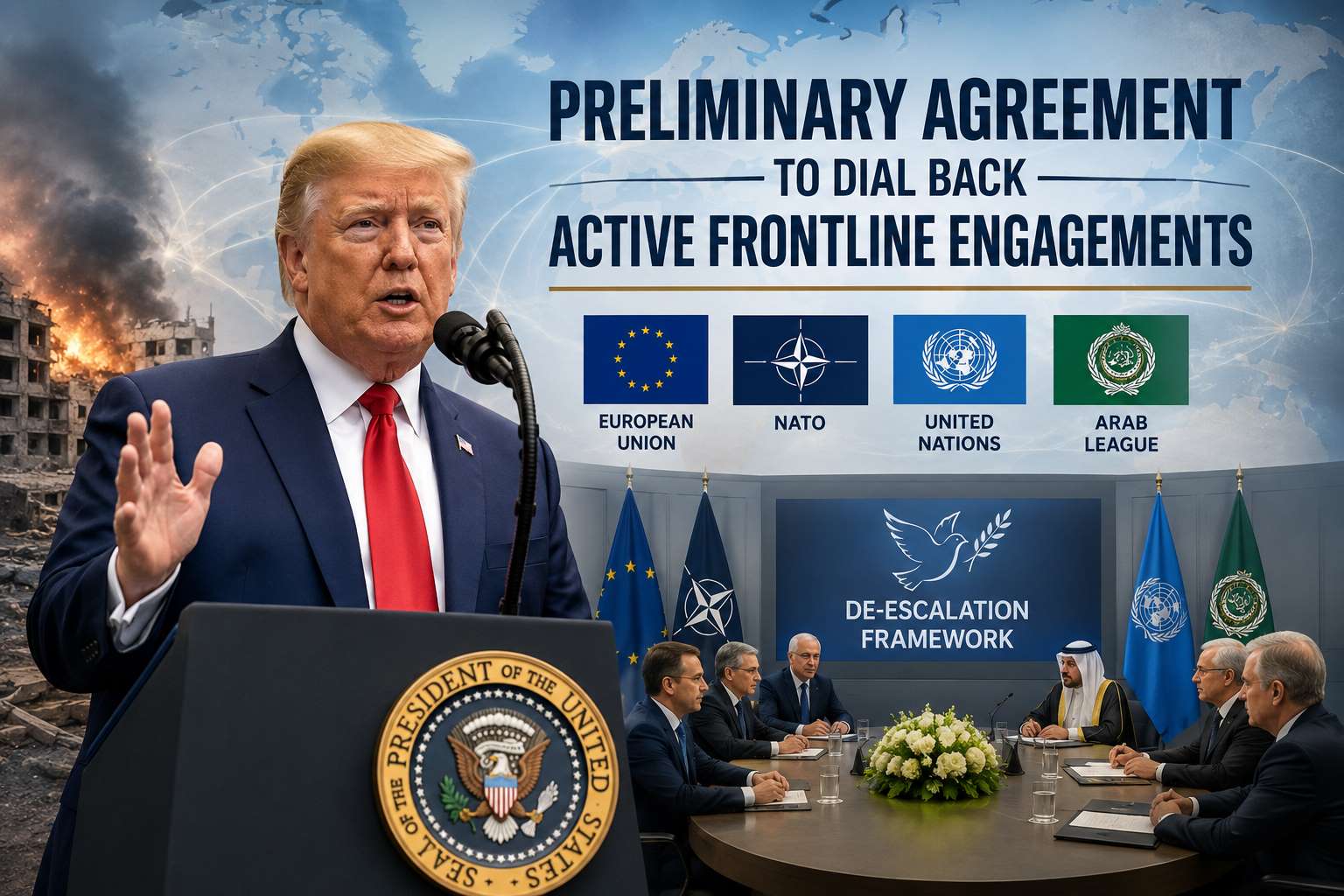
Informal executive discussions suggest foundational progress on a regional de-escalation framework, though key coalition members maintain active cross-border operations.
Publication Date: June 2, 2026
Last Updated: June 2, 2026
Byline: Global War News Editorial
WASHINGTON : US President Donald Trump announced that key regional coalitions and state actors have signaled a preliminary, conceptual alignment to systematically reduce active frontline military engagements across the Middle East. The executive announcement follows a series of indirect diplomatic exchanges and high-level telephone consultations coordinated by Washington over the last 48 hours.
According to a series of public statements released by President Trump, the administration has secured tentative assurances from major state actors and affiliated coalitions to halt further forward offensive movements. The diplomatic initiative aims to establish a unified cooling-off period, providing a political buffer to revive parallel, stalled bilateral truce negotiations in Washington.
However, international tracking data indicates that a formal mechanism has not yet been codified. While the executive branch described the initial commitments as a significant step toward regional stabilization, defense ministries in the affected territories confirmed that field units have not received formal standstill orders, leaving active frontlines vulnerable to localized flare-ups.
Diplomatic Framework and Coalition Responses
The diplomatic initiative seeks to coordinate a simultaneous reduction in combat intensity across multiple overlapping conflict zones. The White House strategy relies on securing parallel compliance from distinct political and military blocs:
- The State of Israel: Following direct consultations between President Trump and Israeli Prime Minister Benjamin Netanyahu, Israeli officials stated that while they remain open to diplomatic stabilization frameworks, active operations will continue until northern border security is established. The Israeli military maintained its high-alert status, citing the need for verifiable security guarantees before altering its forward troop positions.
- The Lebanese State and Hezbollah Channels: Diplomatic envoys from Beirut confirmed that formal documentation regarding a mutual cessation framework had been reviewed. Representatives indicated a conditional willingness to pause cross-border rocket and drone operations, provided that targeted aerial operations against urban infrastructure centers are completely suspended.
- The Iranian Diplomatic Position: Reports from third-party mediators in Qatar and Pakistan suggest that Tehran has acknowledged the de-escalation proposal. However, the Iranian Ministry of Foreign Affairs public statements emphasize that any permanent regional alignment remains strictly dependent on the total lifting of the naval blockade currently restricting commercial shipping in the Gulf of Oman.
Operational Reality and Frontline Attrition
The optimistic tone of the executive announcements contrasts sharply with real-time intelligence summaries collected along active border corridors. According to data monitored by the Institute for the Study of War (ISW), localized tactical engagements have not decreased since the White House discussions commenced.
In southern Lebanon, the Israel Defense Forces (IDF) finalized their capture of the strategic high ground at Beaufort Castle, establishing an artillery and surveillance overlook above the Litani River valley. Concurrently, Lebanon’s National News Agency reported localized drone counter-strikes targeting Israeli military vehicle clusters near the border towns of Zawtar al-Sharqieh and Shukin.
In the maritime theater, the security environment remains highly restrictive. U.S. Naval Forces Central Command issued a renewed notice to commercial mariners confirming that the enforcement of the embargo on Iranian cargo routes remains fully operational. The naval command stated that defensive interdiction measures will continue without modification until a binding, state-to-state treaty is officially executed by all participating sovereign entities.
ANALYSIS: The Sequencing Dilemma in High-Level Interventions
The preliminary alignment announced by the White House highlights the persistent challenge of personalist executive diplomacy when applied to deeply institutionalized conflicts. By utilizing direct, high-level communications to secure conceptual agreements from political leaders, the administration is attempting to bypass the slow, iterative processes of traditional multi-party diplomacy. This method can successfully break diplomatic logjams, but it frequently creates a dangerous gap between political rhetoric and battlefield implementation.
The core vulnerability of the current de-escalation framework lies in its lack of clear sequencing. For a simultaneous reduction in force to succeed, all participating parties must trust that their adversaries will downscale their operational readiness at the exact same moment. In the current Middle Eastern theater, that trust does not exist.
Israeli commanders view their forward positions beyond the Litani River as essential defensive leverage that cannot be abandoned before Hezbollah is completely disarmed. Conversely, regional non-state networks view their asymmetric strike capabilities as their only effective counter-weight against Western aerial superiority. When a political leader announces an agreement in principle while field units are actively executing ammunition re-supply operations on the ground, it risks creating a false sense of security. If a localized field commander misinterprets a tactical troop rotation as an offensive breach, the entire conceptual framework could collapse before formal text can be drafted by legal experts in Washington.
What to Watch Next
As diplomatic teams attempt to transform these conceptual agreements into binding operational protocols, observers are monitoring several key metrics:
- Drafting of Verification Timelines: Whether the upcoming plenary sessions in Washington can successfully establish an objective timeline detailing which faction must freeze its movements first.
- The Status of Maritime Sanctions Waivers: Whether the White House offers partial, conditional relief on Iranian oil shipments as a diplomatic incentive to formalize the frontline pauses.
- Frontline Enforcement Capabilities: Whether sovereign governments possess the domestic political authority to enforce a total ceasefire on localized proxy elements operating along remote borders.
Source Disclosure Note: This report incorporates official public statements from US President Donald Trump, press transcripts from the Israeli Prime Minister’s Office, diplomatic updates from the Lebanese Embassy in Washington, and official wire reports from the Associated Press, Reuters, and the state-affiliated Tasnim news agency. Operational ground context relies on verified data published by the Institute for the Study of War (ISW) and the Lebanese National News Agency.
This article is based on publicly available reporting from named international news agencies and attributed official statements. All claims about ongoing events are attributed to their original sources. Analysis sections represent the editorial interpretation of reported facts and do not constitute advocacy for any party to the described conflict. AI tools may be utilized for image generation to assist in explaining complex concepts, as well as for refining grammar, spelling, and other linguistic enhancements. However, all original content is produced, fact-checked, and revised by the editorial team. This publication does not take political positions on active military conflicts.