
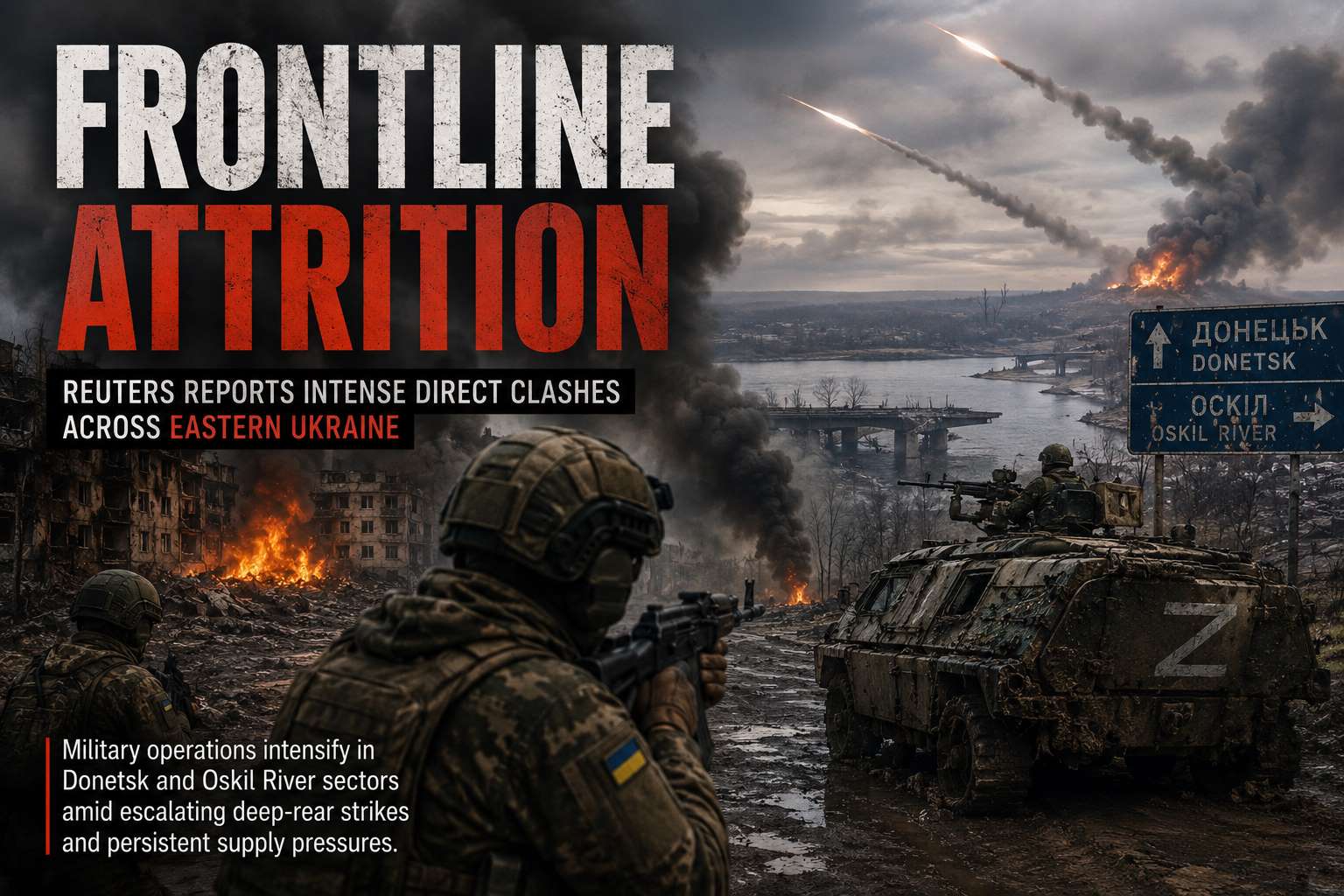
Military operations intensify in Donetsk and Oskil River sectors amid escalating deep-rear strikes and persistent supply pressures.
Publication Date: June 3, 2026
Last Updated: June 3, 2026
Byline: Global War News Editorial
Direct infantry and artillery engagements have intensified across key sectors of the eastern Ukraine frontline. According to international wire reports and military updates, heavy combat is concentrated in the Oskil River basin and across contested sectors of Donetsk Oblast. The escalation on the ground coincides with a significant expansion of long-range aerial bombardments affecting urban infrastructure in the rear and critical energy facilities deep within Russian territory.
Direct Engagements in the Eastern Sectors
International news agencies, including Reuters, reported that direct ground clashes have sustained a high baseline of intensity through the final weeks of May and into early June 2026. In the Oskil River sector, where Russian forces have sought to advance westward into eastern Kharkiv and northern Donetsk Oblasts, confrontations have focused on tactical infiltration.
Frontline commanders from a Ukrainian artillery battery operating in the eastern sectors reported to independent observers that summer vegetation has altered tactical dynamics, providing concealment for infantry units attempting infiltration missions. These commanders noted that the widespread presence of reconnaissance and strike drones has limited the daylight deployment of heavy conventional artillery, forcing both sides to rely more frequently on mobile mortar teams and decentralized infantry assaults.
Further south, in Donetsk Oblast, the Ukrainian General Staff and independent regional observers reported localized counterattacks south of Borova, alongside persistent Russian pressure targeting logistical junctions. Neither side has established confirmed, large-scale territorial breakthroughs along the primary defensive lines, with the frontline characterized by costly positional attrition.
Context and Background: The War of Attrition
The current frontline posture reflects structural adjustments made by both militaries after more than four years of active conflict. Since the initial conventional maneuvers of 2022, the theater has transformed into a highly monitored battlefield where concentrated armor deployments face rapid destruction from distributed drone networks.
This environment has elevated the importance of supply lines and deep-rear logistics. Throughout the spring of 2026, tactical ground operations have been heavily influenced by interdiction campaigns targeting railways and highways in occupied southern and eastern regions, including the M-14 highway corridor. Analysts note that the side capable of sustaining ammunition manufacturing and protecting its transport nodes retains the capacity to hold defensive perimeters, turning the conflict into a baseline industrial endurance struggle rather than a war of rapid geographic movement.
The Rear and the Logistics War
The direct clashes along the eastern frontline are deeply linked to an escalating campaign against deep-rear targets. On June 2, the Associated Press reported that a coordinated overnight bombardment utilizing dozens of missiles and hundreds of drones struck multiple Ukrainian cities, including Kyiv, Dnipro, Kharkiv, and Zaporizhzhia. The Ukrainian Air Force stated that the strike package included ballistic and cruise missiles, resulting in at least 22 civilian fatalities and substantial damage to residential and energy infrastructure. The Russian Defense Ministry issued a statement asserting that its strikes targeted military-industrial facilities across these regions.
Concurrently, Ukrainian long-range drone strikes have increasingly focused on Russian energy infrastructure to disrupt fuel logistics and state revenues. Independent monitoring groups and local officials confirmed that multiple drone attacks have targeted facilities deep inside Russia, including the Novoshakhtinsky oil refinery in Rostov Oblast and infrastructure within the Leningrad region northwest of Moscow. The governor of the Leningrad region, Alexander Drozdenko, reported that air defenses had been actively engaged in repelling drone arrivals just as the annual St. Petersburg International Economic Forum was scheduled to open.
Analysis: What This Means for the Frontline
The synchronization of intense frontline infantry clashes with expansive rear-area strikes suggests a dual strategic intent from both commands.
Observers from independent research institutions indicate that the heavy aerial bombardment of Ukrainian administrative and population centers may be timed to exploit observed shortages in surface-to-air missile interceptors. By forcing the reallocation of defensive assets to protect major cities, these strike packages aim to weaken air defense coverage directly above frontline troops.
Conversely, the targeted disruption of Russian oil refining units—such as the reported damage to processing blocks in Rostov—appears designed to create localized fuel shortages. Analysts suggest that choking the supply of refined petroleum products directly undermines the operational mobility of armored units on the frontline. With both sides heavily restricted by drone surveillance, any logistical breakdown in fuel or ammunition transport can rapidly immobilize defensive positions, rendering them vulnerable to localized infantry advances.
Summary and Outlook
The conflict in eastern Ukraine remains locked in a high-intensity equilibrium. While urban centers and energy networks bear the brunt of long-range missile and drone operations, the frontline itself is defined by small-unit actions and heavy mortar duels under dense canopy cover.
In the coming weeks, observers should monitor two primary indicators: the structural stability of Ukrainian air defense reserves under continuous heavy bombardment, and the measurable impact of refinery strikes on the fuel availability for Russian mechanized units along the Oskil River and Donetsk axes. Neither side shows signs of reducing operational tempo, pointing toward a continuation of this dual-track war of attrition.
Source Disclosure Note: This report relies on verified dispatches from Reuters, the Associated Press, and Agence France-Presse; official data published by the Ukrainian General Staff and the Ministry of Defense of the Russian Federation; public statements by regional governors; and operational assessments from the Institute for the Study of War (ISW).
This article is based on publicly available reporting from named international news agencies and attributed official statements. All claims about ongoing events are attributed to their original sources. Analysis sections represent the editorial interpretation of reported facts and do not constitute advocacy for any party to the described conflict. AI tools may be utilized for image generation to assist in explaining complex concepts, as well as for refining grammar, spelling, and other linguistic enhancements. However, all original content is produced, fact-checked, and revised by the editorial team. This publication does not take political positions on active military conflicts.