
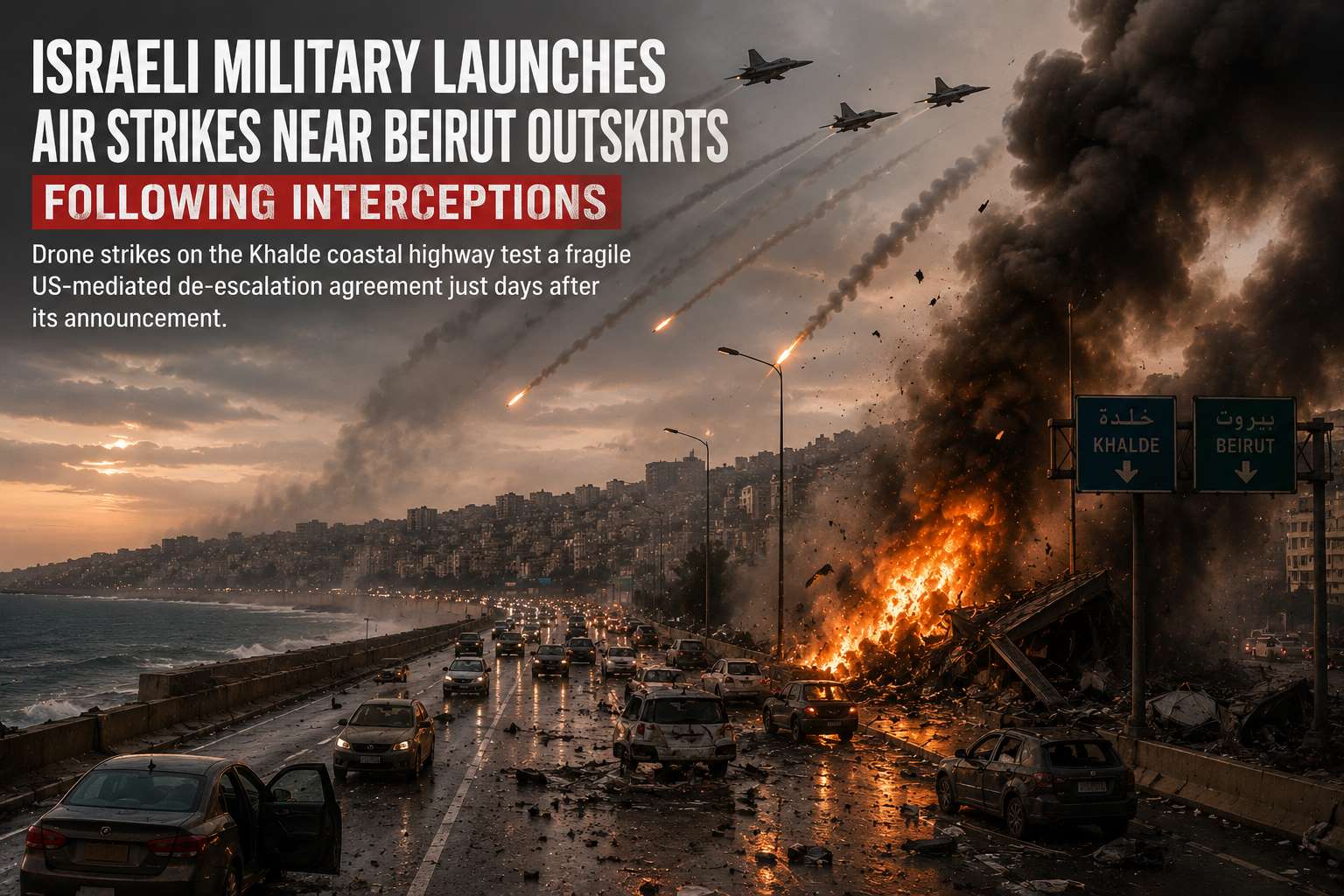
Drone strikes on the Khalde coastal highway test a fragile US-mediated de-escalation agreement just days after its announcement.
Publication Date: June 4, 2026
Last Updated: June 4, 2026
Byline: Global War News Editorial
BEIRUT; Israeli uncrewed aerial vehicles carried out a targeted strike just outside the southern perimeter of Beirut on Wednesday, wounding two people and rattling a highly sensitive, newly announced US-mediated understanding meant to spare the Lebanese capital. The operation marked the closest aerial bombardment to central Beirut in several weeks, occurring against a backdrop of continuing cross-border engagements in southern Lebanon.
According to Lebanese security and civil defense sources, the strike targeted a vehicle travelling along the primary coastal highway in the Khalde area, situated a few kilometres south of the capital city. The Lebanese Health Ministry confirmed that two individuals sustained injuries in the blast and were evacuated to a regional medical facility for treatment.
The aerial activity directly followed a statement from the Israel Defense Forces (IDF), which announced that military air shields had successfully intercepted a “hostile aircraft” alongside two separate projectiles crossing from Lebanese territory into northern Israel. An Israeli military spokesperson stated that the intercepted platform was highly likely a drone deployed by Hezbollah, though the political and military leadership of the Lebanon-based group did not immediately issue a formal claim of responsibility for the launch.
Escalation Sequence and Regional Impact
The strike in Khalde formed part of a broader, multi-tier aerial campaign across the country. Lebanese state media and emergency services reported that Israeli drone assets carried out a series of separate strikes hitting at least 10 vehicles across southern Lebanon on Wednesday.
The consequences of the wider operational push include the following recorded developments:
- Tyre Coastal Road: The Lebanese Health Ministry and state broadcasters reported that an Israeli drone strike hitting a vehicle near the coastal city of Tyre killed six people.
- Southern Towns and Displacements: Heavy artillery and secondary air strikes hit multiple border settlements, following explicit instructions issued by the IDF for residents of Nabatiyeh and six adjacent villages to evacuate their homes ahead of anticipated anti-Hezbollah operations.
- Frontline Engagements: Hezbollah command channels released a statement asserting that its defensive units executed 13 distinct tactical operations against Israeli forces advancing through a self-declared security zone inside southern Lebanon, alleging a direct guided-missile hit on a Merkava tank near Al-Bayyada.
According to data maintained by the Lebanese Health Ministry, the ongoing conflict since early March has resulted in nearly 3,500 fatalities across Lebanon, including more than 700 women, children, and medical workers. The ministry’s tracking data does not explicitly distinguish between civilian non-combatants and active military personnel. Conversely, official updates from Prime Minister Benjamin Netanyahu’s office state that 26 Israeli soldiers and four civilians have been killed in northern border areas and southern Lebanon since the current hostilities opened.
Context: The Fragile Diplomatic “Equation”
The recurrence of over-the-horizon operations near Beirut highlights the severe vulnerabilities embedded within international diplomatic mediation efforts. On Monday, US President Donald Trump had announced a preliminary understanding under which Israel would step back from its threatened full-scale bombardment of Beirut’s heavily populated southern suburbs, known as Dahiyeh, in exchange for a complete cessation of cross-border rocket salvos by Hezbollah.
The diplomatic initiative was designed to prevent a wider regional war from dissolving ongoing parallel truce negotiations in Washington. However, the temporary understanding has done little to calm the local population or stabilize the physical lines of contact.
The political context behind the escalating friction includes several key components:
- The Israeli Position: Israeli Defense Minister Israel Katz announced via his office that the persistence of any cross-border threats would instantly invalidate the geographic restrictions placed on air operations. Katz emphasized that the equation remains simple: if attacks on Israeli communities continue, the military will immediately resume heavy bombardments inside Dahiyeh.
- The Lebanese Position: Lebanese President Michel Aoun issued a public statement condemning the persistent aerial incursions, characterizing them as a fierce aggression against national sovereignty. Concurrently, Lebanese Parliament Chief Nabih Berri stated that a functional settlement remains conditional on a complete, verified cessation of all forward Israeli military incursions.
- The Iranian Position: The geopolitical stakes were amplified by statements from Tehran, where official media channels noted that Iran had suspended direct message exchanges with Washington regarding regional security parameters. The Iranian military warned that further unrest could prompt a direct intervention in support of its regional allies if the status of the Lebanese capital remains under active threat.
Analysis: Interceptor Volatility and Economic Sanctions Risks
Military observers note that the reliance on low-altitude uncrewed assets and fiber-optic guided technologies has fundamentally altered the defensive requirements of both states. While Israel’s iron dome and high-altitude air systems consistently suppress traditional rocket arrays, the frequent infiltration of low-signature, hard-to-detect drones continues to inflict localized casualties, prompting continuous, immediate retaliatory strikes to appease domestic political pressures.
From an economic perspective, the failure to transform short-term understandings into a binding ceasefire exerts direct pressure on regional maritime and energy logistics. Following the breakdown of preliminary Iranian-American diplomatic text exchanges on Monday, Brent crude futures advanced sharply, holding above 95 US dollars a barrel. Financial analysts indicate that the continuing threat of infrastructure damage near major transport corridors and the potential closure of maritime access points near the Levant keep insurance premiums for commercial shipping lines highly volatile, complicating broader international trade recovery efforts across the eastern Mediterranean.
What to Watch
Moving forward, international monitors are focusing on whether the strike in Khalde will trigger a wider retaliatory salvo from Hezbollah against metropolitan targets deep inside Israel, potentially ending the nominal restriction on Dahiyeh bombardments. Attention is also directed toward whether the ongoing round of direct talks in Washington can establish an independent, international monitoring mechanism to verify ceasefire compliance along the blue line. Finally, commodity markets will track whether continuing security threats to regional air corridors will lead to altered schedules for commercial carriers traversing the eastern Mediterranean.
Source Disclosure Note: This report incorporates verified public releases and field reporting provided by the Lebanese Ministry of Public Health, the Lebanese National News Agency, and the Israel Defense Forces communication branch. Additional context and tactical details were compiled from official statements by Israeli Defense Minister Israel Katz, Lebanese President Michel Aoun, and verified regional coverage from Reuters, the Associated Press (AP), Agence France-Presse (AFP), and Al-Monitor.
This article is based on publicly available reporting from named international news agencies and attributed official statements. All claims about ongoing events are attributed to their original sources. Analysis sections represent the editorial interpretation of reported facts and do not constitute advocacy for any party to the described conflict. AI tools may be utilized for image generation to assist in explaining complex concepts, as well as for refining grammar, spelling, and other linguistic enhancements. However, all original content is produced, fact-checked, and revised by the editorial team. This publication does not take political positions on active military conflicts.