
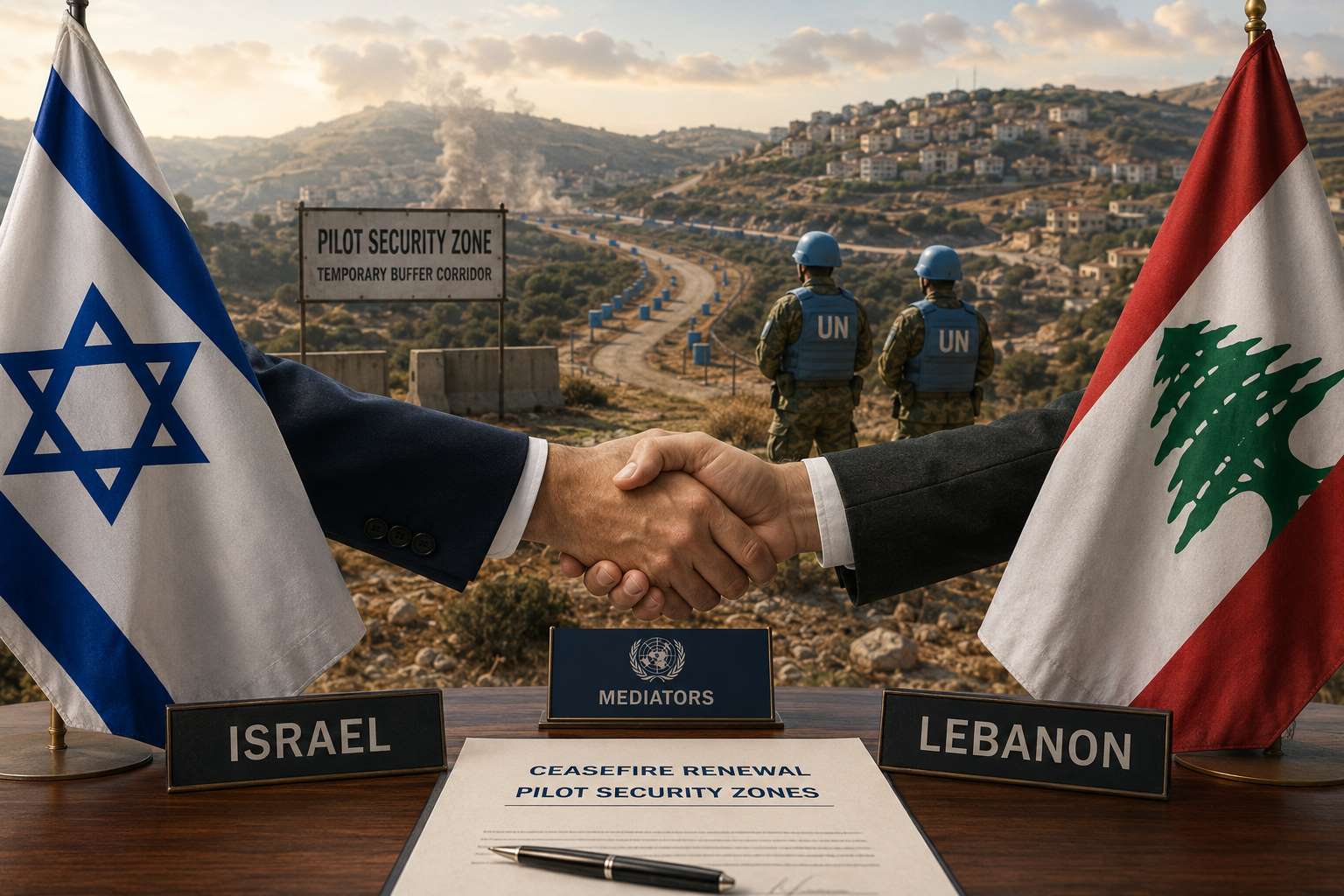
International mediators secure temporary truce renewal alongside experimental buffer corridors, though enforcement mechanisms remain contested.
Publication Date: June 4, 2026
Last Updated: June 4, 2026
Byline: Global War News Editorial
BEIRUT; Diplomatic representatives from Israel and Lebanon have formalised an agreement to renew a fragile, short-term ceasefire framework originally brokered in early April. The updated understanding includes the introduction of experimental, localized security zones along contested border sectors. It is intended to halt the recent surge in cross-border rocket salvos and low-altitude drone strikes that have threatened to draw the region into an unmanageable wider conflict.
According to statements released simultaneously by the Lebanese Prime Minister’s office and the Israeli Ministry of Defense, the renewed truce came into effect at midnight on Wednesday. United States and French mediators, who led the parallel negotiations in Washington and Paris over the preceding 72 hours, stated that the arrangement establishes a critical diplomatic buffer to prevent a full-scale breakdown of regional transport and energy infrastructure.
While both administrations have instructed their frontline units to hold their positions, the operational terms of the pilot security zones remain highly volatile. Lebanese authorities emphasized that the agreement preserves national sovereignty, while Israeli defense officials publicly warned that their air and ground forces maintain the right to launch immediate counter-strikes if uncrewed aerial vehicles or projectiles cross into northern Israeli territory.
Structure of the Pilot Security Zones
The core addition to the renewed truce framework is the establishment of three pilot security zones along the Blue Line, the UN-demarcated border corridor separating the two states. According to technical briefs published by the international mediation team, these experimental zones are designed to test localized stabilization measures before a comprehensive treaty can be negotiated.
The operational parameters of the security zones include several distinct elements:
- Geographic Scope: The pilot corridors cover three specific border sectors where frontline friction has been most acute over the past month: the Khiam valley, the outskirts of Bint Jbeil, and the coastal approach near Naqoura.
- Monitored Withdrawal: Under the text of the understanding, regular military personnel and armed groups are required to pull back heavy artillery and anti-tank guided missile installations five kilometres from the perimeter of these designated zones.
- Verification Mechanisms: An international oversight committee composed of United States, French, and United Nations Interim Force in Lebanon (UNIFIL) officers will deploy mobile monitoring teams and high-altitude surveillance assets to verify compliance within the pilot areas.
The Lebanese state news agency reported that Prime Minister Najib Mikati met with UNIFIL commanders in Beirut to coordinate the logistics of the monitoring deployment. Mikati stated publicly that the success of the pilot zones depends entirely on an immediate and complete cessation of foreign airspace incursions, referencing the frequent low-altitude drone flights over municipal areas.
Divergent Interpretations and Enforcement Discrepancies
Despite the formal announcement, public statements from the primary combatants reveal deep structural disagreements regarding how the truce terms will be enforced in everyday operational settings.
The political leadership of Hezbollah did not issue a formal written document endorsing the agreement. However, political figures aligned with the group indicated through Lebanese legislative channels that they would respect the temporary pause in cross-border operations as long as Israel adhered to the strict geographical limits placed on its air operations.
Conversely, speaking during a security briefing in Tel Aviv, Israeli Defense Minister Israel Katz stated that the military’s strategic objective has not changed. Katz asserted that the IDF will continue to conduct active surveillance and will not hesitate to eliminate forward missile launch sites or drone command centers if field units detect immediate threats, regardless of the nominal pilot zone boundaries. This position matches comments made by Prime Minister Benjamin Netanyahu, who remarked that any implementation of security corridors must guarantee the permanent, verifiable removal of hostile infrastructure from the immediate border area.
The geopolitical complexity is further compounded by shifting diplomatic postures outside the immediate theater. On Monday, official media channels in Tehran noted that Iran had temporarily suspended its direct channel of message exchanges with Western mediators regarding broader regional security parameters. This suspension has raised concerns among observers that localized tactical miscalculations along the Lebanese border could rapidly escalate without an active diplomatic safety valve.
Analysis: Interceptor Stockpiles and Maritime Logistics Risks
Military analysts note that the urgency behind the ceasefire renewal is closely tied to the shifting logistics of modern air defense. Months of multi-directional drone and missile exchanges have placed a continuous strain on global air defense interceptor stockpiles, such as the US-manufactured Patriot and Arrow networks. With Western defense production lines heavily extended due to competing military requirements across multiple international theaters, both regional actors and their international partners face real operational limits on their ability to sustain prolonged high-intensity air shields.
From an economic perspective, the temporary stabilization of the Levant border corridor brings direct relief to Eastern Mediterranean trade dynamics. Following the breakdown of preliminary truce text exchanges early last week, Brent crude futures shifted significantly, holding above 94 US dollars a barrel due to premium risks. Financial analysts indicate that while the announcement of the renewed truce caused a minor downward adjustment in energy futures, shipping and hull insurance rates for commercial vessels transiting the Levant Basin remain highly volatile. Commercial operators emphasize that until the pilot security zones transition into a permanent, internationally verified treaty, the underlying threat of sudden infrastructure damage will continue to complicate long-term maritime logistics and trade planning across the region.
What to Watch
Moving forward, international monitors are focusing on the first scheduled deployment of the US-French oversight teams into the Naqoura and Khiam sectors to see if physical monitoring stations can be established without local interference. Attention is also directed toward whether the Lebanese Armed Forces can successfully deploy supplementary brigades to patrol the pilot corridors as requested by international mediators. Finally, commodity markets will track compliance over the next 14 days, as any confirmed violation inside the pilot zones could trigger a resumption of deep-tier bombardments, instantly altering insurance risk profiles across Eastern Mediterranean transit lanes.
Source Disclosure Note: This report is compiled from official statements and public documentation issued by the Lebanese Prime Minister’s Office, the Israeli Ministry of Defense, and UNIFIL command structures. Additional contextual details and diplomatic developments were sourced from official press briefings by the US State Department, the French Foreign Ministry, and field dispatches from Reuters, the Associated Press (AP), and Agence France-Presse (AFP).
This article is based on publicly available reporting from named international news agencies and attributed official statements. All claims about ongoing events are attributed to their original sources. Analysis sections represent the editorial interpretation of reported facts and do not constitute advocacy for any party to the described conflict. AI tools may be utilized for image generation to assist in explaining complex concepts, as well as for refining grammar, spelling, and other linguistic enhancements. However, all original content is produced, fact-checked, and revised by the editorial team. This publication does not take political positions on active military conflicts.