
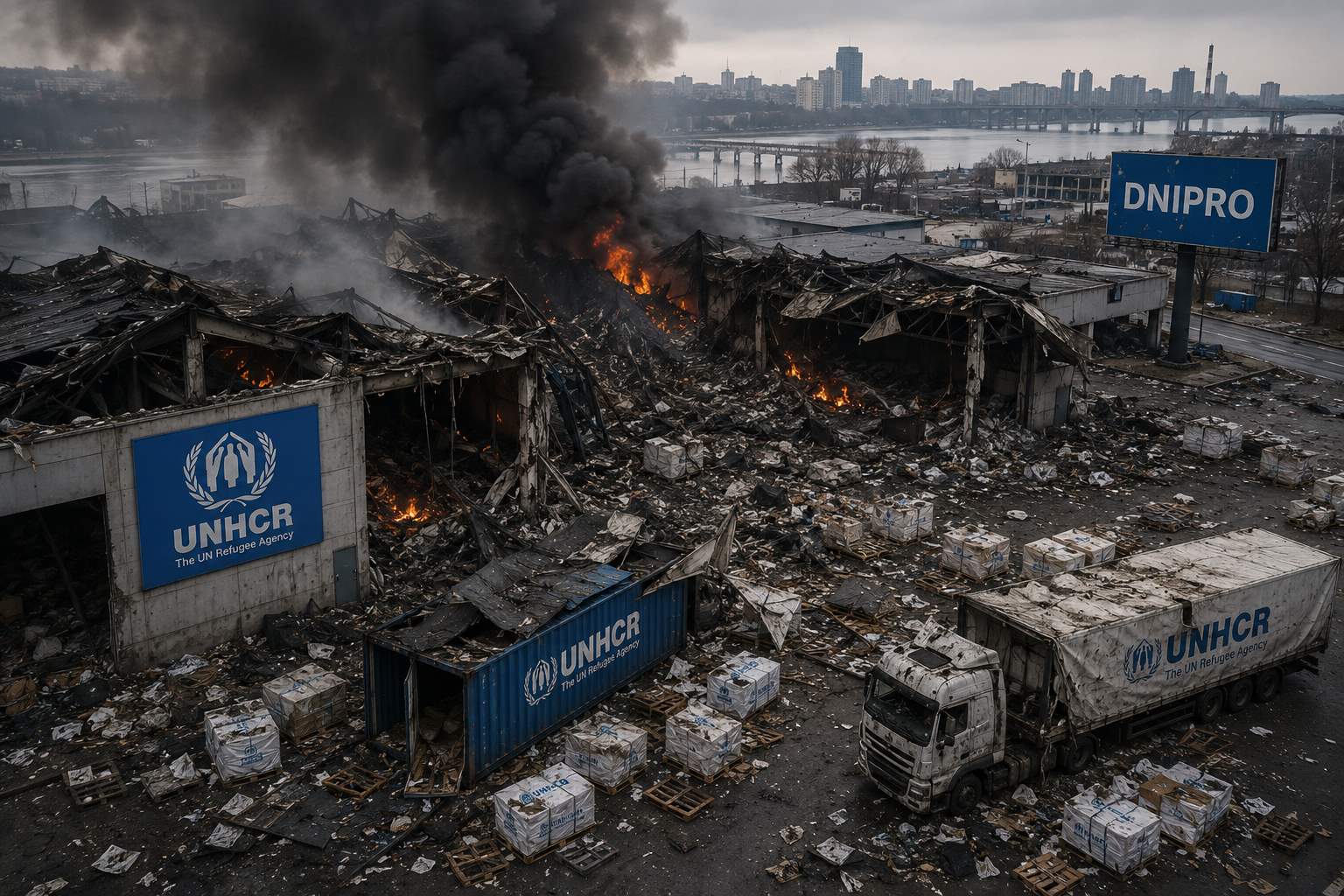
Ballistic missile strike demolishes a United Nations refugee agency logistics hub, wiping out emergency supplies destined for frontline zones and raising regional supply chain costs.
Published: May 22, 2026
Last Updated: May 22, 2026
Byline: Staff Writer, Global War News
A series of Russian missile and drone attacks targeting the central Ukrainian city of Dnipro has inflicted severe damage on international logistics networks, destroying more than 1 million USD worth of humanitarian aid. The strikes, which occurred overnight on May 19-20, 2026, directly hit a commercial warehouse contracted by the United Nations High Commissioner for Refugees (UNHCR).
The incident marks a significant escalation in the economic and operational toll levied against global aid infrastructure operating within the conflict zone. Beyond the loss of life, the destruction of large-scale supply reserves is expected to trigger immediate supply bottlenecks across neighboring frontline districts that rely on Dnipro as a central distribution gateway.
Local emergency teams and international observers spent the days following the strike assessing the structural and financial damage. The operational disruption forces global relief agencies to re-route vulnerable supply corridors, compounding insurance and logistics costs in an already strained wartime economy.
Direct Impacts on the Ground in Dnipro
According to an official public statement issued by Bernadette Castel-Hollingsworth, the UNHCR Representative in Ukraine, the warehouse facility was struck by a ballistic missile, which ignited a large-scale industrial fire. The UN agency confirmed that two warehouse workers lost their lives in the attack, and several civilian bystanders sustained injuries.
Preliminary assessments from the UN indicate that approximately 900 pallets of critical relief items were entirely consumed by the blaze. The destroyed inventory included heavy blankets, sleeping mats, emergency shelter materials, and hygiene kits.
The immediate local financial loss of the inventory is valued at more than 1 million USD. This figure does not include the structural value of the logistics complex or the specialized equipment required to manage large-scale distribution.
Separately, the head of the Dnipropetrovsk Oblast Military Administration, Oleksandr Hanzha, reported via his official media channels that concurrent aerial bombardments across the city damaged residential quarters, local industrial facilities, and educational infrastructure. The local administration noted that the continuous nature of the strikes created temporary disruptions to regional transit networks and emergency service deployments.
Context and Regional Logistics Vulnerabilities
Dnipro has long served as a critical economic and humanitarian node for eastern and southern Ukraine. Because of its geographic proximity to active frontlines in the Donbas and Zaporizhzhia regions, the city functions as the primary staging ground for international agencies delivering emergency resources to hundreds of thousands of displaced persons.
The targeted destruction of a major storage hub highlights a growing vulnerability for international non-governmental organizations and UN bodies operating inside Ukraine. Over the course of 2026, international analysts have noted a pattern of strikes impacting secondary infrastructure, including transport links, grain storage silos, and commercial warehouses used for non-military storage.
When warehouse capacity is compromised, agencies are forced to decentralize their storage or move operations further west, lengthening supply lines and increasing fuel consumption in a market heavily impacted by energy grid instability.
Analysis: The Broader Economic Fallout
From an economic perspective, the destruction of a 1 million USD aid cache carries implications well beyond the immediate loss of capital. Analysts suggest that the recurrent targeting of commercial infrastructure used by international entities will almost certainly drive up war-risk insurance premiums for civilian operations within Ukraine.
As insurance underwriters adjust their risk models to account for direct hits on UN-contracted facilities, the cost of securing commercial real estate, shipping fleets, and logistics labor is projected to rise. This premium increase effectively lowers the purchasing power of international aid budgets, as a larger percentage of global donations must be diverted toward security, risk mitigation, and transport overhead.
Furthermore, replacing 900 pallets of specialized goods requires navigating highly competitive European manufacturing and transport markets. Because emergency blankets, medical supplies, and temporary shelter materials are often procured on tight schedules, sudden bulk replacements can trigger short-term price volatility among regional suppliers in neighboring Poland, Romania, and Slovakia.
The loss also places an immediate strain on local municipal budgets, which must redirect utility workers and structural engineers to clear industrial debris and secure weakened industrial zones, diverting resources away from standard economic recovery projects.
Outlook and What to Watch
Moving forward, international observers will be closely monitoring how global agencies adapt their logistical footings in response to direct infrastructural exposure. The UNHCR has stated that it is currently in dialogue with Ukrainian authorities and alternative commercial partners to locate secure warehouse space and replenish the destroyed stock.
The key indicators to watch in the coming weeks include whether international organizations begin shifting their primary distribution hubs away from central Ukrainian hubs like Dnipro to western regions, and how such moves might slow down emergency response times along the perimeter of the conflict zone.
Additionally, the willingness of commercial transport companies to service eastern regions without substantial price hikes will serve as a bellwether for the perceived stability of Ukraine’s internal trade routes.
Source Disclosure Note: This report relies on primary source data and official statements, including the formal press release issued by the UNHCR Representative in Ukraine on May 20, 2026, official situational updates from the United Nations Office for the Coordination of Humanitarian Affairs (OCHA), and localized damage reports published by the Dnipropetrovsk Oblast Military Administration. Supplemental regional context was drawn from verified international wire dispatches by Reuters and BBC News tracking infrastructure impacts in May 2026.
This article is based on publicly available reporting from named international news agencies and attributed official statements. All claims about ongoing events are attributed to their original sources. Analysis sections represent the editorial interpretation of reported facts and do not constitute advocacy for any party to the described conflict. AI tools may be utilized for image generation to assist in explaining complex concepts, as well as for refining grammar, spelling, and other linguistic enhancements. However, all original content is produced, fact-checked, and revised by the editorial team. This publication does not take political positions on active military conflicts.