
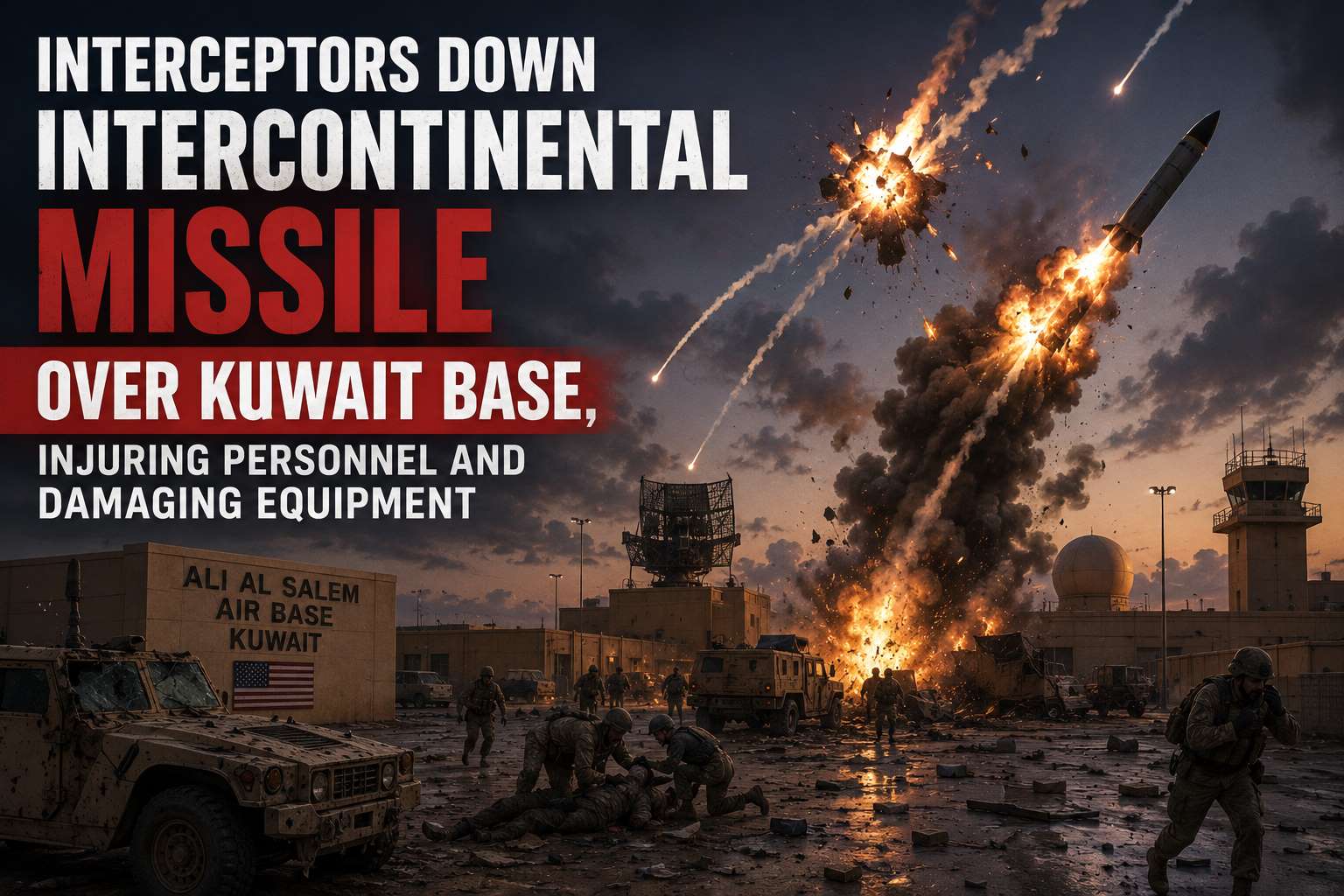
Shrapnel and falling debris from a mid-air engagement damage structural facilities and maintenance hangars at Ali Al Salem Air Base, marking a dangerous geographic expansion of the Persian Gulf security crisis.
Publication Date: June 2, 2026
Last Updated: June 2, 2026
Byline: Global War News Editorial
KUWAIT CITY: Advanced air defense systems operating at a key international military facility in Kuwait intercepted an inbound ballistic missile during the early hours of Tuesday. The engagement marks the first direct targeting of an international installation inside Kuwait since regional hostilities erupted in late February.
According to a formal statement released by U.S. Central Command (CENTCOM) on Tuesday morning, integrated theater air defense batteries successfully tracked and neutralized a single medium-range ballistic missile launched from an unconfirmed location within western Iran. The intercept occurred directly over the perimeter of Ali Al Salem Air Base, an installation located approximately 50 kilometers west of the Iraqi border that hosts both Kuwaiti Air Force units and elements of the U.S. Ninth Air Force.
While the primary warhead was destroyed in mid-air, falling debris and heavy metallic shrapnel impacted the base’s secondary logistics zone. CENTCOM confirmed that three service personnel suffered non-life-threatening injuries from shattered glass and structural fragments, while two maintenance hangars and a ground-based communications array sustained moderate physical damage. Kuwaiti defense officials confirmed that operations at the airfield were temporarily paused for four hours to clear runway debris before normal transport traffic resumed.
The Dynamics of the Mid-Air Engagement
The operational profile of the strike suggests a deliberate attempt to penetrate the highly coordinated defensive network guarding the northern sector of the Arabian Peninsula. Military officials provided preliminary details regarding the timeline of the intercept:
- Early Detection and Tracking: According to statements from the Kuwaiti Ministry of Defense, early warning radar networks detected the missile’s high-altitude trajectory shortly after launch. The technical telemetry indicated an incoming speed and arc characteristic of an intermediate-class liquid-fueled ballistic vector.
- The Interception Sequence: Defense assets, including terminal high-altitude batteries and Patriot PAC-3 interceptors stationed at the perimeter, engaged the threat as it commenced its atmospheric re-entry phase. Visual tracking confirmed a successful detonate-on-impact engagement at an altitude exceeding 25,000 meters.
- Debris Field Distribution: The high-altitude collision resulted in a wide fragmentation zone. Emergency response teams at Ali Al Salem reported that while the lethal explosive payload was completely neutralized, heavy structural components of the rocket casing impacted the base’s western vehicle depot, triggering localized fuel fires that were brought under control by military personnel within 40 minutes.
Escalating Regional Pressures and Strategic Warnings
The expansion of active strikes into Kuwaiti territory follows repeated warnings from regional defense networks concerning the broader spillover of the conflict. On May 30, independent analysts at the Soufan Center published an assessment indicating that as the U.S.-led naval blockade chokes off commercial maritime traffic through the Strait of Hormuz, opposing forces would likely expand their target profiles to include logistics and supply hubs located outside the immediate theater of war.
Ali Al Salem Air Base serves as a vital intra-theater transit node, facilitating the movement of personnel, cargo, and aerial refueling assets across the entire Middle East region. By targeting this specific facility, the attacking forces have demonstrated an intent to disrupt the logistical backing that sustains the international naval embargo currently operating in the Gulf of Oman.
The geopolitical response from Kuwait City was immediate. The Kuwaiti government issued an official diplomatic note condemning the strike as an unprovoked violation of its sovereign airspace and a direct threat to domestic civilian security. The statement confirmed that while Kuwait maintains a policy of absolute neutrality regarding the active bilateral war between Washington and Tehran, it will take all necessary sovereign military actions to defend its borders and critical national infrastructure.
ANALYSIS: The Strategic Meaning of the Kuwait Vector
The intercept over Ali Al Salem Air Base reveals a critical shift in the geography of the current war. For the past three months, kinetic engagements have been largely confined to maritime corridors, specialized shipping networks, and localized cross-border strikes near immediate frontlines. By launching a heavy ballistic asset toward Kuwait, the firing authority has signaled that traditional regional safe zones are no longer exempt from the conflict’s architecture.
From a tactical standpoint, the attack highlights the strengths and vulnerabilities of theater air defenses. The successful destruction of the missile body demonstrates that integrated systems like the Patriot PAC-3 are highly capable of neutralizing high-speed ballistic threats. However, the resulting structural damage and personnel injuries on the ground remind observers that an interception is not a clean erasure of a weapon; it is a redirection of force. When an interception occurs directly over a concentrated military facility, the sheer volume of falling kinetic debris can achieve significant damage without a warhead detonation.
The strategic calculations for Kuwait are deeply complicated. The state hosts thousands of international personnel under established bilateral defense pacts, yet its broader foreign policy relies on maintaining diplomatic balance with all regional neighbors. If external factions continue to classify facilities on Kuwaiti soil as active co-belligerent nodes due to the logistics flights they support, Kuwait City will face mounting domestic pressure to either demand stricter operational limits on foreign forces or significantly ramp up its own long-range defensive procurement pipelines from Western manufacturers.
What to Watch Next
As military clean-up operations conclude at the installation, three specific developments will dictate whether this incident leads to a broader escalation:
- Changes in Counter-Battery Proximity: Whether Western forces retaliate against the specific launch facilities identified within western Iran, or if they rely purely on defensive containment to preserve ongoing 60-day truce negotiations.
- Deployment of Additional Air Defenses: Whether CENTCOM and regional allies alter their deployment patterns by sending supplementary naval-based Aegis systems into the northern Persian Gulf to intercept missiles earlier in their boost phase.
- Diplomatic Alignment of Fragmented Alliances: How neighboring Gulf Cooperation Council (GCC) states adjust their joint early-warning data networks in response to the clear expansion of the target zone beyond the immediate maritime theaters.
Source Disclosure Note: This report utilizes verified tactical data from U.S. Central Command (CENTCOM) operational briefings, official sovereignty statements from the Kuwaiti Ministry of Defense, telemetry insights published by the Institute for the Study of War (ISW), and regional reporting from the Associated Press and Reuters.
This article is based on publicly available reporting from named international news agencies and attributed official statements. All claims about ongoing events are attributed to their original sources. Analysis sections represent the editorial interpretation of reported facts and do not constitute advocacy for any party to the described conflict. AI tools may be utilized for image generation to assist in explaining complex concepts, as well as for refining grammar, spelling, and other linguistic enhancements. However, all original content is produced, fact-checked, and revised by the editorial team. This publication does not take political positions on active military conflicts.