
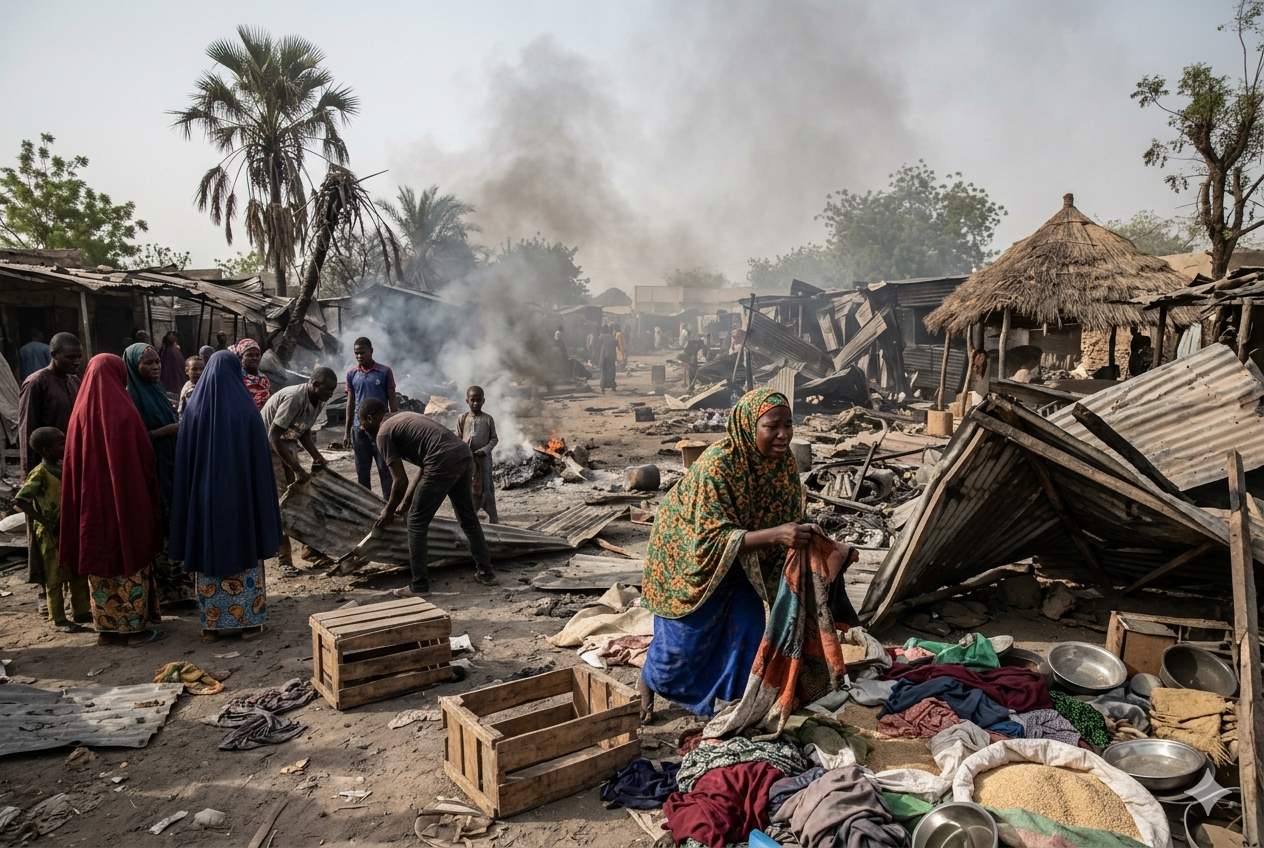
Regional authorities and witnesses report multiple fatalities in Borno State during operations targeting insurgent groups
May 13, 2026
Last updated: 23:45 GMT
By Global War News Editorial
Authorities in Nigeria’s northeastern Borno State have reported that a military airstrike hit a crowded local market on Tuesday, resulting in a significant number of civilian deaths and injuries. Local community leaders and health officials stated that the incident occurred in a village near the border with Niger, an area where the Nigerian military has been conducting sustained operations against insurgent factions, including Boko Haram and the Islamic State West Africa Province (ISWAP).
According to a report by Reuters, at least 25 people were killed in the blast, though local residents suggest the final toll could be higher as many remains were recovered from the debris of market stalls. The Nigerian Air Force (NAF) issued a brief statement confirming that “air interdiction missions” were carried out in the region against known terrorist hideouts but did not initially confirm or deny the reports of civilian casualties.
The incident has triggered a wave of concern regarding the precision of aerial operations in populated rural areas. While the military maintains that such strikes are essential to disrupting insurgent supply lines, human rights monitors have repeatedly warned of the humanitarian cost associated with the use of heavy ordnance near civilian infrastructure.
Details of the Incident and Response
According to witnesses who spoke to the Associated Press (AP), the strike occurred during the peak hours of a weekly trade market. Survivors described a sudden explosion that destroyed several permanent structures and dozens of temporary stalls. “There were no militants in the market at that moment, only traders and farmers,” a local traditional leader stated in a public remark on record.
The Nigerian Ministry of Defence has announced that a formal board of inquiry will be established to investigate the circumstances of the mission. A spokesperson for the military, Brigadier General Tukur Ibrahim, stated that the air force “takes every precaution to avoid collateral damage” and that any loss of innocent life is “deeply regretted.”
Independent monitors from the Center for Civilians in Conflict (CIVIC) noted that this is the third reported incident of “erroneous” targeting in the northeast within the last six months. The organization has called for greater transparency in the military’s after-action reports and for a more robust compensation mechanism for the families of the victims.
Regional and Economic Context
The northern Borno region is already suffering from a protracted humanitarian crisis, with millions of people dependent on local markets for survival as large-scale agriculture remains dangerous due to the insurgency. Analysts suggest that incidents such as the market strike further destabilize the local economy by discouraging trade and increasing the displacement of rural populations toward provincial capitals.
The United Nations Office for the Coordination of Humanitarian Affairs (OCHA) reported that the area surrounding the strike is home to several thousand internally displaced persons (IDPs). The destruction of the market is expected to lead to immediate localized food shortages and a spike in the prices of basic commodities, as merchants may now fear traveling to the region.
Furthermore, the incident complicates the federal government’s efforts to win the “hearts and minds” of the local population. Observers note that civilian casualties resulting from state action are frequently used as recruitment tools by insurgent groups, who frame the military as an indiscriminate force.
Analysis: Operational Challenges and Accountability
The reported airstrike raises questions about the intelligence-gathering processes used to designate targets in the northeast. While drone surveillance and human intelligence are frequently cited as the basis for these missions, the density of the civilian population in rural markets presents a persistent tactical challenge for the NAF.
“The difficulty lies in the blurred lines between insurgent movements and civilian transit in these border zones,” noted a security analyst specializing in West African conflict. “However, the repeated nature of these incidents suggests a systemic failure in verifying targets before ordnance is released.”
It remains unclear whether the findings of the military’s board of inquiry will be made public. Historically, internal investigations into civilian harm in Nigeria have faced criticism for a lack of external oversight. The international community, including major partners that provide military hardware and training to Nigeria, is likely to increase pressure on Abuja to implement more stringent rules of engagement for air operations in populated areas.
Source Disclosure Note: This report is based on statements from the Nigerian Ministry of Defence, reporting from Reuters and the Associated Press (AP), and data provided by the UN Office for the Coordination of Humanitarian Affairs (OCHA) and the Center for Civilians in Conflict (CIVIC).
This article is based on publicly available reporting from named international news agencies and attributed official statements. All claims about ongoing events are attributed to their original sources. Analysis sections represent the editorial interpretation of reported facts and do not constitute advocacy for any party to the described conflict. AI tools may be utilized for image generation to assist in explaining complex concepts, as well as for refining grammar, spelling, and other linguistic enhancements. However, all original content is produced, fact-checked, and revised by the editorial team. This publication does not take political positions on active military conflicts.