
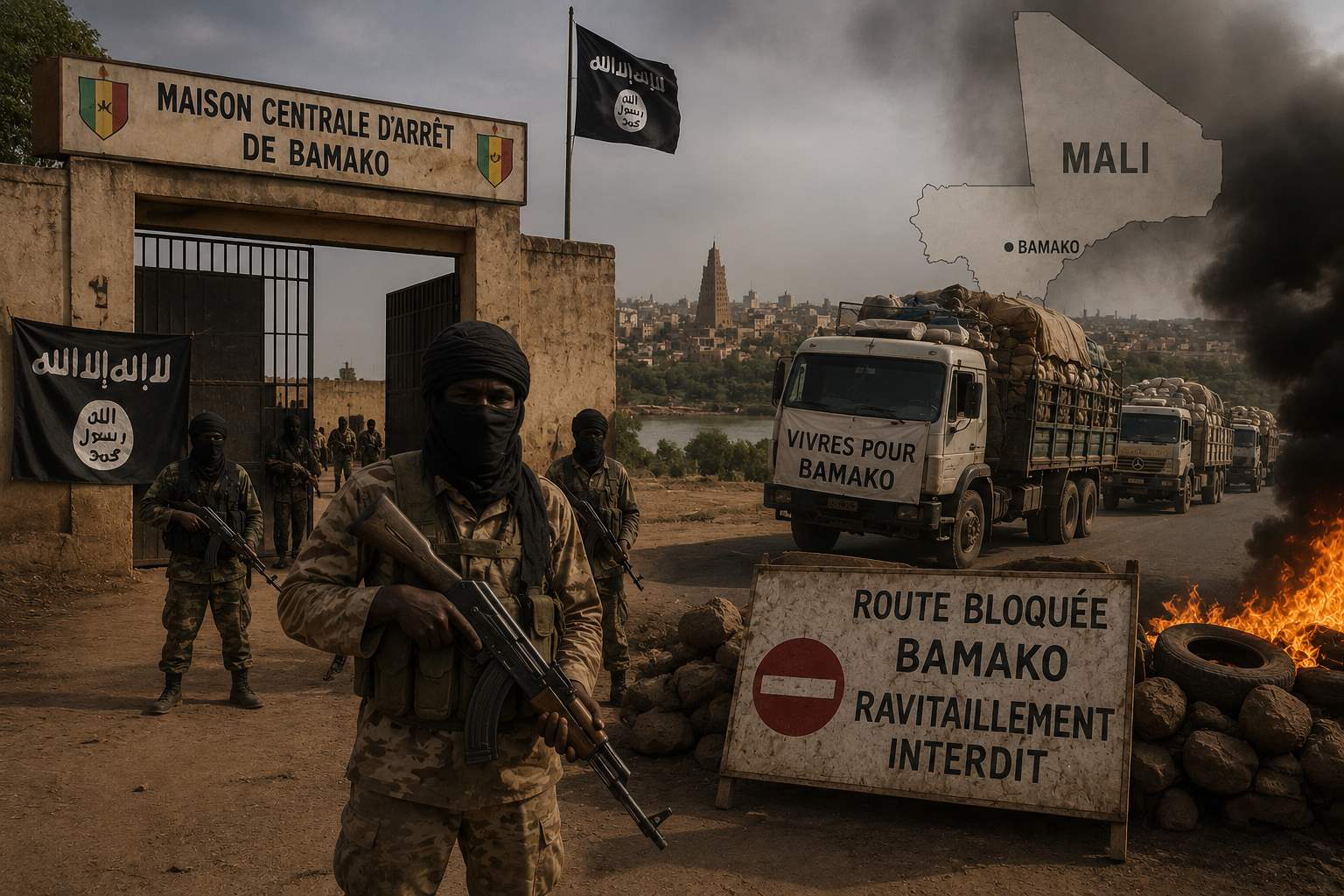
A significant tactical shift in the Sahel conflict sees militants targeting urban logistics and food security hubs.
May 8, 2026
Global War News Editorial
Mali’s security situation has faced a sharp deterioration as fighters linked to al-Qaeda’s regional affiliate, the Group for the Support of Islam and Muslims (JNIM), reportedly seized a major prison facility and established roadblocks on primary supply routes leading to the capital, Bamako. The escalation marks a tactical pivot for the insurgency, moving beyond rural skirmishes to directly threaten the logistical stability of the nation’s largest urban center.
According to reports from Reuters and local observers in the region, the militants overran a detention center located on the outskirts of the capital during the early hours of Thursday. While the Malian transitional government has not yet released an official tally of escapees, unverified local reports suggest that several high-profile detainees may have been freed during the raid.
Siege Tactics and Food Security
In a simultaneous operation, JNIM fighters have reportedly established mobile checkpoints along the RN6 and RN7 highways, which serve as the primary conduits for food and fuel entering Bamako from the south and east. The World Food Programme (WFP) issued a statement on Friday expressing “grave concern” over the disruption, noting that Bamako relies heavily on these corridors for grain and livestock supplies.
Analysts have noted that this “stranglehold” strategy appears designed to incite domestic pressure on the ruling military junta by driving up the cost of living. “By targeting the capital’s stomach rather than just its periphery, the group is attempting to demonstrate the government’s inability to protect basic civilian needs,” observed a regional analyst from the International Crisis Group.
The Government Response
The Malian Armed Forces (FAMa) stated via social media that “operations are underway to restore order” and that additional reinforcements have been deployed to the affected corridors. However, official communication regarding the status of the prison remains limited.
This latest surge in violence follows the withdrawal of UN peacekeeping forces (MINUSMA) and the departure of French military assets in previous years, leaving security responsibilities primarily to the Malian state and its international partners, including Russian private military contractors. According to the Associated Press, the presence of these contractors has been a point of contention, with human rights organizations alleging that the intensifying conflict is exacerbating the humanitarian crisis in central and northern Mali.
Analysis: A Shift to Urban Insurgency
The seizure of a prison facility near the capital suggests an advanced level of intelligence and coordination by JNIM. Historically, al-Qaeda-linked groups in the Sahel have operated in the remote “triple border” region between Mali, Burkina Faso, and Niger. Moving operations toward Bamako indicates an effort to capitalize on the security vacuum created by shifting international alliances.
The economic implications are immediate. If the blockade persists, inflation in Bamako, which was already projected by the IMF to remain high through 2026, could spike as traders struggle to bypass the militant-held checkpoints. It remains unclear whether the Malian military has the logistical capacity to maintain a prolonged multi-front counter-offensive while also securing the capital’s interior.
Outlook
The international community is watching closely to see if the Economic Community of West African States (ECOWAS) or other regional bodies will offer mediated support. For now, the focus remains on the RN6 and RN7 highways. The ability of the Malian state to reopen these roads within the next 48 to 72 hours will likely determine the severity of the impending food shortage in the capital.
Source Disclosure: Reporting from Reuters, the Associated Press, and Al Jazeera. Official statements from the Malian Armed Forces (FAMa) and the World Food Programme (WFP). Analysis provided by regional security observers.
This article is based on publicly available reporting from named international news agencies and attributed official statements. All claims about ongoing events are attributed to their original sources. Analysis sections represent the editorial interpretation of reported facts and do not constitute advocacy for any party to the described conflict. AI tools may be utilized for image generation to assist in explaining complex concepts, as well as for refining grammar, spelling, and other linguistic enhancements. However, all original content is produced, fact-checked, and revised by the editorial team. This publication does not take political positions on active military conflicts.