
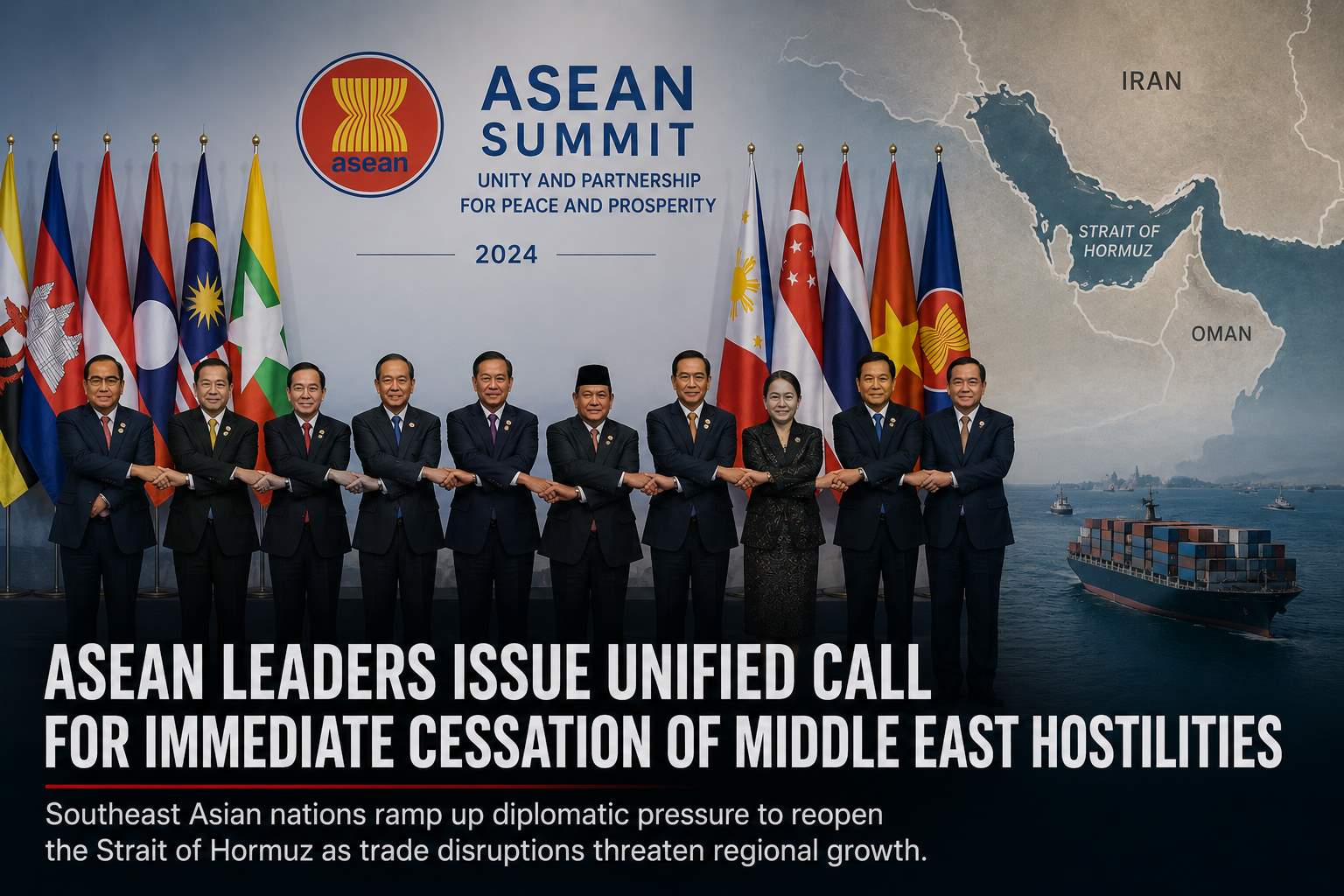
Southeast Asian nations ramp up diplomatic pressure to reopen the Strait of Hormuz as trade disruptions threaten regional growth.
May 8, 2026
Global War News Editorial
By Staff Writer, Global War News
Leaders of the Association of Southeast Asian Nations (ASEAN) have issued a rare unified statement calling for an immediate and unconditional cessation of hostilities in the Middle East. The joint declaration, released following an emergency summit in Jakarta on Friday, underscores the growing alarm among Southeast Asian economies regarding the prolonged closure of the Strait of Hormuz and its cascading impact on global supply chains.
The statement, signed by all ten member states, emphasizes the “urgent necessity” of restoring maritime security and ensuring the unhindered flow of energy and commercial goods. While ASEAN traditionally adheres to a policy of non-interference in extra-regional conflicts, the 69-day war between the United States and Iran has forced a strategic pivot as member states face rising domestic inflationary pressures.
Economic Stakes for Southeast Asia
The blockade of the Strait of Hormuz has had a direct and measurable impact on the energy security of the ASEAN bloc. According to data from the Asian Development Bank (ADB), several member states, including Thailand and the Philippines, have seen energy import costs rise by more than 22% since hostilities began in February.
In his opening remarks, Indonesian President Prabowo Subianto stated that the region cannot remain a “silent bystander” while the global economy is pushed toward a recession. “The stability of our own development is inextricably linked to the freedom of navigation in the Middle East,” President Subianto said, according to a transcript provided by the Indonesian State News Agency (Antara).
Diplomatic Mediation Efforts
The ASEAN declaration coincides with reports that the bloc is seeking to coordinate with other neutral powers, including Pakistan and Brazil, to bolster ongoing mediation efforts. While the United States and Iran are currently reviewing a draft proposal facilitated by Islamabad, ASEAN leaders expressed concern that recent kinetic escalations in the Strait could derail the diplomatic window.
The unified call also highlights a subtle shift in regional alignment. Observers note that the statement avoids assigning direct blame to either Washington or Tehran, instead focusing on the “collective responsibility” of all parties to prevent a total collapse of international trade norms. As reported by the Straits Times, Singapore’s Ministry of Foreign Affairs stressed that as a hub for global shipping, the city-state views the current maritime insecurity as a fundamental threat to the “rules-based international order.”
Analysis: A New Voice in Global Mediation
The emergence of ASEAN as a unified diplomatic voice in the Middle East conflict reflects the reality of a multipolar world where regional blocs are no longer willing to wait for major powers to resolve disputes that have global consequences. Analysts suggest that this “middle-power diplomacy” is intended to provide a face-saving exit for both primary combatants by framing de-escalation as a response to the needs of the global south.
However, questions remain regarding how much leverage ASEAN truly holds. While the bloc represents a significant collective economy, it lacks the military or financial instruments to enforce a maritime truce. According to a research note from the ISEAS-Yusof Ishak Institute, the success of this diplomatic push depends entirely on whether the United States and Iran view ASEAN’s concerns as a significant enough political cost to alter their current military postures.
Outlook
The ASEAN Secretariat confirmed that a delegation is scheduled to meet with UN officials in New York next week to present the joint declaration. Meanwhile, domestic markets in Malaysia and Vietnam are reacting cautiously to the news, with analysts watching for any signs that this diplomatic pressure will expedite the reopening of the Strait. For now, the region remains in a state of “wait and see” as the 30-day negotiation window continues to tick down.
Source Disclosure: Reporting from Reuters, the Straits Times, Antara (Indonesian State News Agency), and the Asian Development Bank (ADB). Official statements from the ASEAN Secretariat and the Singapore Ministry of Foreign Affairs.
This article is based on publicly available reporting from named international news agencies and attributed official statements. All claims about ongoing events are attributed to their original sources. Analysis sections represent the editorial interpretation of reported facts and do not constitute advocacy for any party to the described conflict. AI tools may be utilized for image generation to assist in explaining complex concepts, as well as for refining grammar, spelling, and other linguistic enhancements. However, all original content is produced, fact-checked, and revised by the editorial team. This publication does not take political positions on active military conflicts.