
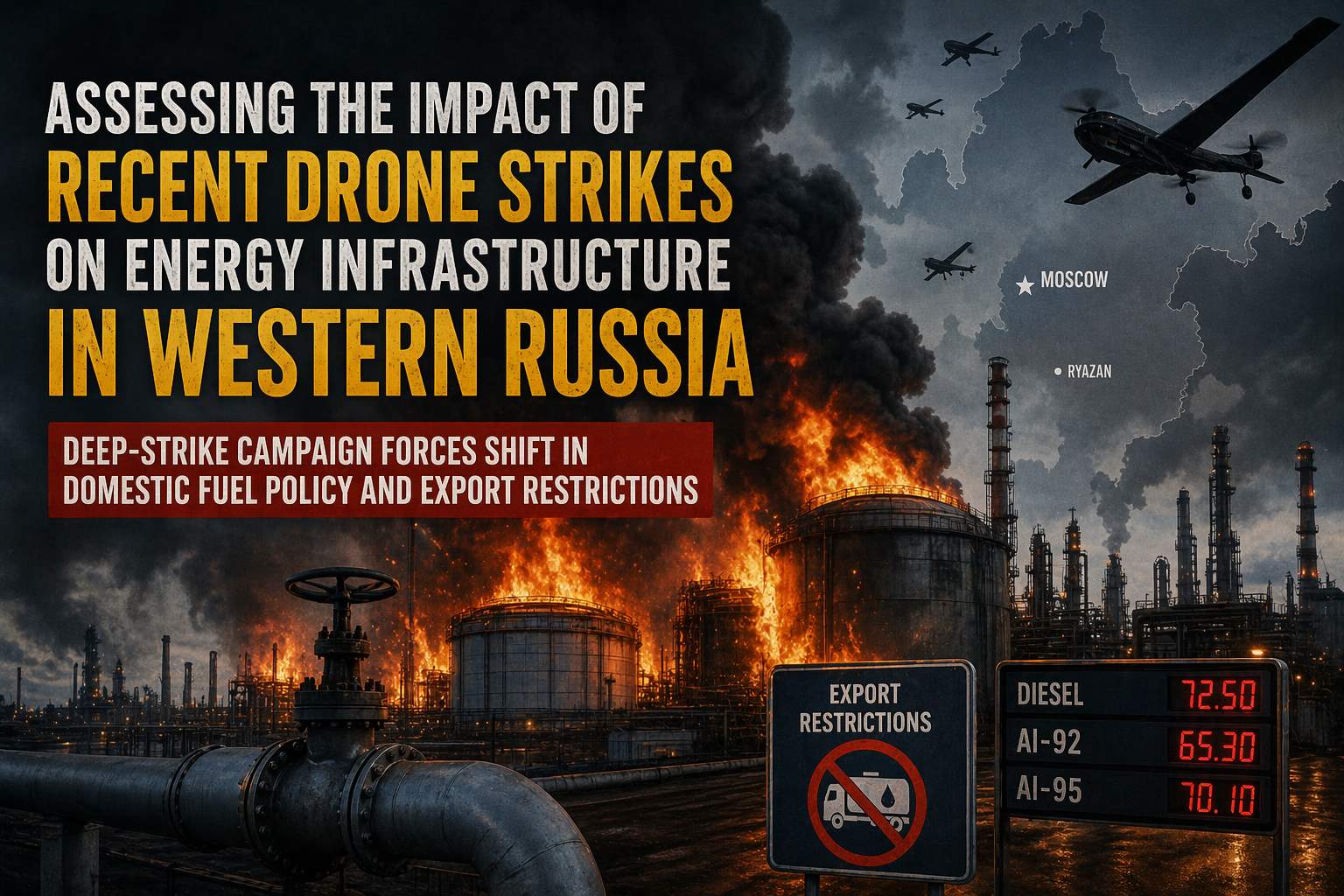
Deep-strike campaign forces shift in domestic fuel policy and export restrictions
April 24, 2026
Last Updated: 15:45 UTC
By Staff Writer, Global War News
A sustained campaign of long-range drone strikes targeting energy infrastructure in Western Russia has led to significant disruptions in regional fuel logistics and forced the Russian government to implement emergency economic measures. According to reports from international news agencies and geolocated satellite imagery, multiple refineries and export terminals have sustained damage since late March 2026, leading to the sharpest monthly decline in Russian oil production since 2020.
The strikes have primarily focused on primary processing units—expensive, complex components that are difficult to replace under current international sanction regimes. These disruptions have prompted Moscow to ban gasoline exports until late July 2026 to stabilize a domestic market facing rising wholesale prices and localized supply shortages.
Damage Assessment: Refineries and Terminals
During the first three weeks of April, several high-capacity facilities reported incidents. According to Reuters and local regional governors, the Rosneft-operated Novokuibyshevsk refinery in the Samara region reportedly halted primary processing operations on April 18 following a drone strike. This facility alone has an annual capacity of approximately 8.8 million metric tons.
Further north, satellite photography analyzed by Al Jazeera suggests that export infrastructure at the Baltic ports of Primorsk and Ust-Luga sustained damage earlier in the month. Reports indicate that Primorsk may have lost up to 40% of its storage capacity, while gas condensate processing at Ust-Luga was temporarily suspended.
The cumulative effect of these strikes is substantial. Industry sources told Reuters that Russia was forced to slash oil production by an estimated 300,000 to 400,000 barrels per day in April. Analysts note that these strikes are increasingly timed to coincide with seasonal maintenance windows, compounding the technical challenges faced by plant engineers.
Regional Logistics and Domestic Market Impact
The physical damage to refineries has created a “bottleneck” effect in Western Russia’s fuel distribution network. As primary processing units go offline, the ability to convert crude oil into usable gasoline and diesel diminishes, even if crude stocks remain high.
- Price Volatility: Data from the St. Petersburg International Mercantile Exchange showed that wholesale gasoline prices rose by nearly 7% in a single week in February, with subsequent spikes recorded in April as news of the Novokuibyshevsk outage circulated.
- Export Restrictions: To prevent these costs from reaching the consumer level, the Russian government issued a decree banning gasoline exports effective April 1, 2026. This ban, according to a statement by Deputy Prime Minister Alexander Novak, is intended to ensure priority supply for the domestic agricultural sector during the spring sowing season.
- Logistics Rerouting: With several Western refineries operating at reduced capacity, fuel must be transported over longer distances from Siberian facilities. This has reportedly increased the burden on the Russian railway network, which is already heavily utilized for military logistics.
Analysis: The Economic “War of Attrition”
Analysts have suggested that the current drone campaign represents a shift toward economic attrition. By targeting the “revenue engines” of the state, the strikes aim to diminish the windfall profits Russia has recently seen due to high global oil prices—which traded near $130 per barrel in March 2026 following unrelated disruptions in the Middle East.
Observers note that while the Russian economy has shown resilience, the cost of repairing specialized refinery equipment is rising. It remains unclear whether Russian industry can secure the necessary precision components to return these facilities to full capacity while under strict Western technology sanctions. For now, the strategy appears to be focused on maintaining domestic social stability through export bans at the expense of international energy revenue.
Closing Summary
The recent strikes on Western Russian energy infrastructure have moved the conflict’s economic consequences from the treasury to the petrol pump. While the government has acted to shield citizens through export bans, the long-term integrity of the refining sector remains under pressure. As of late April, the frequency of these long-range operations shows no sign of diminishing, suggesting that energy security will remain a primary point of friction for the foreseeable future.
Sources: This report is based on reporting from Reuters, Al Jazeera, The Moscow Times, and the International Energy Agency (IEA). Damage assessments were cross-referenced with satellite imagery analysis and official statements from Russian regional governors and the Ministry of Energy.
This article is based on publicly available reporting from named international news agencies and attributed official statements. All claims about ongoing events are attributed to their original sources. Analysis sections represent the editorial interpretation of reported facts and do not constitute advocacy for any party to the described conflict. AI tools may be utilized for image generation to assist in explaining complex concepts, as well as for refining grammar, spelling, and other linguistic enhancements. However, all original content is produced, fact-checked, and revised by the editorial team. This publication does not take political positions on active military conflicts.