
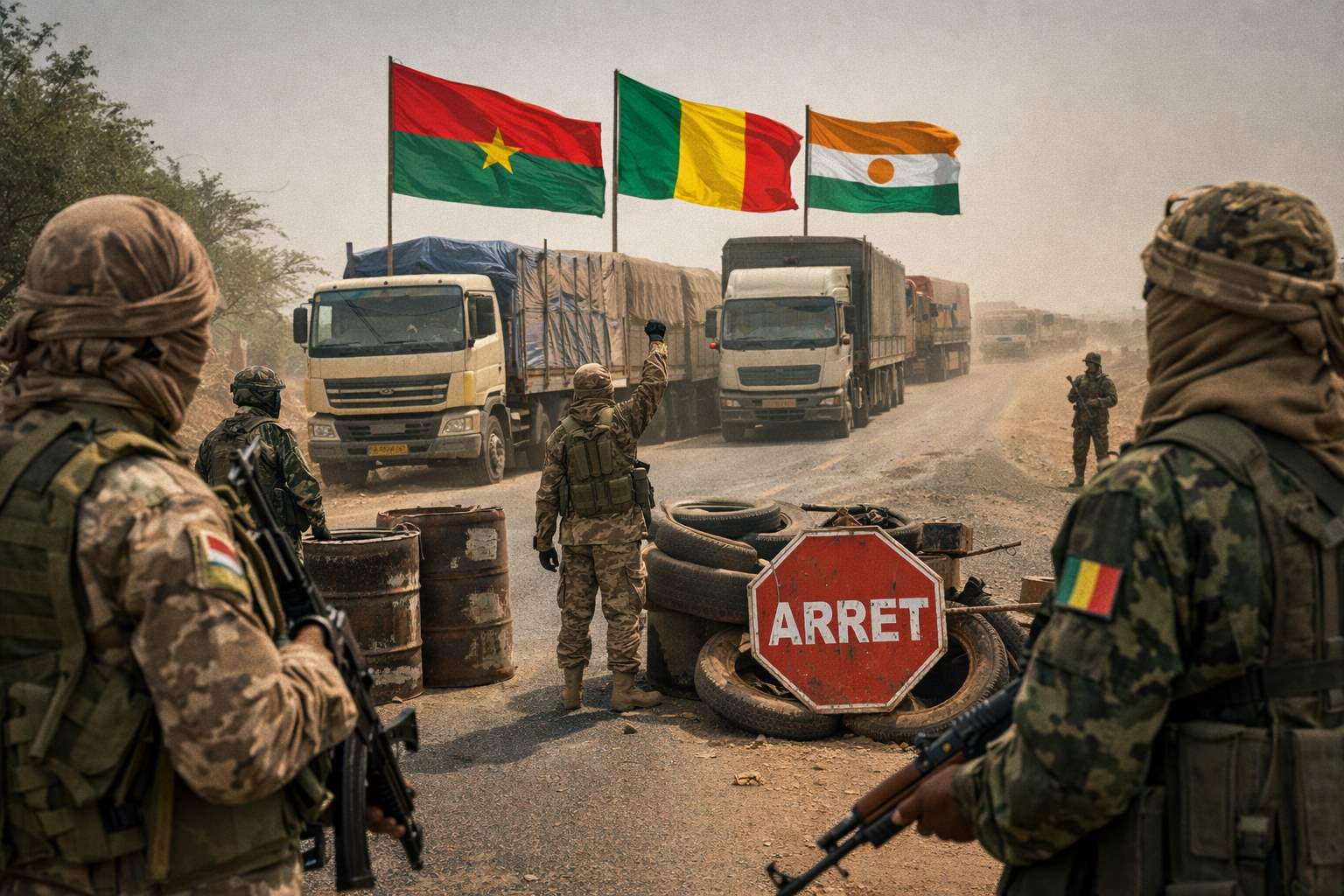
Armed blockades and the pivot toward new coastal corridors redefine the “Alliance of Sahel States” economic survival strategy.
May 4, 2026
Last Updated: May 4, 2026
By Staff Writer, Global War News
Logistics and supply chain stability across the Central Sahel have reached a critical inflection point as of May 2026. The Alliance of Sahel States (AES), comprising Mali, Burkina Faso, and Niger, is currently grappling with a dual-track logistics crisis: the systematic “choking” of internal routes by insurgent blockades and a radical geopolitical shift in external trade corridors following their withdrawal from ECOWAS.
According to data from the Global Centre for the Responsibility to Protect and OCHA, armed Islamist groups, primarily JNIM and IS-Sahel, have intensified their use of “siege tactics.” By controlling major road junctions and utilizing improvised explosive devices (IEDs), these groups have isolated dozens of urban centers. In Burkina Faso alone, February 2026 saw a week-long series of coordinated attacks that effectively severed the primary northern and eastern trade routes, leading to acute shortages of medicine and fuel in besieged areas.
Internationally, the landscape is shifting. With the formal transition out of ECOWAS nearing completion, the AES states are aggressively pursuing the “Togo Strategy.” A new 2026–2028 cooperation roadmap unveiled in Lomé last month aims to position Togo as the primary maritime gateway for the landlocked Sahel, bypassing traditional routes through Abidjan and Cotonou.
The Siege Economy: Internal Supply Disruptions
The internal logistics of the Sahel are no longer governed by market forces but by military checkpoints. Insurgent groups have embedded themselves within the regional socio-economic fabric, leveraging control over land and water to enforce “shadow taxation” on commercial transport.
- Besieged Hubs: In parts of central Mali and northern Burkina Faso, “militarized convoys” are now the only viable means of transporting food. However, these convoys are frequent targets of IEDs and drone-assisted ambushes, significantly increasing freight costs.
- Agricultural Paralysis: The conflict has restricted access to nearly 30% of previously arable land in the Liptako-Gourma tri-border area. According to the FAO, this disruption is a primary driver behind projections that 52.8 million people in the wider region will face acute food insecurity during the 2026 lean season (June-August).
- Infrastructure Degradation: Deliberate destruction of water services and health centers in transit towns has turned previously vibrant trade stops into humanitarian “dead zones,” further discouraging commercial transporters.
External Pivot: The New Logistics Corridors
The withdrawal from ECOWAS has forced the AES to find alternative “lungs” for their economies. The traditional dependence on Beninese and Ivorian ports is being replaced by a north-south axis through Togo and a westward look toward Morocco’s “African Rotterdam” project at Nador.
Togo’s newly unveiled Sahel Strategy focuses on three logistics pillars:
- Direct Escorted Corridors: Secured road networks from Lomé through northern Togo into Burkina Faso.
- Harmonized Customs: Simplified digital traceability systems designed to bypass ECOWAS-linked sanctions or tariffs.
- Energy Integration: Plans for trans-border solar and hydroelectric dam projects aimed at reducing the Sahel’s reliance on coastal power grids.
Economic and Security Feedbacks
The cost of this logistics shift is reflected in record-high inflation. The World Bank reports a surge in fertilizer prices, rising 46% in early 2026, partly due to the diversion of trade routes and regional instability. This “security premium” on basic goods is draining the national treasuries of Mali and Niger, both of which have recently declared “general mobilizations,” granting the state sweeping powers to requisition civilian resources.
Furthermore, the withdrawal of international counter-terrorism support has left a vacuum. While Russian-backed forces continue to operate in Mali, recent reports suggest a tactical retreat from several northern outposts following a series of high-profile insurgent attacks in late April 2026. This has left mineral-rich areas, particularly gold mines in Burkina Faso, vulnerable to “protection rackets” by local militias.
Analysis: Connectivity as Survival
The stability of the Sahel in 2026 is no longer just a matter of counter-insurgency; it is a battle for connectivity. The AES’s ability to maintain the “Togo Corridor” while breaking the internal insurgent blockades will determine if the confederation can survive as an independent economic bloc.
Analysts suggest that if the current “siege economy” persists, the region risks a de facto fragmentation where urban centers remain isolated islands of state control surrounded by insurgent-governed hinterlands. The coming months will test whether the “Togo Strategy” can provide enough fiscal oxygen to sustain the military juntas through what is projected to be the most severe food crisis in recent history.
Source Disclosure: Factual reporting on security incidents and road blockades is based on data from OCHA, the Global Centre for the Responsibility to Protect, and the Council on Foreign Relations’ Global Conflict Tracker. Economic figures and trade corridor details were sourced from the FAO, World Bank, and Ecofin Agency reports on the Togo-Sahel 2026–2028 strategy. Regional political context was provided by Al Jazeera and Amani Africa.
This article is based on publicly available reporting from named international news agencies and attributed official statements. All claims about ongoing events are attributed to their original sources. Analysis sections represent the editorial interpretation of reported facts and do not constitute advocacy for any party to the described conflict. AI tools may be utilized for image generation to assist in explaining complex concepts, as well as for refining grammar, spelling, and other linguistic enhancements. However, all original content is produced, fact-checked, and revised by the editorial team. This publication does not take political positions on active military conflicts.