
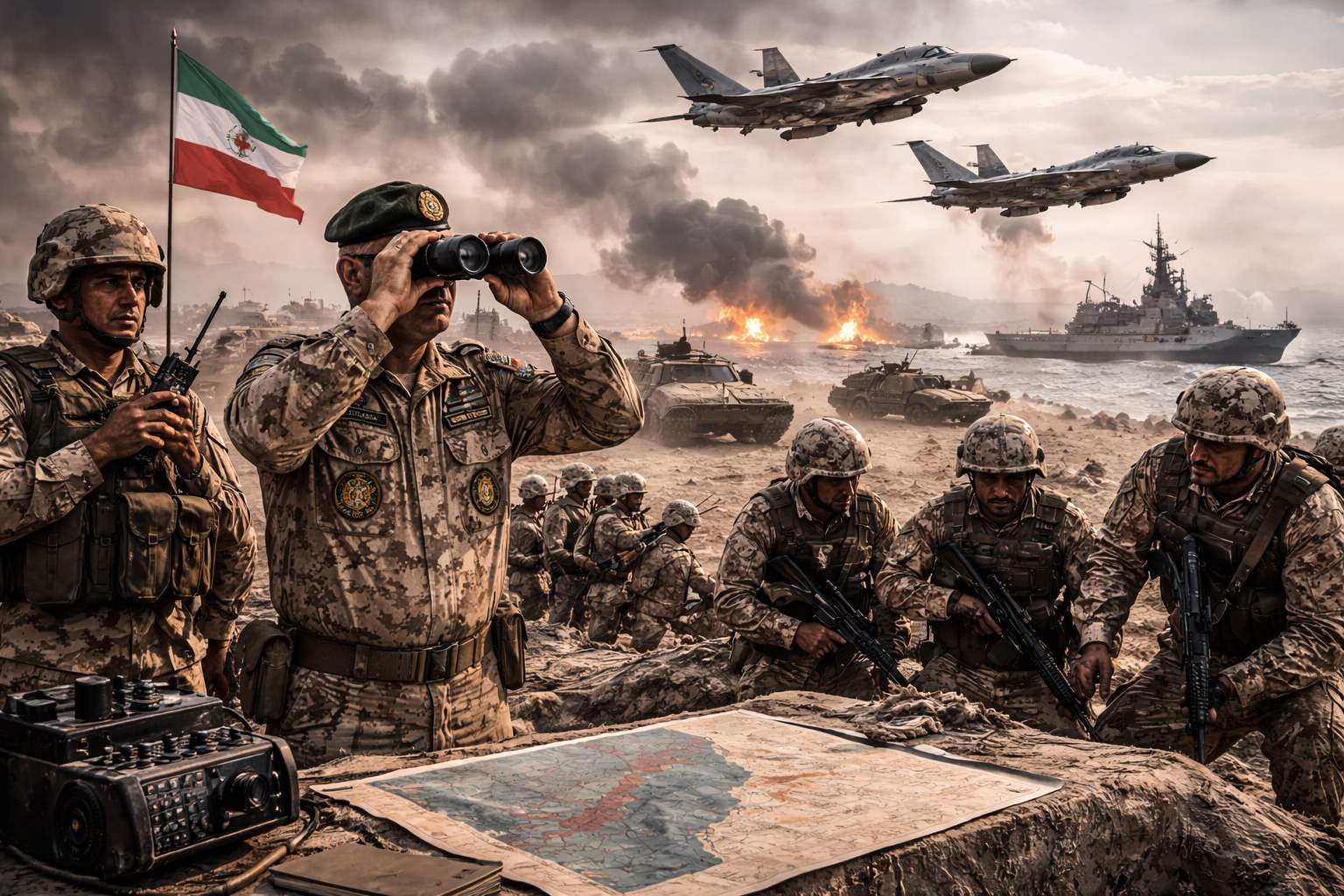
After two months of high-intensity strikes, the regular “Artesh” maintains its ground sovereignty focus while its air and naval branches adapt to severe degradation.
April 29, 2026
By Global War News Editorial
The Islamic Republic of Iran’s regular military, the Artesh, is operating under a doctrine of “maximum preservation” as the regional conflict enters its ninth week. Following the initial “Operation Epic Fury” air campaign in late February—which targeted command-and-control hubs and leadership—the regular army has shifted its focus from offensive projection to the internal defense of the Iranian plateau.
While the Islamic Revolutionary Guard Corps (IRGC) continues to manage asymmetric maritime operations and proxy coordination, the Artesh remains the primary guarantor of Iran’s territorial borders. On Tuesday, Army spokesperson Amir Akraminia stated publicly that the situation is “still considered a war” despite the current fragile ceasefire. He asserted that the Artesh has updated its “bank of objectives” and remains in a state of high readiness to confront any potential ground incursion.
Degradation of Air and Naval Conventional Assets
The conventional air and naval branches of the Artesh have sustained the most significant damage of the conflict. According to assessments from the International Institute for Strategic Studies (IISS), US and Israeli air supremacy was established in the opening hours of the war, leading to the destruction of a significant portion of Iran’s aging fighter fleet on the ground.
- Air Defense Status: Reports indicate that the S-300 and Khordad-15 systems protecting major cities like Tehran and Isfahan were heavily targeted. While Army spokespersons claim “decisive actions” against hostile aircraft, independent satellite imagery suggests that many fixed air defense sites remain inoperable or have been relocated to mobile, concealed positions.
- Naval Capabilities: Unlike the IRGC’s “mosquito fleet” of fast-attack craft, the Artesh Navy operates larger, conventional frigates and destroyers. Analysts note that these larger platforms proved vulnerable to precision strikes at Konarak and Bandar Abbas. Consequently, the conventional navy has largely retreated to “green water” coastal defense, leaving the operational control of the Strait of Hormuz to the IRGC’s asymmetric units.
Ground Forces: The “One Million Fighter” Claim
The Artesh Ground Forces, numbering approximately 350,000 active personnel, represent the regime’s most resilient military pillar. Following the start of the conflict, Tehran claimed to have mobilized over “one million fighters” by integrating the Artesh with the Basij paramilitary and volunteer units.
Military experts from Georgetown University have noted that while the “one million” figure likely serves a domestic morale purpose, the actual field-ready force remains significant. The ground forces have successfully deployed units across the country’s diverse topography, utilizing the Zagros Mountains and eastern deserts to create a “deep defense” posture. Spokesperson Akraminia emphasized this week that “the enemy did not dare to attack Iran on land,” attributing the lack of a US ground invasion to the high state of readiness maintained by these regular units.
Analysis: A Bifurcated Military Strategy
Observers note that the 2026 conflict has highlighted the distinct roles of Iran’s parallel military structures. The Artesh is being preserved as a traditional state army to prevent a total collapse of national sovereignty, while the IRGC is expended in high-risk asymmetric warfare designed to pressure global markets.
This raises questions about the long-term sustainability of the Artesh. Continued infrastructure strikes on Iranian electrical plants and fuel depots—threatened by the Trump administration if negotiations fail, would directly impact the logistics and mobility of the ground forces. Analysts have suggested that if the Artesh is unable to provide basic security or disaster relief due to supply chain collapse, the internal stability of the country may fracture regardless of the army’s “readiness” for a conventional invasion.
What to Watch
The primary indicator of Artesh preparedness in the coming weeks will be the relocation of mobile air defense units and the status of communications between the General Staff and provincial commanders. If the current ceasefire extension expires in mid-May without a diplomatic breakthrough, the Artesh Ground Forces may be called upon to manage internal civil unrest as much as external threats. For now, the “regular” army remains a battered but cohesive force, waiting on the plateau for a ground war that has yet to materialize.
Source Disclosure: This article is based on official statements from Army spokesperson Amir Akraminia via IRIB, as well as reporting from the Associated Press and Reuters. Technical assessments were sourced from the IISS, the Institute for the Study of War (ISW), and CSIS. Additional context on Iranian ground force numbers was provided by Alhurra and the Hudson Institute.
This article is based on publicly available reporting from named international news agencies and attributed official statements. All claims about ongoing events are attributed to their original sources. Analysis sections represent the editorial interpretation of reported facts and do not constitute advocacy for any party to the described conflict. AI tools may be utilized for image generation to assist in explaining complex concepts, as well as for refining grammar, spelling, and other linguistic enhancements. However, all original content is produced, fact-checked, and revised by the editorial team. This publication does not take political positions on active military conflicts.