
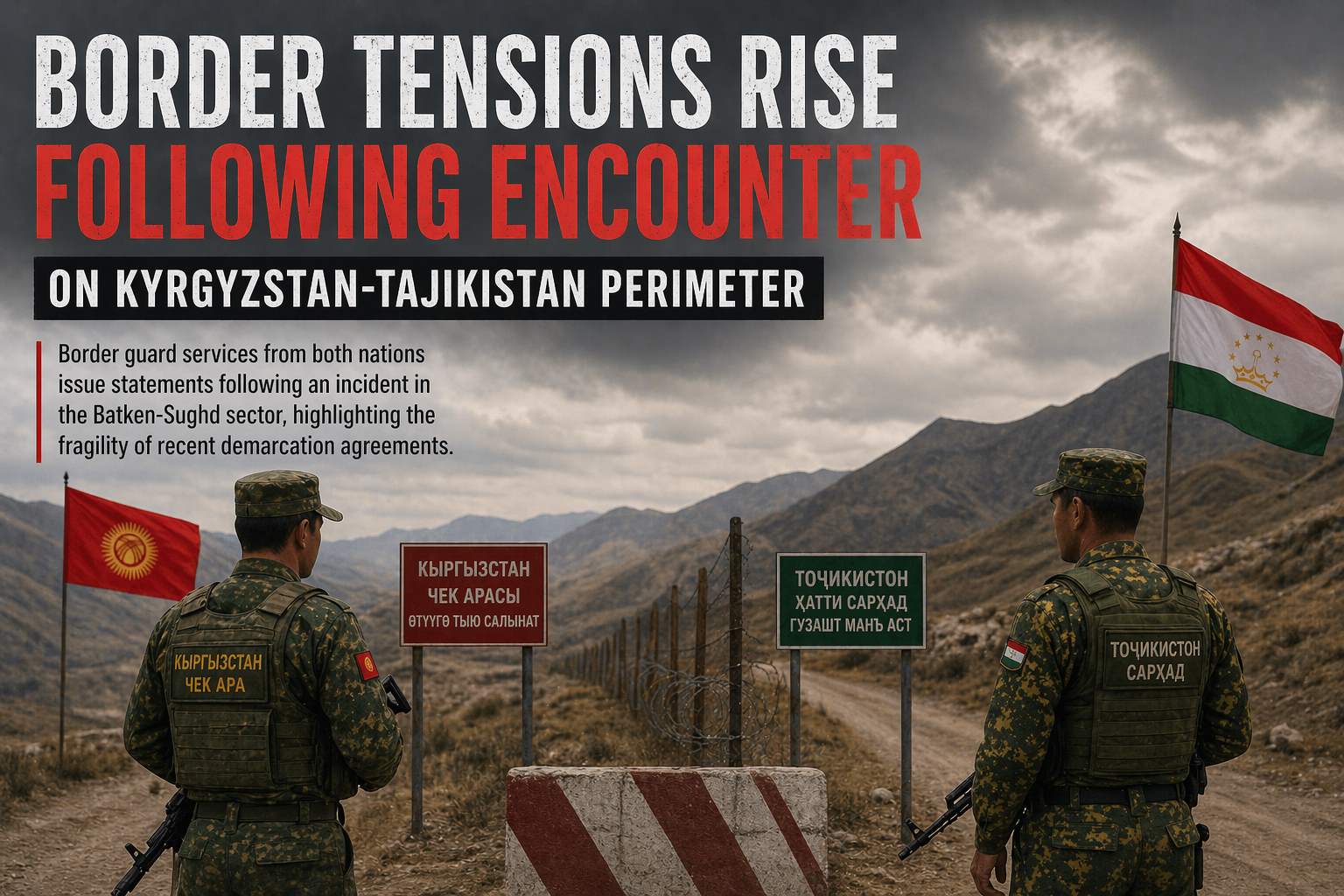
Border guard services from both nations issue statements following an incident in the Batken-Sughd sector, highlighting the fragility of recent demarcation agreements.
April 21, 2026
By Staff Writer, Global War News
Security forces along the Kyrgyz-Tajik border are on high alert following a reported encounter between border guard detachments within the last 48 hours. According to official statements released by the State Border Service of the Kyrgyz Republic and the State Committee for National Security of Tajikistan, the incident occurred in a disputed perimeter zone near the Batken region, a traditional flashpoint for territorial friction.
While the “Khujand Treaty” of March 2025 significantly resolved roughly 90% of the delimitation issues between the two nations, the latest encounter underscores that the final stages of demarcation remain a source of localized tension. Both sides have attributed the incident to “unauthorized movement” within the buffer zone, though no casualties have been officially confirmed.
Statements from Border Guard Services
According to a press release from the Kyrgyz State Border Service, the encounter took place on the afternoon of April 20 when a Tajik border patrol reportedly entered a section of land that Kyrgyzstan maintains is currently under its administrative control following recent land exchanges. The Kyrgyz side stated that “warning shots were fired into the air” to prevent an escalation, after which both units withdrew to their respective bases.
In a counter-statement issued by Dushanbe, the Tajik State Committee for National Security alleged that Kyrgyz personnel had “violated the border regime” by attempting to establish temporary fortifications in a zone where fieldwork is still ongoing. The Tajik statement characterized the actions as a “provocation” that contradicts the spirit of the 2025 historic border agreement.
Context: The Legacy of the Khujand Treaty
The current tensions arise against the backdrop of a landmark peace process initiated in 2025. Following decades of violent skirmishes—most notably in 2021 and 2022—the presidents of Kyrgyzstan, Tajikistan, and Uzbekistan signed the Khujand Treaty on March 31, 2025. This agreement aimed to finalize the “junction point” of their national borders and included several critical provisions:
- Equivalent Land Exchange: The mutual transfer of territories of equal size to resolve enclaves and transit corridors.
- Demilitarization: A formal commitment to refrain from deploying heavy military equipment or drones within a specified distance of the border.
- Joint Resource Management: Provisions for the shared use of water resources, which have historically been a root cause of conflict in the Fergana Valley.
Despite these high-level successes, the physical demarcation—the actual placement of markers and barriers—is still a work in progress. According to reports from the Times of Central Asia, Kyrgyzstan recently began constructing barriers along newly acquired sections in the Batken and Leylek districts, a process that local residents in neighboring Tajik villages sometimes view with suspicion.
Economic Impact of Border Instability
The stability of the Kyrgyz-Tajik border is essential for the regional economy of the Fergana Valley. The area serves as a primary transit route for agricultural products and cross-border trade.
- Trade Disruptions: Each perimeter incident frequently leads to temporary closures of official checkpoints. Analysts from the Eurasian Research Institute note that even a 24-hour closure can lead to significant losses for local farmers who rely on daily access to markets in neighboring districts.
- Asset Distribution: The Kyrgyz government recently adopted a resolution to register real estate and land received from Tajikistan. Any increase in tension slows the legal redistribution of these assets to citizens who lost property during the 2022 conflict.
- Smuggling and Illegal Export: Local media reported that just last week, border guards in Batken intercepted several attempts to illegally transport livestock across the border. Continued tension often incentivizes the use of unofficial “bypass” routes, further complicating border security management.
Analysis: Navigating the Final 10 Percent
Diplomatic observers suggest that the “final 10 percent” of border delimitation is often the most difficult because it involves residential gardens, graveyards, and shared water access points. According to analysts, the latest encounter in the Batken sector reflects a “technical friction” where military patrols on the ground are sometimes operating ahead of the official topographic maps finalized by the joint commission.
It remains unclear whether this incident will lead to a suspension of the ongoing joint border patrols agreed upon earlier this month. However, both governments have signaled an intent to resolve the matter through the established “Border Representatives” mechanism rather than through military escalation.
Closing Summary
As of the evening of April 21, 2026, the situation at the border is reported as stable. High-ranking representatives from the Batken and Sughd regions are expected to meet within the next 48 hours to de-conflict the specific coordinates of the incident. We will continue to monitor official channels for a joint statement on the progress of the final demarcation protocols.
Sources:
This article is based on official statements from the State Border Service of the Kyrgyz Republic and the Tajik State Committee for National Security. Additional context was sourced from 24.kg news agency, The Times of Central Asia, and reports on the 2025 Khujand Treaty from the Eurasian Research Institute and United Nations press releases.
This article is based on publicly available reporting from named international news agencies and attributed official statements. All claims about ongoing events are attributed to their original sources. Analysis sections represent the editorial interpretation of reported facts and do not constitute advocacy for any party to the described conflict. AI tools may be utilized for image generation to assist in explaining complex concepts, as well as for refining grammar, spelling, and other linguistic enhancements. However, all original content is produced, fact-checked, and revised by the editorial team. This publication does not take political positions on active military conflicts.