
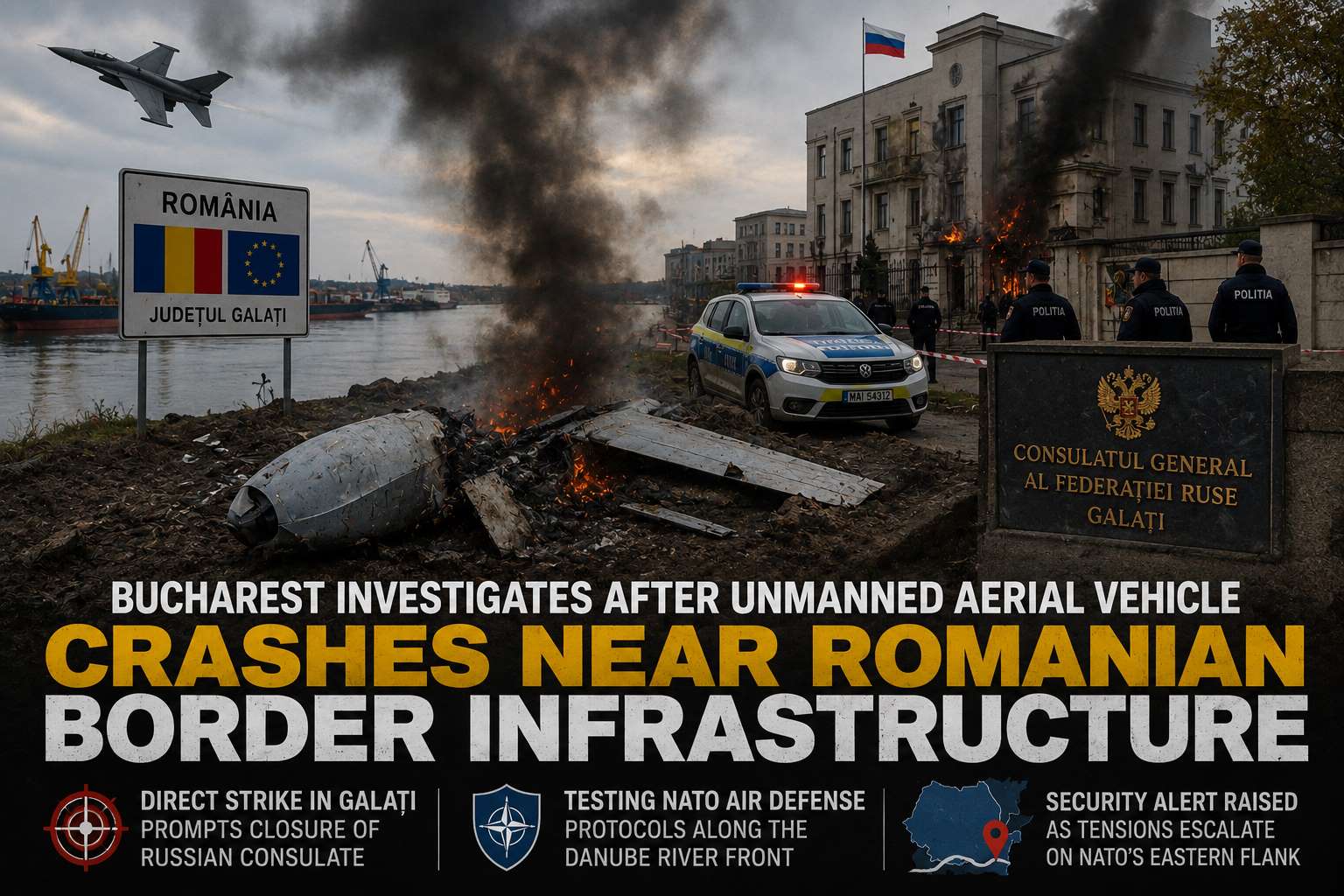
Direct Strike in Galați Prompts Closure of Russian Consulate, Testing NATO Air Defense Protocols Along the Danube River Front
Publication Date: June 1, 2026
Last Updated: June 1, 2026
Byline: Global War News Editorial
Authorities in Bucharest launched a comprehensive forensic and military investigation following a significant cross-border aerial incident along the European Union and NATO frontier. Early in the morning on Friday, May 29, 2026, an explosive-laden unmanned aerial vehicle (UAV) entered Romanian airspace and struck the upper floors of a residential apartment building in the southeastern city of Galați. The city is a major Danube River port situated less than 15 kilometers from the tripoint border separating Romania, Ukraine, and Moldova.
According to a series of technical assessments published by the Romanian Ministry of National Defense on May 31, 2026, investigators recovered physical wreckage from the impact site bearing distinct Cyrillic markings. Romanian President Nicușor Dan announced that experts conclusively identified the debris as belonging to a Russian-made Geran-2 loitering munition, commonly known as a Shahed-type strike drone. President Dan stated that physical and chemical analyses of the navigation systems, engine elements, and fuel residue matched those of similar military drones recovered during previous border incursions.
The drone strike represents a sharp operational escalation, marking the first time a cross-border aerial incursion has inflicted direct civilian injuries on the territory of a NATO member state since the outbreak of full-scale regional hostilities. The Romanian Interior Ministry reported that a child and a woman were hospitalized for their injuries, and emergency response teams were forced to evacuate more than 70 residents after a fire erupted on the building’s roof. In immediate diplomatic retaliation, Bucharest ordered the closure of the Russian Consulate General in the Black Sea port city of Constanța and declared the Russian consul persona non grata.
Context and Background
The Danube River delta and its adjacent shipping corridors have served as persistent flashpoints for airspace violations due to their extreme geographic proximity to active combat zones. The port cities of Galați and neighboring Brăila sit directly across the water from the southern Odesa region of Ukraine, where critical grain terminals and transport infrastructure are regularly subjected to long-range aerial bombardments. According to historical tracking data compiled by the Romanian military, Russian drones or their fragmented debris have crossed into or impacted Romanian territory over three dozen times since 2022.
The structural details of the May 29 flight path reveal severe constraints within regional air defense architectures. According to the Romanian Defense Ministry, military radar networks initially locked onto a group of aerial targets at 1:46 a.m. local time while the aircraft were still navigating Ukrainian airspace, approximately 19 kilometers from the national border. The drone crossed into Romania around 2:00 a.m. and spent approximately four minutes in domestic airspace before colliding with the apartment structure.
The incident highlights a delicate regulatory challenge for NATO forces operating near active war zones. The Acting Commander of the Romanian Armed Forces Joint Staff, Brigadier General Gheorghe Maxim, stated on May 29 that current national legislation strictly prohibits domestic air defenses from conducting operations that could affect the sovereign airspace of a neighboring country. This rule effectively bars Romanian batteries from launching interceptor projectiles that might cross into Ukraine, leaving border units with a highly compressed timeframe to engage low-altitude targets safely.
Economic and Humanitarian Impact
The spillover of the conflict onto Romanian soil has immediate economic ramifications for Black Sea maritime logistics and regional insurance frameworks. Shipping registries indicated that the overnight drone assault on the wider Danube delta caused secondary damage to three civilian cargo vessels anchored in the Black Sea. Maritime security analysts note that repeated kinetic incidents near shared waterways will likely prompt international insurers to increase risk premiums for commercial vessels utilizing the Danube corridor, which acts as a vital alternative trade artery for Central and Eastern European agricultural exports.
The humanitarian toll within the Galați district remains managed but highly volatile. While local engineering teams have initiated structural integrity reviews of the damaged residential complex, regional administrative bodies are coordinating emergency housing accommodations for the displaced families. Local police units have established temporary exclusion zones around the impact site to facilitate forensic data gathering and ensure the complete removal of unexploded ordnance components.
Beyond the immediate damage to civilian property, the cross-border strike has intensified security concerns within neighboring Moldova. Moldovan energy infrastructure is deeply integrated with Romanian supply lines, and previous border area engagements have repeatedly threatened the stability of high-voltage transmission lines crossing the Danube, adding further economic vulnerability to one of Europe’s most fragile peacetime economies.
International Reactions and Diplomatic Friction
The strike in Galați triggered swift diplomatic condemnation across the European Union and NATO, alongside sharp denials from the Kremlin. European Commission President Ursula von der Leyen stated that the incident represented a serious and irresponsible escalation, emphasizing that the cross-border strike had crossed yet another line. Romanian Foreign Minister Oana Toiu confirmed that Bucharest had briefed NATO Secretary General Mark Rutte on the structural findings and formally requested measures to accelerate the transfer of advanced anti-drone capabilities under the EU’s SAFE defense assistance program.
Conversely, Russian President Vladimir Putin rejected the initial findings, demanding objective forensic proof of the drone’s origin during a press conference in Kazakhstan. President Putin suggested that the aircraft may have been a Ukrainian defense asset that veered off course due to electronic warfare interference or mechanical malfunction, citing past unverified drone deviations in the Baltic region. Russian Foreign Ministry spokesperson Maria Zakharova echoed these remarks, calling the accusations from Bucharest unsubstantiated.
The escalating rhetoric was further compounded by comments from Russian Security Council Deputy Chairperson Dmitry Medvedev, who publicly claimed that European nations are acting as direct participants in the conflict against Russia. Medvedev warned that European states must adjust to the risks of border-adjacent operations, drawing immediate rebukes from Western diplomats who view the rhetoric as an attempt to test NATO’s collective defense resolve.
Analysis: What This Could Mean
Military and geopolitical analysts suggest that the Galați drone crash exposes the operational limits of conventional air defense doctrines when dealing with low-cost, low-altitude asymmetric threats near international borders. Because loitering munitions like the Geran-2 fly at low altitudes and possess minimal radar signatures, early detection is exceptionally difficult, and the four-minute window available to Romanian forces was insufficient to safely deploy scrambled F-16 fighter jets or IAR-330 helicopters over populated urban areas.
The technical evaluation provided by President Dan indicates that the drone was likely damaged or destabilized by Ukrainian air defenses near the port city of Reni before it redirected toward Romanian territory. This introduces a persistent operational paradox for NATO’s eastern flank: as long as intense aerial campaigns continue within close proximity to international borders, the probability of damaged or electronically suppressed guidance systems causing munitions to stray into allied territory remains high.
Furthermore, Brigadier General Maxim’s disclosures regarding the risk of falling air defense debris highlight a critical tactical reality. Military commanders must constantly weigh whether launching interceptor missiles over populated border towns like Galați might cause more severe civilian casualties and property destruction than the incoming drone itself. Unless NATO adjusts its defensive frameworks to negotiate specialized cross-border air defense agreements with Ukraine and Moldova, the Danube shipping corridors are likely to remain exposed to sudden, erratic disruptions that threaten both regional civilian safety and the economic stability of Black Sea trade networks through the remainder of 2026.
Source Disclosure: This report utilizes official technical summaries and public statements released by the Romanian Ministry of National Defense, Romanian President Nicușor Dan, and Foreign Minister Oana Toiu. International data and diplomatic positions are derived from official press releases by the European Commission, public remarks by Russian President Vladimir Putin, and independent conflict tracking metrics published by the Armed Conflict Location & Event Data Project (ACLED) and the Institute for the Study of War (ISW). Supplemental field details regarding civilian displacement and vessel tracking were compiled from verified dispatches by Reuters, Agence France-Presse (AFP), and The Moscow Times.
This article is based on publicly available reporting from named international news agencies and attributed official statements. All claims about ongoing events are attributed to their original sources. Analysis sections represent the editorial interpretation of reported facts and do not constitute advocacy for any party to the described conflict. AI tools may be utilized for image generation to assist in explaining complex concepts, as well as for refining grammar, spelling, and other linguistic enhancements. However, all original content is produced, fact-checked, and revised by the editorial team. This publication does not take political positions on active military conflicts.