
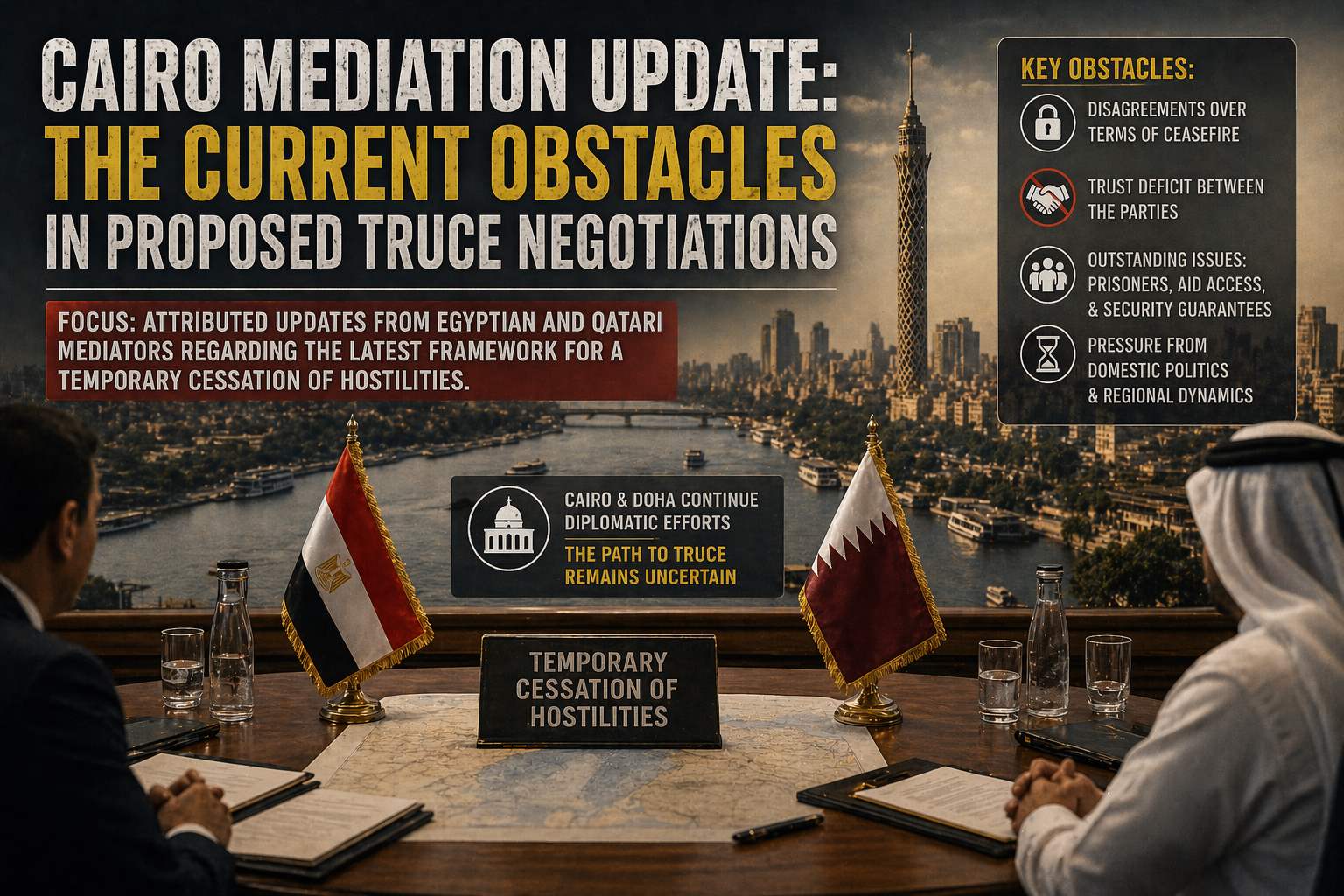
Negotiations for a long-term cessation of hostilities enter a critical phase as mediators balance disarmament demands against reconstruction timelines
April 24, 2026
Last Updated: 19:40 UTC
By Staff Writer, Global War News
High-level diplomatic efforts in Cairo have reached a pivotal impasse this week as Egyptian and Qatari mediators attempt to bridge the divide between the latest international peace framework and the realities on the ground in Gaza. Following a series of indirect meetings involving a Hamas delegation led by Dr. Khalil al-Hayya and representatives from the UN-endorsed “Board of Peace,” officials have indicated that while the structure of a second-phase truce exists, its implementation remains stalled.
The current negotiations center on transitioning from the initial ceasefire, established in October 2025, to a more permanent stability agreement. According to statements from the Egyptian Ministry of Foreign Affairs, the primary objective is to finalize the “Sharm El-Sheikh Agreement” framework, which aligns with the US-proposed “Comprehensive Plan to End the Gaza Conflict.” However, despite the presence of international mediators, both sides remain locked in a dispute over the sequencing of troop withdrawals and the decommissioning of military assets.
The New Framework: Phase Two Objectives
The proposed framework, endorsed by UN Security Council Resolution 2803, envisions a three-stage transition toward Palestinian self-determination. According to Qatari officials, the current round of talks in Cairo is focused specifically on the following “Phase Two” pillars:
- Interim Governance: The establishment of a National Transitional Committee, comprised of Palestinian experts, to manage essential services and reconstruction efforts under international oversight.
- Staged Withdrawal: A reciprocal timeline linking the withdrawal of Israeli forces from the “Yellow Line” (the current agreed-upon boundary) to the decommissioning of heavy weaponry.
- Humanitarian Surge: An immediate increase in aid flow to address what the World Bank recently estimated as $71.4 billion in total recovery and reconstruction needs.
While both sides have expressed a “positive stance” regarding the broad principles of the plan, mediators note that the technical details of the transition are where the consensus has fractured.
Primary Obstacles to a Final Agreement
According to attributed briefings from the negotiating teams in Cairo, three primary hurdles are currently preventing a signature on the Phase Two document.
1. The Disarmament Timeline
A central point of friction is the “Mladenov Plan” for phased disarmament. According to reports from independent observers, Hamas has formally refused a plan that would require full disarmament within eight months. In a statement released on April 20, 2026, the movement distinguished between “disarmament” and “handing over weapons,” proposing an alternative three-year timeline that allows them to retain light arms for self-defense during the transitional period.
2. Implementation of Phase One Commitments
Hamas and other Palestinian factions have publicly accused the Israeli military of failing to adhere to Phase One commitments. According to a statement issued in Cairo, the movement alleges that over 2,400 violations have occurred since October, including ongoing restrictions on the movement of people and materials. Conversely, Israeli officials have pointed to continued skirmishes along the “Yellow Line” as proof that the ceasefire is too fragile for a full withdrawal.
3. The Gaza Reconstruction Verification
International donors, led by the Board of Peace, have pledged approximately $17 billion for immediate relief. However, as stated by mediators, this funding is strictly conditioned on a verified decommissioning of weapons. Mediators from Egypt and Qatar are currently attempting to negotiate a “neutral verification” system that would satisfy international donors without being perceived by local factions as a surrender of their security capabilities.
Analysis: The “Grand Bargain” vs. Regional Escalation
Analysts have suggested that the Cairo talks are no longer occurring in a vacuum. The broader regional conflict, including the “Operation Epic Fury” campaign involving the United States and Iran, has placed additional pressure on Cairo to secure a regional de-escalation. Egypt’s role as a mediator is not only a diplomatic choice but a strategic imperative; the country’s economy has faced a 77% collapse in export volumes due to regional instability.
Observers note that while the parties are “inches apart” on some humanitarian clauses, the core issue of sovereignty remains the “decapitation paradox” of the negotiations. Without a clear authority figure in Gaza capable of enforcing a disarmament agreement, any signed deal risks immediate collapse. It remains unclear whether the Board of Peace can provide sufficient security guarantees to convince local factions to cede control to the proposed International Stabilization Force (ISF).
Closing Summary
The Cairo mediation remains the most viable path toward ending the cycle of violence in Gaza, but the current impasse over disarmament reflects deep-seated mistrust. As mediators from Egypt and Qatar continue to host delegations, the focus has shifted toward securing a “partial memorandum of understanding” that would allow for reconstruction to begin while the more sensitive military questions are deferred to later in the year. The success of this round will likely depend on whether the international community can provide a verification framework that balances Israeli security needs with Palestinian demands for a credible path to statehood.
Sources: This report is based on official statements from the Egyptian Ministry of Foreign Affairs, the Qatari Ministry of Foreign Affairs, and public declarations by Hamas’s negotiating delegation in Cairo. Additional data regarding the “Comprehensive Plan” and reconstruction costs were sourced from UN Security Council Resolution 2803 and the joint UN-World Bank Rapid Damage and Needs Assessment (RDNA) published in April 2026.
This article is based on publicly available reporting from named international news agencies and attributed official statements. All claims about ongoing events are attributed to their original sources. Analysis sections represent the editorial interpretation of reported facts and do not constitute advocacy for any party to the described conflict. AI tools may be utilized for image generation to assist in explaining complex concepts, as well as for refining grammar, spelling, and other linguistic enhancements. However, all original content is produced, fact-checked, and revised by the editorial team. This publication does not take political positions on active military conflicts.