
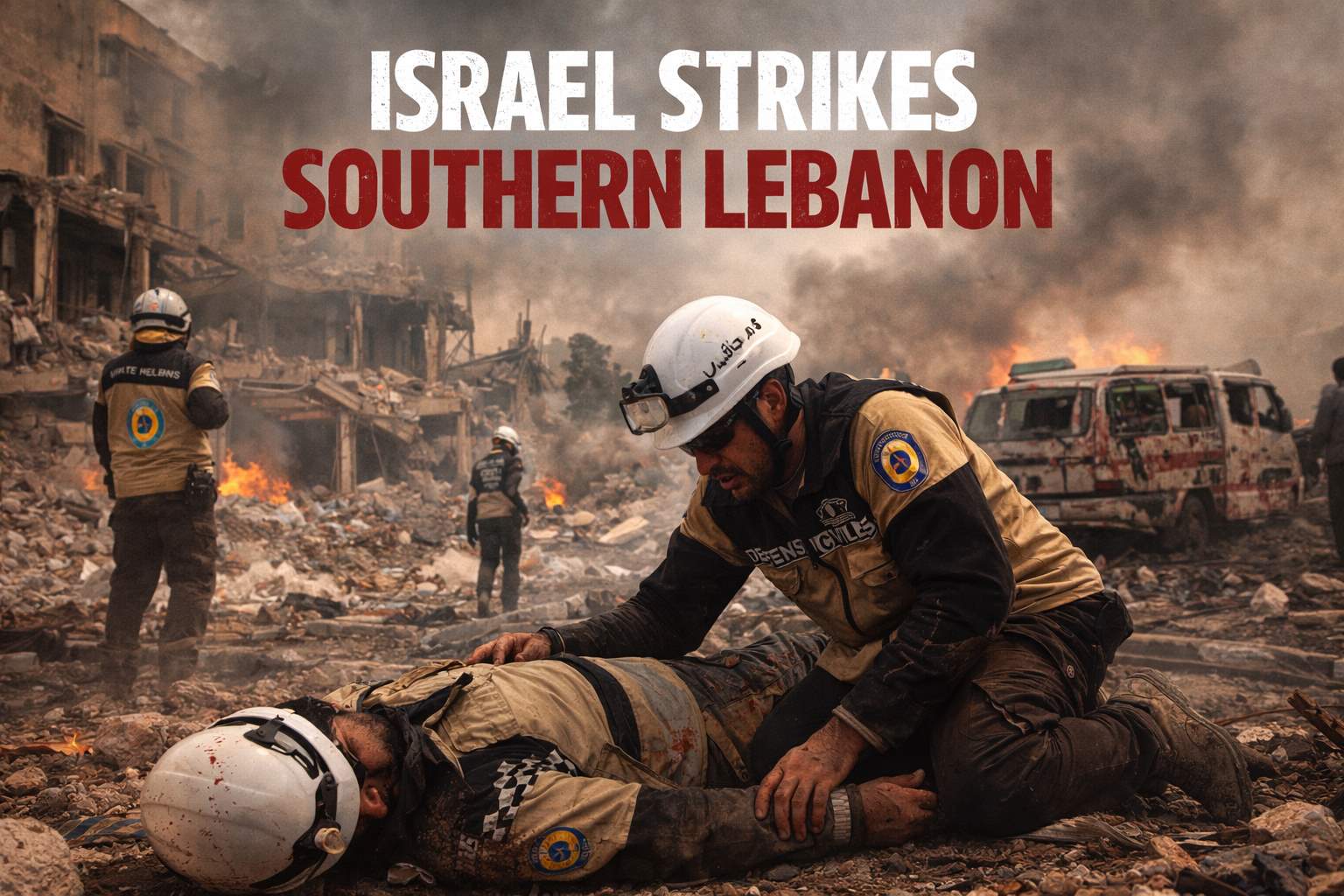
Fatalities include rescue workers in Nabatieh as fragile ceasefire faces continued violations
May 13, 2026
Last updated: 09:15 GMT
By Global War News Editorial
Authorities in Lebanon reported on Tuesday that at least 13 people were killed following a series of Israeli airstrikes across several southern towns. The Lebanese Ministry of Health stated that the fatalities occurred during strikes on the city of Nabatieh and the villages of Jibchit and Bint Jbeil. The incident marks a significant escalation in violence despite a nominal ceasefire agreement that has been in place since mid-April.
According to Lebanon’s National News Agency (NNA), two of the deceased in Nabatieh were paramedics associated with the Lebanese Civil Defense. The agency reported that these rescue workers were targeted while attempting to evacuate individuals wounded in an earlier raid. Lebanon’s Health Minister, Rakan Nassereddine, described the targeting of medical personnel as a violation of international humanitarian law.
The Israeli Defense Forces (IDF) have not issued a specific statement regarding the Nabatieh incident but have maintained that their operations in southern Lebanon are aimed at “clearing terrorist infrastructure.” The IDF has previously accused Hezbollah of using civilian vehicles and medical facilities for military purposes, a claim that Lebanese officials and Hezbollah leadership have consistently denied.
Escalation Despite Ceasefire Framework
The current hostilities are occurring within the context of a “fragile and ineffective” ceasefire that took effect on April 17, 2026. While the agreement was intended to halt major offensive operations, it allowed for military action against “imminent threats.” This clause has been frequently invoked as both sides continue to exchange fire along the border and within the 10-kilometer “security buffer zone” currently occupied by Israeli troops.
Reporting from Agence France-Presse (AFP) indicates that the Lebanese government now estimates 380 people have been killed in the country since the ceasefire began. The Ministry of Health official data suggests this figure includes at least 39 women and 22 children. Conversely, the Alma Research and Education Center, an Israeli-based security monitor, reported that Hezbollah has launched over 220 attack waves against Israeli positions since the truce began, utilizing explosive drones and rocket barrages.
Economic and Humanitarian Impact
The continued military activity in southern Lebanon has severely disrupted efforts to return displaced populations to their homes. Approximately 1.6 million people, roughly one-fifth of Lebanon’s population, remain displaced according to UN-affiliated reporting. The destruction of civilian infrastructure, including a solar-powered water pumping station in Deir Mimas reported destroyed on Tuesday, continues to degrade basic services.
In Israel, the economic strain of maintaining three military divisions in southern Lebanon persists. The Northern Command remains on high alert as Hezbollah continues to deploy fiber-optic guided drones, which the Israeli military has identified as a significant technical challenge due to their resistance to electronic jamming.
Analysis: The Washington Talks
The surge in strikes comes just 48 hours before scheduled diplomatic talks in Washington, D.C. Representatives from Lebanon and Israel are expected to meet at the US State Department on May 14 and 15 to discuss the potential for a more permanent peace framework.
Observers note that both parties appear to be intensifying military operations to secure a stronger bargaining position ahead of these negotiations. Hezbollah leader Naim Qassem recently stated that the group’s arsenal is not a subject for discussion, while the US State Department has indicated that “complete disarmament” of the group remains a central goal for regional stability. It remains unclear whether the current level of violence will derail the upcoming talks or serve as a catalyst for a more robust enforcement mechanism for the April truce.
Source Disclosure Note: This report is based on official statements from the Lebanese Ministry of Health, reporting from the National News Agency (NNA), and international coverage provided by AFP, Reuters, and Xinhua. Data regarding military movements and Hezbollah activity was cross-referenced with reports from the Alma Research and Education Center and Israel’s Channel 12.
This article is based on publicly available reporting from named international news agencies and attributed official statements. All claims about ongoing events are attributed to their original sources. Analysis sections represent the editorial interpretation of reported facts and do not constitute advocacy for any party to the described conflict. AI tools may be utilized for image generation to assist in explaining complex concepts, as well as for refining grammar, spelling, and other linguistic enhancements. However, all original content is produced, fact-checked, and revised by the editorial team. This publication does not take political positions on active military conflicts.