
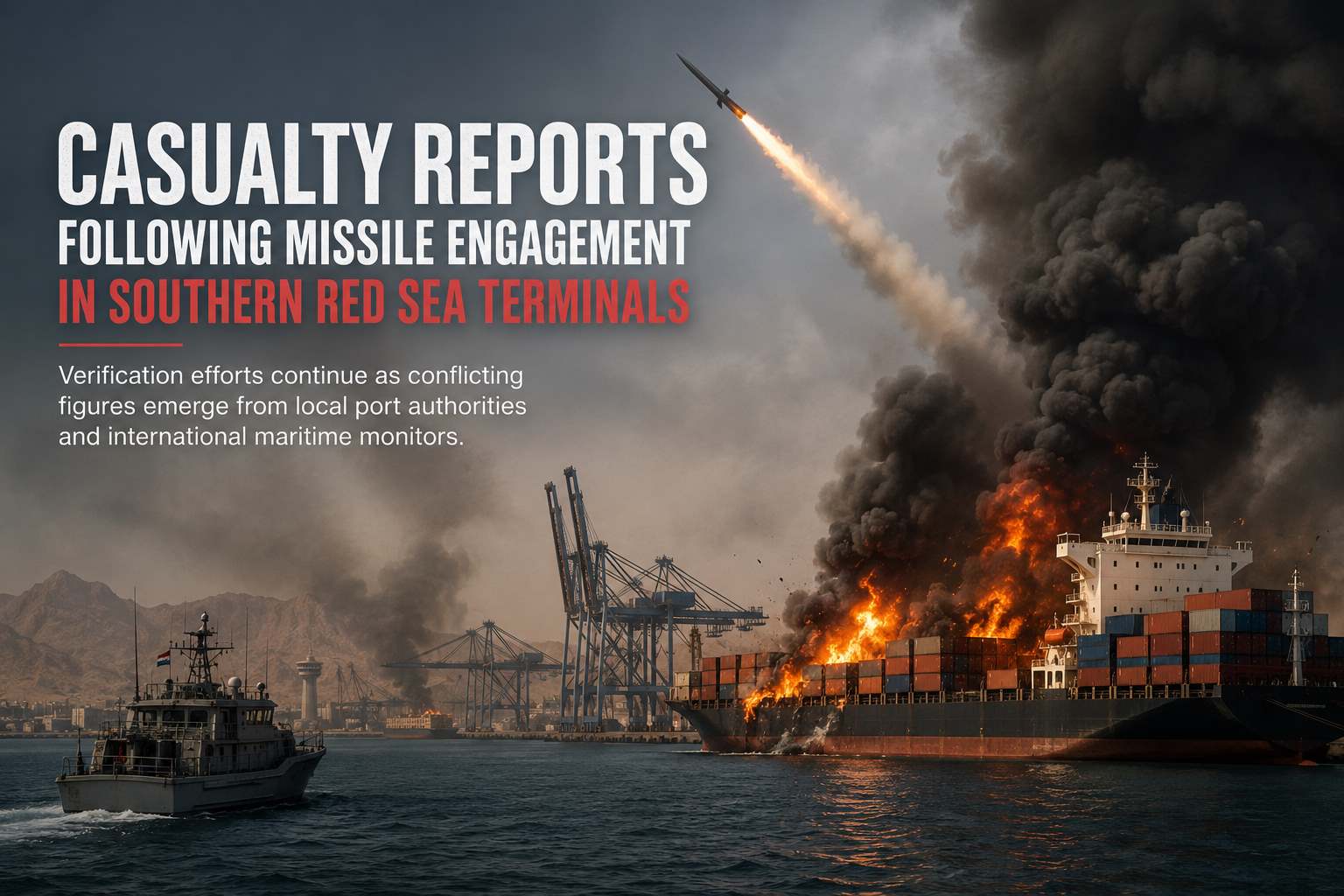
Verification efforts continue as conflicting figures emerge from local port authorities and international maritime monitors.
May 7, 2026
Last updated: May 7, 2026
By Global War News Editorial
Reports of a missile engagement targeting critical energy terminals in the southern Red Sea have triggered a complex verification process regarding potential casualties. While localized reports from port workers suggest a significant impact on logistical personnel, official casualty figures remain unconfirmed as international naval task forces and regional governments assess the damage.
The engagement reportedly occurred late yesterday near a major transshipment hub. According to a preliminary report from the Associated Press, at least two anti-ship ballistic missiles were detected in the vicinity of the terminal. However, the exact number of individuals affected remains a point of contention between local sources and official military briefings.
The Challenge of Verifying Casualties in High-Risk Zones
Establishing accurate casualty counts in the immediate aftermath of a missile strike is often hampered by security lockdowns and the disruption of local communication networks. In the Red Sea corridor, this is further complicated by the multinational nature of the workforce operating within these terminals.
As reported by Reuters, maritime security firms have noted that search and rescue operations were initiated shortly after the explosions were recorded. However, a spokesperson for the regional maritime authority stated that while property damage is “evident,” a full accounting of personnel is still underway. “Unverified reports suggest casualties among the night shift staff, but we cannot confirm these figures until all manifests are cross-referenced,” the official said.
Strategic Context and Regional Stability
The southern Red Sea serves as one of the world’s most vital maritime chokepoints, facilitating the transit of approximately 12% of global seaborne trade. Any direct engagement involving land-based terminals represents a significant escalation from previous incidents involving vessels at sea.
According to a briefing from the International Monetary Fund (IMF) earlier this year, persistent instability in this region has already led to a 15% increase in shipping costs for Mediterranean-bound cargo. Analysts at the Center for Strategic and International Studies (CSIS) suggest that targeting terminals, rather than ships, indicates a tactical shift intended to degrade the long-term logistical capacity of the region’s energy exporters.
Analysis: The Fog of Information
The current discrepancy in casualty reporting highlights the difficulty of maintaining transparency in active conflict zones. Localized reports often prioritize speed over verification, leading to figures that may be inflated by initial panic or deflated by official censorship.
By targeting terminal infrastructure, the attackers create a “high-consequence” scenario that forces shipping companies to reassess their insurance risk. Even if the casualty count remains low, the perceived threat to personnel can trigger a mass exit of skilled logistical workers, effectively halting port operations more efficiently than physical destruction alone. It remains unclear whether this specific engagement was a singular event or the beginning of a broader campaign against land-based maritime assets.
What to Watch
In the coming 48 hours, observers should monitor for official statements from the shipping companies managing the terminal’s operations. Confirmation of casualties from these corporate entities often precedes official government tallies. Additionally, the impact on the “Brent Crude” index will be a key indicator of how global markets perceive the risk of prolonged disruption in the southern Red Sea corridor.
Sources: Associated Press (AP) field reporting, Reuters maritime security update, CSIS regional analysis, International Monetary Fund (IMF) trade data, Regional Maritime Authority official statement.
This article is based on publicly available reporting from named international news agencies and attributed official statements. All claims about ongoing events are attributed to their original sources. Analysis sections represent the editorial interpretation of reported facts and do not constitute advocacy for any party to the described conflict. AI tools may be utilized for image generation to assist in explaining complex concepts, as well as for refining grammar, spelling, and other linguistic enhancements. However, all original content is produced, fact-checked, and revised by the editorial team. This publication does not take political positions on active military conflicts.