
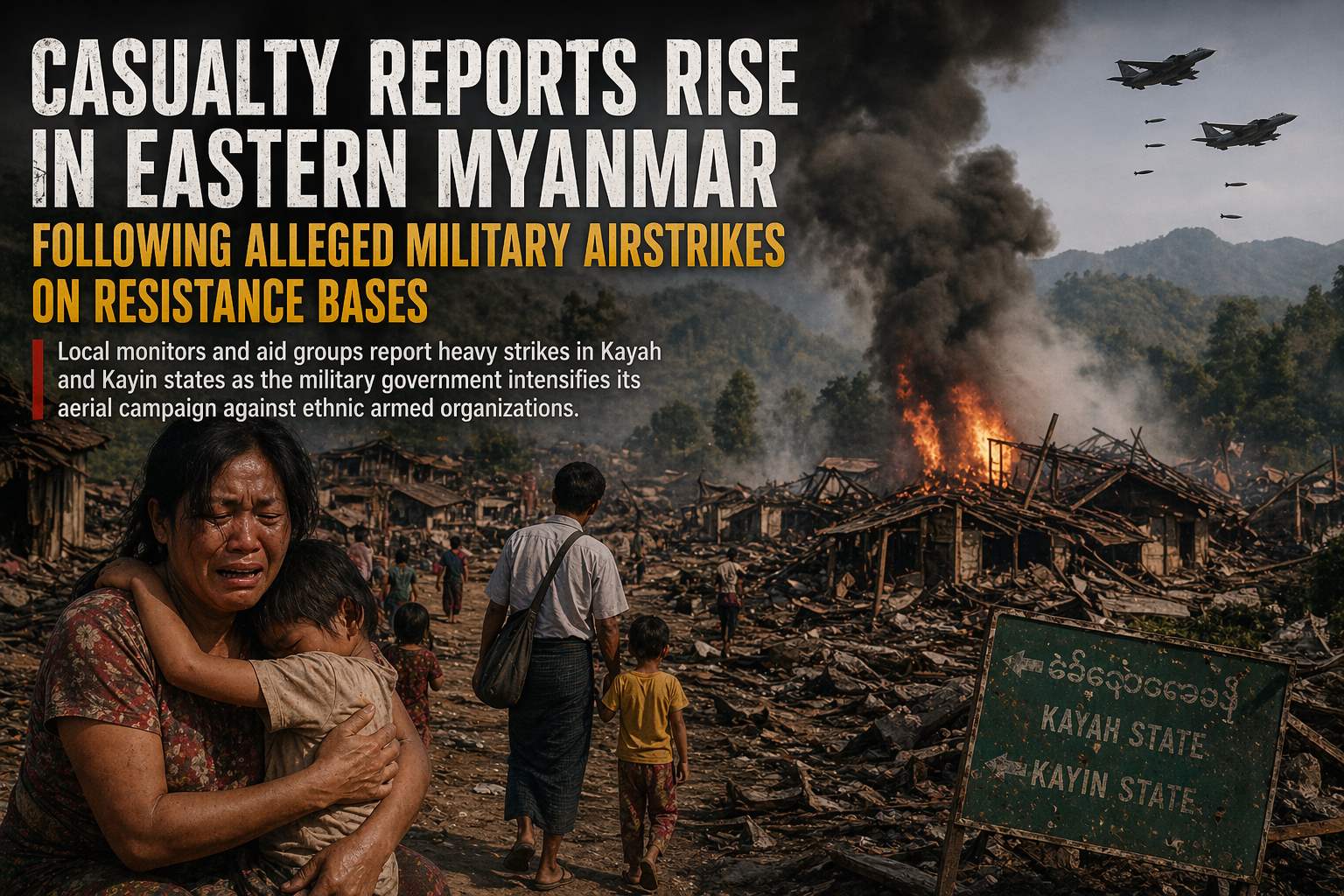
Local monitors and aid groups report heavy strikes in Kayah and Kayin states as the military government intensifies its aerial campaign against ethnic armed organizations.
April 23, 2026
Last Updated: April 23, 2026
By Global War News Editorial
Reports of rising casualties are emerging from eastern Myanmar following a series of intensified airstrikes allegedly conducted by the military government (State Administration Council) against resistance strongholds. According to local monitoring groups and the Karenni Human Rights Group (KnHRG), the strikes targeted several outposts and administrative centers controlled by the Karenni Nationalities Defence Force (KNDF) and the Karen National Union (KNU) in Kayah and Kayin states.
While the Myanmar military has not issued a specific statement regarding the latest sorties, state-run media (MRTV) has previously stated that “counter-terrorism operations” are being conducted in the border regions to maintain “territorial integrity.” Independent humanitarian organizations operating in the region report that the scale of the aerial bombardment has led to the destruction of multiple civilian structures, including a primary school and a rural clinic near the town of Loikaw.
The escalation comes as the military government faces increasing pressure on multiple fronts, leading to what analysts describe as a heavier reliance on air power to compensate for territorial losses on the ground.
Verified Casualties and Displacement
The exact number of casualties remains difficult to verify due to the remote nature of the terrain and ongoing hostilities. However, the Assistance Association for Political Prisoners (Burma) stated on Thursday that at least 22 individuals, including four children, were reportedly killed in a single strike on a displaced persons camp near the Thai-Myanmar border.
According to reporting from Reuters, which cited satellite data and local witness accounts, the airstrikes were followed by heavy artillery fire. The UN Refugee Agency (UNHCR) has expressed “grave concern” over the development, noting that approximately 15,000 additional civilians have fled toward the Salween River in the last 48 hours, seeking refuge in forest hideouts or attempting to cross into neighboring Thailand.
The Tactical Shift to Aerial Attrition
Military analysts have suggested that the current campaign represents a strategic shift by the Myanmar Air Force (MAF). Following the success of the “Operation 1027” offensive by resistance forces in late 2023 and throughout 2024, the military has increasingly used its fleet of Yak-130 and Su-30 aircraft to strike logistics hubs and communication lines in resistance-held territory.
Reports from Agence France-Presse (AFP) indicate that these strikes often target areas where ethnic armed organizations (EAOs) have established “alternative governance” structures. By targeting schools, hospitals, and local administrative offices, observers note that the military aims to undermine the civilian support base of the resistance movements.
Analysis: Economic and Regional Implications
The intensification of the conflict in eastern Myanmar has significant economic repercussions for the wider Southeast Asian region. The border trade between Myanmar and Thailand, which is worth billions of dollars annually, has been severely disrupted. According to data from the Thai Ministry of Commerce, trade volume at the Mae Sot-Myawaddy crossing, one of the region’s busiest, has dropped by nearly 60% since the start of the year.
Furthermore, the “war of the skies” is placing an immense strain on the military government’s dwindling foreign currency reserves. According to independent research institutions, the high operational cost of maintaining a modern air force, coupled with the need to import aviation fuel and spare parts despite international sanctions, is contributing to the rapid devaluation of the Myanmar Kyat.
Analysts also point out that the strikes near the border increase the risk of “accidental overflights” or ordnance landing in Thai territory, which has previously prompted the Royal Thai Air Force to scramble F-16 jets and raises questions about regional escalation.
International Response and Accountability
The international community has largely condemned the use of airstrikes against civilian-populated areas. In a statement on Wednesday, the ASEAN chair urged “maximum restraint” and called for an immediate cessation of violence. However, the “Five-Point Consensus” remains largely unimplemented as the conflict enters a more destructive phase.
Reports differ on the source of the military’s aviation fuel. While some human rights groups have called for a total embargo on aviation fuel to Myanmar, others note that the military has successfully diversified its supply chains through regional middlemen.
What to watch for in the coming weeks is whether resistance forces, who have recently acquired more sophisticated man-portable air-defense systems (MANPADS), will be able to challenge the MAF’s air superiority. Any confirmed downing of military aircraft would likely lead to a further intensification of retributive strikes.
Sources: This article is based on reporting and official statements from the Karenni Human Rights Group (KnHRG), the Assistance Association for Political Prisoners (Burma), Reuters, AFP, the UNHCR, and state-run media (MRTV).
This article is based on publicly available reporting from named international news agencies and attributed official statements. All claims about ongoing events are attributed to their original sources. Analysis sections represent the editorial interpretation of reported facts and do not constitute advocacy for any party to the described conflict. AI tools may be utilized for image generation to assist in explaining complex concepts, as well as for refining grammar, spelling, and other linguistic enhancements. However, all original content is produced, fact-checked, and revised by the editorial team. This publication does not take political positions on active military conflicts.