
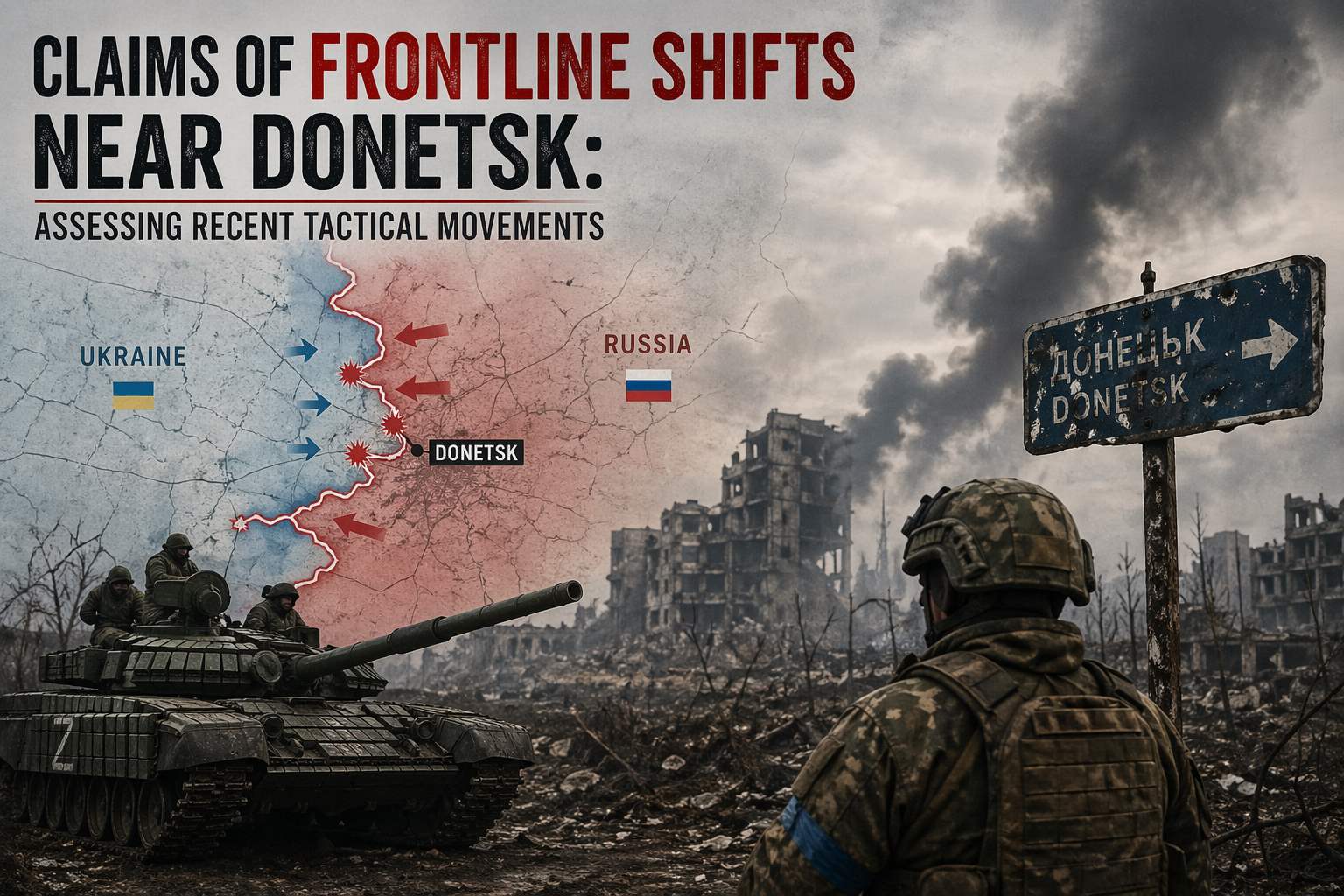
While Russian forces report localized territorial gains, Ukrainian commanders maintain that defensive lines remain intact amid intensified shelling.
April 23, 2026
Last Updated: 15:42 GMT
By Global War News Editorial
The frontline situation near the city of Donetsk has seen a marked increase in kinetic activity over the last 48 hours. Both the Russian Ministry of Defense and the Ukrainian General Staff have issued conflicting reports regarding the control of tactical positions on the outskirts of the city. While Moscow asserts that its units have moved forward to improve their tactical standing, Kyiv reports that all primary defensive perimeters remain under their control despite a surge in artillery and drone strikes.
Claims of Territorial Advancement
According to a statement released by the Russian Ministry of Defense on Thursday morning, Russian units have reportedly seized several “advantageous positions” in the direction of the Donetsk sector. The statement claimed that these advancements were supported by coordinated aviation and artillery strikes targeting Ukrainian supply routes.
However, these claims have not been independently verified by international observers. According to reports from the Associated Press, while there is evidence of increased smoke plumes and acoustic signatures consistent with heavy fighting in the region, satellite imagery from the previous 24-hour cycle does not yet show a significant shift in the established line of contact.
Ukrainian Defensive Response
In its daily operational briefing, the General Staff of the Armed Forces of Ukraine stated that its troops had successfully repelled multiple attacks in the vicinity of Donetsk. The briefing acknowledged a “difficult situation” due to constant shelling but emphasized that the frontline has not been breached.
According to Ukrainian military spokespersons, the intensity of Russian drone deployments has reached a new peak this month. This surge in unmanned aerial vehicle (UAV) activity appears to be aimed at disrupting the rotation of Ukrainian personnel.
Analysis: The Strategic Context
Analysts from independent research groups, such as the Institute for the Study of War, suggest that these reported shifts likely represent “positional warfare” rather than a large-scale breakthrough. The objective of these localized pushes, according to observers, may be to force the opposing side to commit reserves to the Donetsk sector, potentially thinning out defenses in other areas of the front.
It remains unclear whether the reported Russian advances constitute a permanent change in the map or a temporary occupation of “grey zones”—areas between the two main defensive lines that neither side fully controls. Historically, these zones frequently change hands during periods of high-intensity skirmishing.
Economic Impact of Continued Escalation
The renewed focus on the Donetsk sector continues to have ripples beyond the immediate battlefield. According to data from the World Bank’s latest regional update, the sustained destruction of local infrastructure in the Donbas region has increased the projected cost of long-term reconstruction. Furthermore, global energy markets remain sensitive to any escalation that could threaten remaining transit pipelines in Eastern Europe.
What to Watch
Observers are currently monitoring whether the reported Russian tactical improvements lead to a sustained offensive toward larger logistical hubs. The effectiveness of Ukrainian counter-battery fire in the coming days will likely determine if these Russian claims of advancement can be maintained or if the frontline will return to a stalemate.
Sources: This report utilized official statements from the Russian Ministry of Defense and the General Staff of the Armed Forces of Ukraine. Additional contextual reporting was sourced from the Associated Press and Reuters. Strategic analysis was informed by public assessments from the Institute for the Study of War.
This article is based on publicly available reporting from named international news agencies and attributed official statements. All claims about ongoing events are attributed to their original sources. Analysis sections represent the editorial interpretation of reported facts and do not constitute advocacy for any party to the described conflict. AI tools may be utilized for image generation to assist in explaining complex concepts, as well as for refining grammar, spelling, and other linguistic enhancements. However, all original content is produced, fact-checked, and revised by the editorial team. This publication does not take political positions on active military conflicts.