
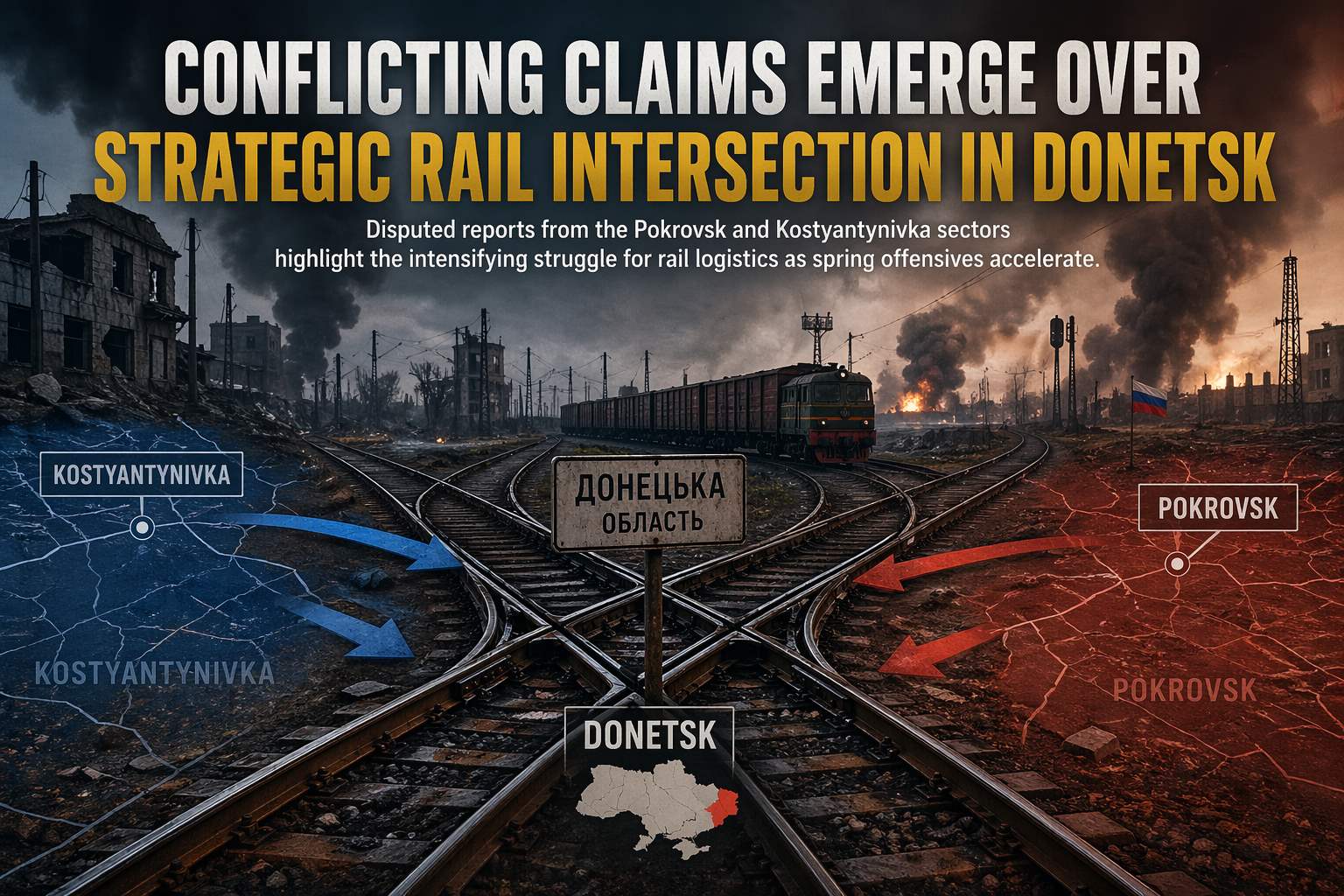
Disputed reports from the Pokrovsk and Kostyantynivka sectors highlight the intensifying struggle for rail logistics as spring offensives accelerate.
April 22, 2026
Last Updated: April 22, 2026
By Global War News Editorial
Conflicting reports have emerged from the Donetsk region regarding the control of a critical railway intersection situated between the Pokrovsk and Kostyantynivka sectors. According to a Tuesday briefing from the Russian Ministry of Defence, its units have successfully established “fire control” over a vital logistics junction near the settlement of Hryshyne. Russian Chief of General Staff Valery Gerasimov further claimed that Russian forces have “almost completely occupied” the area, a move that would significantly impede Ukrainian troop rotations.
However, the General Staff of the Armed Forces of Ukraine has directly refuted these assertions. In a statement released on Wednesday, Ukrainian military officials reported that while the Pokrovsk sector remains the site of the “fiercest combat” along the entire front, the rail intersection remains under contested control. According to Kyiv, Ukrainian defenders have successfully repelled 12 separate assaults toward Pokrovsk and its surrounding rail infrastructure in the last 24 hours alone.
The discrepancy in these accounts underscores the high strategic value of Donetsk’s railway network, which serves as the primary artery for moving heavy equipment and ammunition to the frontline.
The Strategic Value of the Hryshyne-Pokrovsk Link
The contested intersection is a major node in the regional rail system, connecting the industrial hubs of central Donetsk to the primary supply depots in the west. According to reporting from Reuters, which cited recent satellite imagery, both militaries have prioritized this sector as the focus of their spring campaigns.
For the Russian military, capturing this hub would allow for the direct transfer of supplies toward the Kramatorsk-Slovyansk agglomeration. Conversely, for the Ukrainian Armed Forces, maintaining this link is essential for the defense of the broader Donbas region. Since the closure of major stations in Slovyansk and Kramatorsk earlier this year due to constant shelling, secondary hubs like Hryshyne have taken on outsized importance for regional logistics.
Intensification of Strikes on Rail Infrastructure
The battle for ground control is occurring alongside a broader campaign targeting the tracks themselves. According to the Ukrainian Ministry of Infrastructure, Russia has carried out over 600 attacks on railway logistics since the start of 2026, with 65 recorded in April alone.
Reports from El País indicate that the danger to the rail system has forced passenger and freight trains to terminate their routes further west, in cities such as Lozova. “Beyond the current line of contact, the overhead lines are largely destroyed, and the enemy is constantly present via drone surveillance,” noted one veteran train driver interviewed in the region.
Analysis: The “Fog of War” and Tactical Claims
Military analysts suggest that the conflicting claims regarding the Hryshyne intersection reflect a “fluid tactical situation” where neither side maintains absolute dominance. According to the Institute for the Study of War (ISW), while Russian forces have made marginal gains in the Pokrovsk direction, there is currently no verified evidence to support claims of a complete takeover of the rail hub.
“What we are seeing is a pattern of maximalist claims,” says one regional defense analyst. “By claiming control of a rail junction before it is fully secured, a command can project an image of momentum. However, in modern urban and industrial warfare, ‘control’ is often temporary and subject to rapid counter-attacks.”
Economically, the disruption of this intersection has already forced a recalculation of supply chain costs for the Ukrainian defense effort. According to data from independent research institutions, the loss of direct rail access increases the reliance on road transport, which is slower, carries less volume, and is significantly more vulnerable to drone and artillery strikes.
What to Watch For
The focus in the coming days will be on whether the Ukrainian 47th or 115th Mechanized Brigades—reportedly active in this sector—can launch a counter-offensive to push Russian artillery out of range of the tracks.
According to reports from the BBC’s monitoring team, the civilian population in the surrounding villages has been urged to evacuate as the combat shifts from the outskirts into the industrial zones. If the rail intersection is confirmed to be under Russian control in the near future, it would likely signal a significant shift in the defense of the remaining Ukrainian-held cities in Donetsk.
Sources: This article is based on reporting and official statements from the Ukrainian General Staff, the Russian Ministry of Defence, Reuters, the Associated Press, the Institute for the Study of War (ISW), and El País.
This article is based on publicly available reporting from named international news agencies and attributed official statements. All claims about ongoing events are attributed to their original sources. Analysis sections represent the editorial interpretation of reported facts and do not constitute advocacy for any party to the described conflict. AI tools may be utilized for image generation to assist in explaining complex concepts, as well as for refining grammar, spelling, and other linguistic enhancements. However, all original content is produced, fact-checked, and revised by the editorial team. This publication does not take political positions on active military conflicts.