
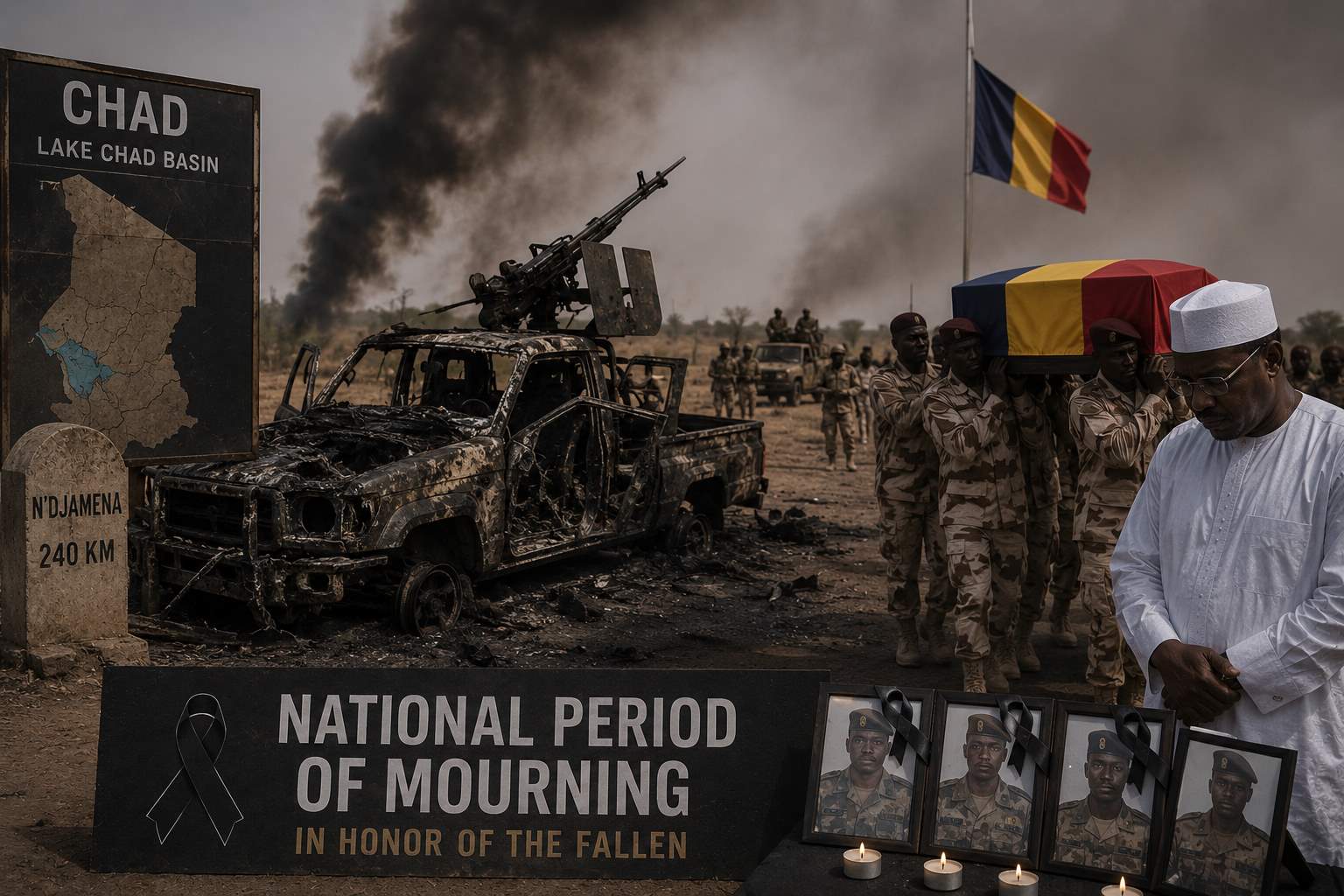
A high-casualty militant strike in the Lake Chad Basin signals a resurgence of regional instability.
May 8, 2026
Global War News Editorial
The government of Chad has declared a three-day period of national mourning following a significant ambush by Boko Haram militants that left dozens of soldiers dead in the Lake Chad Basin. The attack, which took place near the border with Nigeria and Niger, represents one of the deadliest strikes against the Chadian military in recent years and highlights the persistent security challenges in a region long plagued by extremist violence.
Chadian President Mahamat Idriss Déby Itno confirmed the incident in a statement released late Thursday, describing the loss as a “national tragedy.” While the presidency did not provide an exact final death toll, the Associated Press reported that at least 40 soldiers were killed when militants launched a surprise assault on a military outpost in the marshy borderlands of the Lake Chad region.
Tactical Shift in the Lake Chad Basin
The ambush reportedly occurred during a routine security sweep as militants utilized the dense vegetation of the lake’s islands to conceal their movement. According to Reuters, the attackers seized a quantity of military equipment, including vehicles and ammunition, before retreating into the labyrinthine waterways that characterize the border zone.
This surge in activity follows several months of relative calm in the area. Analysts from the International Crisis Group have suggested that the strike may indicate a regrouping of Boko Haram factions following internal leadership disputes. The ability to overrun a fortified military position suggests a high level of tactical coordination and intelligence gathering by the militant group, which has been active in the region for over a decade.
Regional Security Implications
The Lake Chad Basin remains a critical flashpoint for the Multinational Joint Task Force (MNJTF), a coalition comprised of troops from Chad, Nigeria, Niger, and Cameroon. The recent strike raises questions about the current effectiveness of regional intelligence sharing. As reported by Al Jazeera, the Chadian military has launched a “massive counter-offensive” to track the perpetrators, though the difficult terrain has historically hampered long-term containment efforts.
For the Chadian government, the timing of the attack is particularly sensitive. N’Djamena has long positioned itself as a regional security pillar, deploying troops to combat insurgencies across the Sahel. A significant defeat on its own soil could pressure the administration to refocus military resources inward, potentially affecting its commitments to international peacekeeping missions in neighboring countries.
Analysis: The Resilience of Insurgent Networks
The persistence of Boko Haram, despite years of military operations, underscores the complex socio-economic factors that fuel the insurgency. Observers note that the group continues to exploit the porous borders and the lack of state presence in remote areas to maintain logistical hubs.
From an economic perspective, the renewed violence threatens to disrupt local trade and fishing, which are the primary livelihoods for millions in the basin. If the insecurity persists, it could trigger a new wave of internal displacement, adding to the humanitarian burden in a region already struggling with food insecurity and climate-related challenges. It remains unclear whether this ambush is an isolated incident or the start of a broader seasonal offensive by the group.
Outlook
As the national mourning period begins, the focus remains on the military’s response in the Lake Chad region. International partners, including the United States and France, have issued statements of support for the Chadian government, though it is yet to be seen if this will translate into increased tactical assistance. The ability of the MNJTF to secure the border zone in the coming weeks will be a key indicator of whether the recent escalation can be contained.
Source Disclosure: Reporting from the Associated Press, Reuters, and Al Jazeera. Official statements from the Presidency of the Republic of Chad and the Multinational Joint Task Force (MNJTF).
This article is based on publicly available reporting from named international news agencies and attributed official statements. All claims about ongoing events are attributed to their original sources. Analysis sections represent the editorial interpretation of reported facts and do not constitute advocacy for any party to the described conflict. AI tools may be utilized for image generation to assist in explaining complex concepts, as well as for refining grammar, spelling, and other linguistic enhancements. However, all original content is produced, fact-checked, and revised by the editorial team. This publication does not take political positions on active military conflicts.