
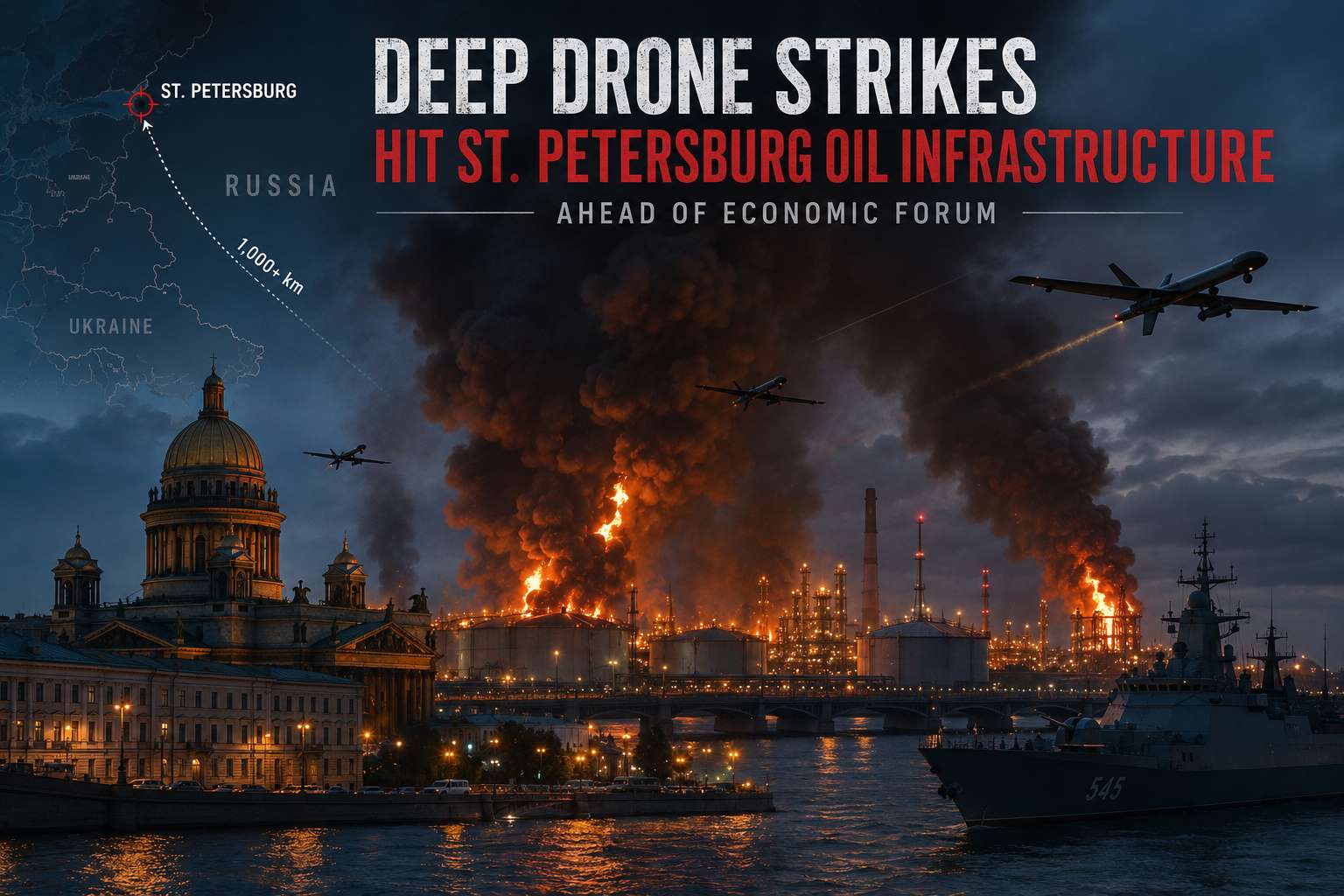
Strategic energy hub and naval assets targeted more than 1,000 kilometres from Ukrainian border as flagship summit opens.
Publication Date: June 4, 2026
Last Updated: June 4, 2026
Byline: Global War News Editorial
ST. PETERSBURG: A wave of long-range Ukrainian drones targeted critical energy and military infrastructure in St. Petersburg on Wednesday, setting a major oil trans-shipment terminal on fire. The aerial operation took place just hours before the opening of the city’s flagship annual economic event, the St. Petersburg International Economic Forum (SPIEF), an gathering often promoted by Russian President Vladimir Putin to demonstrate national economic resilience.
Ukrainian President Volodymyr Zelenskyy confirmed the operation via social media, stating that domestic uncrewed aerial vehicles (UAVs) flew more than 1,000 kilometres (600 miles) to strike the St. Petersburg Oil Terminal. Zelenskyy described the operation as part of a broader strategy of “long-range sanctions” aimed at degrading Russia’s energy export revenues and war-funding capabilities.
Russian authorities acknowledged that infrastructure sites within the city were damaged but offered contrasting details regarding the scale and impact of the operation. Leningrad regional Governor Alexander Beglov stated that emergency services responded to incidents in the city’s Kirovsky and Krasnoselsky districts, confirming that structural damage occurred but reporting no civilian fatalities at the site.
Details of the Operation and Tactical Impact
The late-night strike brought visible disruption to Russia’s second-largest city. Plumes of thick black smoke rose over the Baltic Sea port area, visible to arriving delegates at the nearby Expoforum convention center. According to reports from the Associated Press, local authorities briefly suspended flight operations at St. Petersburg’s Pulkovo Airport and temporarily cut off regional mobile internet services overnight as air defence systems engaged incoming targets.
Beyond the energy terminal, the scope of the operation extended to naval infrastructure. According to statements from the Ukrainian military and footage distributed by its drone forces, UAVs penetrated security perimeters at the nearby Kronstadt naval base, home to Russia’s Baltic Fleet. Ukrainian officials claimed a direct hit on the Russian guided-missile corvette Boikiy, which was reportedly undergoing repairs in a dry dock facility.
The Russian Ministry of Defence countered the narrative of widespread penetration, announcing that its air defence forces neutralized 354 Ukrainian drones across multiple regions overnight. However, independent Russian Telegram news channels and local residents corroborated multiple loud explosions and subsequent fires at the commercial port area.
Context: The “Russian Davos” and Tit-for-Tat Escalation
The timing of the operation carried significant symbolic weight, occurring on the opening day of SPIEF 2026. Historically referred to as the “Russian Davos,” the forum is used by the Kremlin to court international investors and state delegations from BRICS nations and the Global South, including large corporate and political delegations from Saudi Arabia, Uzbekistan, and Tanzania this year.
The strike followed twenty-four hours after a massive Russian missile and drone barrage across Ukraine on Tuesday. According to Ukrainian state authorities, those prior Russian strikes killed at least 23 civilians and wounded over 130 others in Kyiv and various regional hubs. Speaking alongside NATO Secretary General Mark Rutte in Kyiv, Zelenskyy termed the St. Petersburg strikes a fair and necessary response, indicating that Ukraine plans to expand the intensity and scale of its deep-tier production strikes.
At the same time, the broader regional conflict saw significant civilian casualties elsewhere. In the Russian-controlled portion of Ukraine’s Donetsk region, local Kremlin-appointed official Denis Pushilin alleged that a Ukrainian drone struck a civilian bus in Yenakiieve, killing eight people and wounding 11. Kyiv did not comment directly on the incident, maintaining its standard policy of denying deliberate targeting of non-military personnel.
Analysis: Economic Vulnerabilities and Strategic Shifts
Observers note that the successful penetration of air defences around St. Petersburg highlights the shifting geography of the conflict. By successfully hitting an asset located 1,100 kilometres from the state border, Ukraine demonstrated that Russia’s concentration of anti-aircraft systems in active frontline territories has left industrial centers in the Russian interior exposed to low-altitude drone infiltration.
From an economic perspective, the St. Petersburg Oil Terminal is a vital logistical cog, equipped with 32 storage tanks and an annual capacity to handle 12.5 million tons of petroleum products. Continuous disruptions to these northern maritime export pathways elevate security and insurance risks for commercial shipping in the Baltic Sea. While Kremlin spokesperson Dmitry Peskov vowed a “systemic response” to safeguard critical infrastructure, analysts suggest that regular exposure to long-range aerial strikes threatens the stable flow of oil revenues that form the core of Moscow’s war economy.
What to Watch
In the coming days, international monitors will watch for any operational adjustments at the Baltic shipping ports and assess whether Russia shifts heavy air defence assets from the Ukrainian frontline back toward northern industrial sectors. Furthermore, attention will focus on President Vladimir Putin’s upcoming keynote address at the economic forum on Friday, where he is expected to address domestic infrastructure security and alternative international trade partnerships amid ongoing Western sanctions.
Source Disclosure Note: This report is compiled from verified statements and coverage provided by international news agencies including Reuters, the Associated Press (AP), and Agence France-Presse (AFP). Additional context is drawn from official press releases by the Ukrainian Presidency, the Russian Ministry of Defence, local statements from Governor Alexander Beglov, and regional reports from independent media outlets including the Guardian and the Indian Express.
This article is based on publicly available reporting from named international news agencies and attributed official statements. All claims about ongoing events are attributed to their original sources. Analysis sections represent the editorial interpretation of reported facts and do not constitute advocacy for any party to the described conflict. AI tools may be utilized for image generation to assist in explaining complex concepts, as well as for refining grammar, spelling, and other linguistic enhancements. However, all original content is produced, fact-checked, and revised by the editorial team. This publication does not take political positions on active military conflicts.