
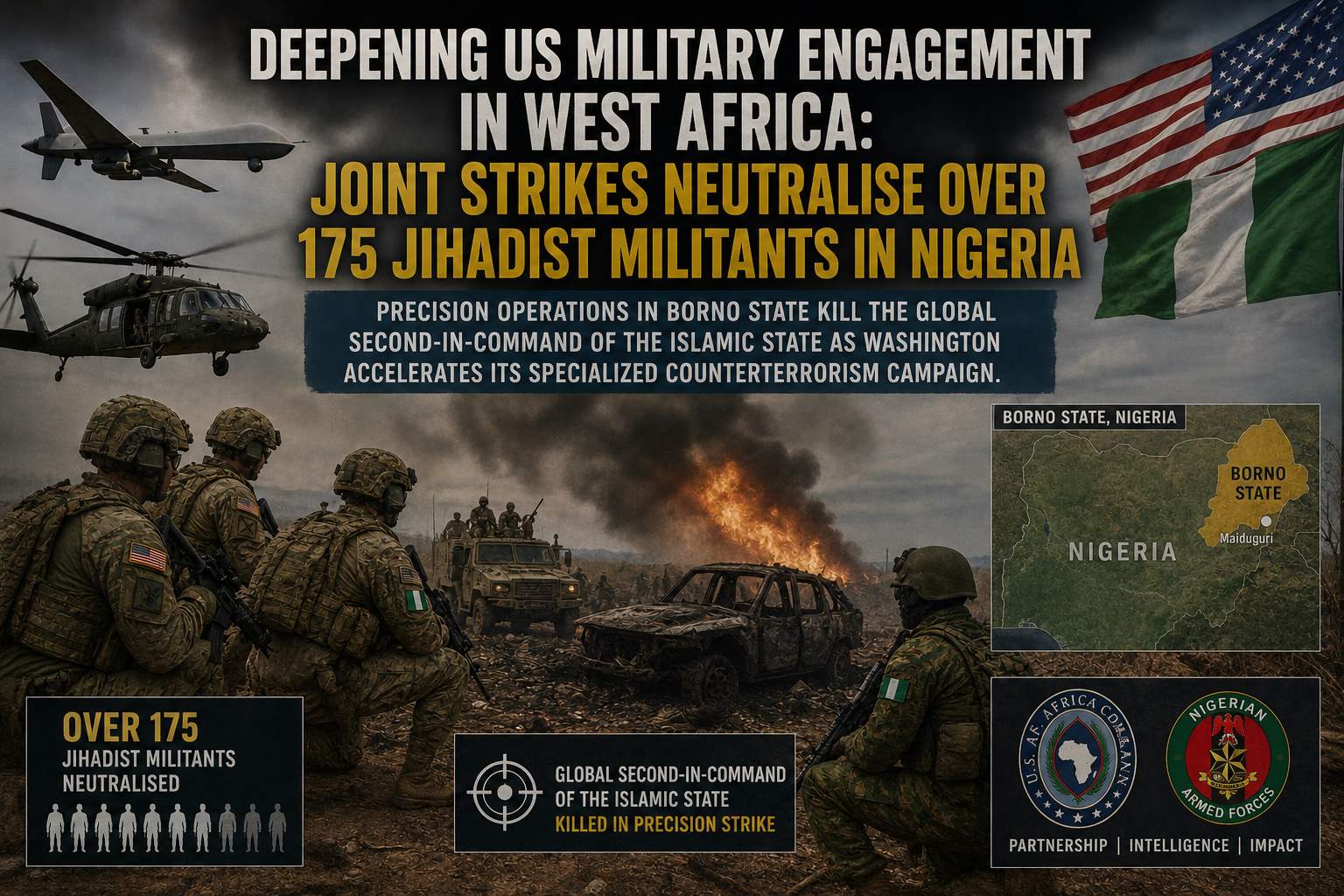
Precision operations in Borno State kill the global second-in-command of the Islamic State as Washington accelerates its specialized counterterrorism campaign.
Published: May 21, 2026
By: Global War News Editorial
A series of high-intensity, coordinated military operations conducted by the United States and Nigerian armed forces in northeastern Nigeria has resulted in the deaths of approximately 175 Islamic State fighters over the last several days.
The joint offensive, which marks a significant escalation in direct US kinetic involvement in West Africa, achieved its primary objective on Saturday with the elimination of Abu-Bilal al-Minuki, also identified by officials as Abu Bakr al-Mainuki. According to official dispatches from Washington and Abuja, al-Minuki was the global second-in-command of the Islamic State and the head of its General Directorate of States, making his removal the most substantial blow to the trans-regional terrorist network in recent years.
The Air-Land Assault on Lake Chad Basin
The initial operation commenced during the early hours of Saturday, May 16, targeting a highly fortified insurgent stronghold hidden on remote islands within the Lake Chad Basin. According to statements released by the Nigerian military task force spokesperson, Colonel Sani Uba, the mission was executed as a highly complex precision air-land operation under total darkness.
The assault began when approximately two dozen specialized operators, including elements from the elite US Navy SEAL Team 6, arrived via low-altitude helicopters on the islands of Tumbun Gini and Tumbun Dalo. Ground forces engaged in a fierce three-hour firefight with entrenched militants.
When it became clear that the insurgent commanders would not surrender, and to prevent a potential tactical escape through the dense marshlands, an airstrike was directed onto the central compound. The strike killed al-Minuki along with several high-ranking lieutenants.
According to international security logs, the operation also neutralized several key specialized personnel:
- Abd-al Wahhab: A senior regional commander responsible for tactical coordination and regional recruitment frameworks.
- Abu Musa al-Mangawi: A prominent internal operative within the Islamic State West Africa Province network.
- Abu al-Muthanna al-Muhajir: The director overseeing regional media production and digital propaganda networks.
Sustained Kinetic Campaign and Casualties
The initial air-land raid was not an isolated engagement. Following the collection of battlefield intelligence from the captured compound, US Africa Command, in close coordination with the Government of Nigeria, executed additional waves of kinetic airstrikes on Sunday, May 17, and Monday, May 18.
On Sunday, airstrikes targeted active logistical hubs and assembly points near the town of Metele in northern Borno State, killing an estimated 20 militants. By Tuesday, May 19, the Nigerian Defence Headquarters confirmed that the cumulative insurgent death toll across the four-day offensive had reached approximately 175 fighters belonging to both ISWAP and its historical rival faction, Boko Haram. Both US and Nigerian military commands verified that no friendly forces were harmed or state assets lost during the engagements.
Context: Shifting Directives in US Foreign Policy
The scale of the offensive represents a definitive shift toward direct US military intervention in Nigeria. Washington and Abuja have rapidly intensified security cooperation following a foreign policy redesign late last year, when US President Donald Trump designated Nigeria as a country of particular concern over regional security threats.
While previous US administrations restricted their involvement primarily to intelligence sharing, logistics advice, and localized drone surveillance, current operations include direct combat tracking on the ground. In December, President Trump authorized initial airstrikes against armed cells in northwestern Sokoto State.
By February, more than 100 specialized US advisory personnel had deployed to local bases, accompanied by advanced long-range aerial defense assets. Air Force General Dagvin R. M. Anderson, commander of US Africa Command, addressed the House Armed Services Committee on Tuesday, characterizing al-Minuki as one of the most active and impactful threat actors globally and noting that these continuous strikes have fundamentally disrupted the transnational operational capacity of the Islamic State network.
Regional Significance and Geopolitical Gaps
The elimination of al-Minuki carries broad strategic implications for the Lake Chad region, where ISWAP has consistently maintained territorial influence over expansive rural corridors.
| Operation Date | Location | Primary Targets | Reported Enemy Casualties |
| May 16, 2026 | Lake Chad Basin Islands | Global Deputy Abu-Bilal al-Minuki & Key Lieutenants | Multiple Senior Officials Killed |
| May 17, 2026 | Metele Region, Borno State | ISWAP Logistics Hubs & Staging Ground | ~20 Militants Neutralised |
| May 18, 2026 | Northeastern Cross-Border Zones | Dispersed Boko Haram & ISWAP Retaliation Units | Cumulative Toll Reaches ~175 |
Independent security researchers, including Malik Samuel at Good Governance Africa, note that while the strikes represent a massive psychological and intelligence success, they may prompt a swift and aggressive internal reorganization. Historically, regional jihadist factions have demonstrated a high capacity to rapidly fill vacuum positions in their command hierarchies.
Furthermore, analysts highlight potential domestic political sensitivities. While Nigerian President Bola Tinubu has strongly supported the enhanced US security partnership, deep-seated domestic concerns remain regarding foreign military footprints within northern Nigeria. Framed strictly as joint operations, the Tinubu administration seeks to balance local sovereign authority with the specialized military capabilities required to dismantle entrenched insurgent networks that have displaced millions over the past decade.
What to Watch Next
Military planners indicate that complete assessments of the affected zones remain ongoing, with aerial reconnaissance units tracking potential insurgent regroupings along the borders of Niger and Cameroon. The primary question moving forward is whether the sudden degradation of ISWAP’s central leadership will allow state authorities to re-establish administrative governance in rural Borno, or if the remaining cells will launch decentralized retaliatory campaigns against local civilian centers and symbols of international cooperation.
Source Disclosure Note: This report is based on official operational statements and briefing data from US Africa Command, testimony by General Dagvin R. M. Anderson before the US House Armed Services Committee, and formal press statements issued by Colonel Sani Uba of the Nigerian military task force. Additional reporting and contextual details were gathered from the international news agencies Associated Press, Agence France-Presse, and BBC News, alongside data tracking from the Counter Extremism Project and Good Governance Africa.
This article is based on publicly available reporting from named international news agencies and attributed official statements. All claims about ongoing events are attributed to their original sources. Analysis sections represent the editorial interpretation of reported facts and do not constitute advocacy for any party to the described conflict. AI tools may be utilized for image generation to assist in explaining complex concepts, as well as for refining grammar, spelling, and other linguistic enhancements. However, all original content is produced, fact-checked, and revised by the editorial team. This publication does not take political positions on active military conflicts.