
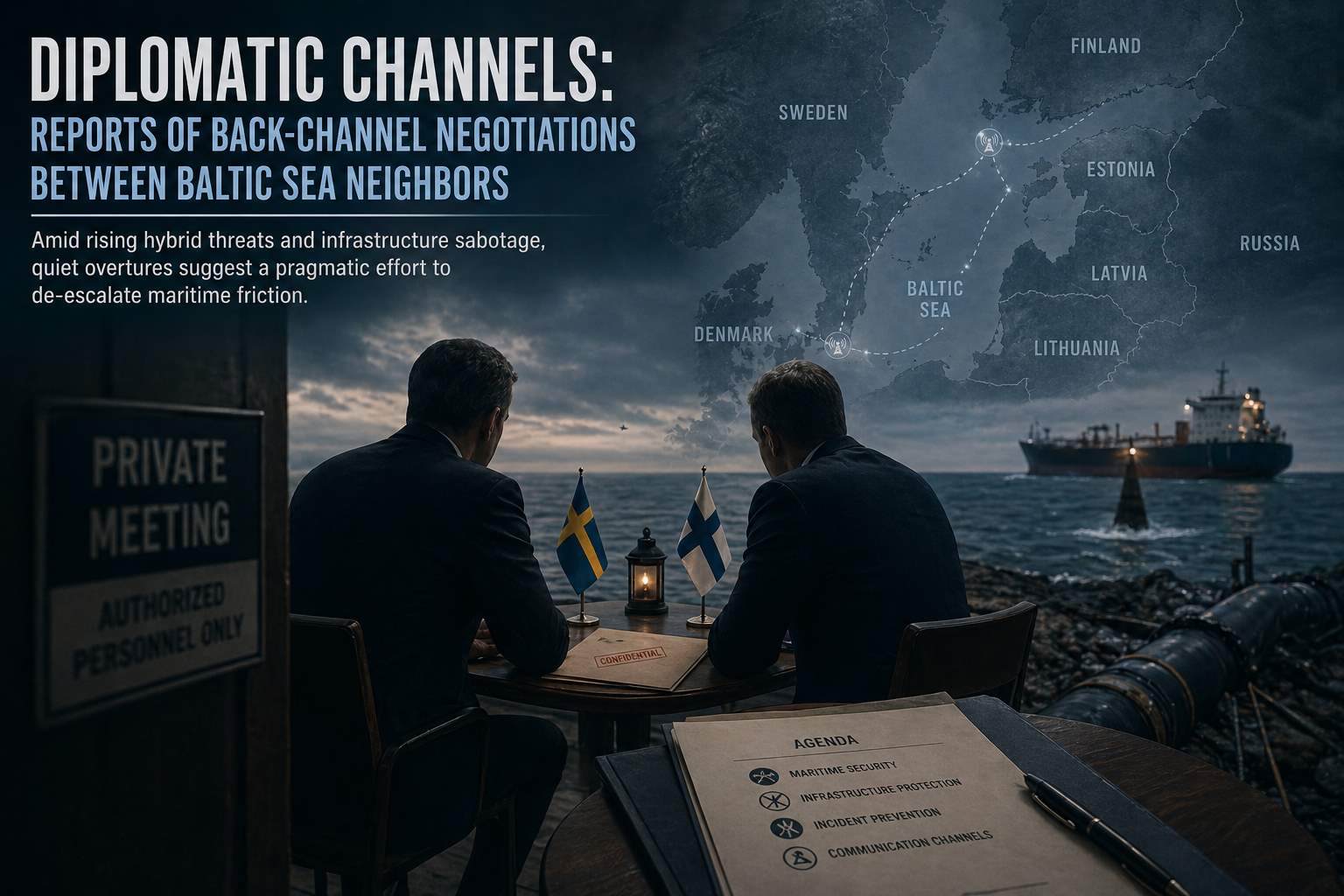
Amid rising hybrid threats and infrastructure sabotage, quiet overtures suggest a pragmatic effort to de-escalate maritime friction.
April 27, 2026
Last updated: April 27, 2026
By Global War News Editorial
Unconfirmed reports of discrete “back-channel” negotiations between several Baltic Sea states and regional actors have surfaced, suggesting a quiet diplomatic effort to mitigate the risk of accidental escalation. These discussions, reportedly held in neutral European capitals over the past fortnight, appear focused on establishing basic maritime safety protocols and “hotline” communication channels to prevent hybrid incidents from spiraling into conventional military confrontations.
While official government spokespersons in the Baltic capitals and Moscow have publicly maintained a posture of non-engagement, diplomatic sources cited by Bloomberg and Le Monde Diplomatique indicate that mid-level officials have engaged in “exploratory” talks. The primary impetus for these contacts is the increasing frequency of GPS jamming, drone incursions, and the persistent presence of the “shadow fleet” in the Baltic’s narrow transit corridors.
Background: A Sea of Strategic Friction
The Baltic Sea has become one of the world’s most contested maritime spaces following the 2022 sabotage of the Nord Stream pipelines and the more recent 2025 incidents involving subsea data cables and the Balticconnector. By April 2026, the region has effectively transitioned into a “NATO lake” with the full integration of Finland and Sweden, yet it remains a vital—and increasingly volatile—corridor for Russian energy exports from St. Petersburg and Ust-Luga.
Tensions reached a new peak earlier this month when the Russian Security Council accused Lithuania of “militarizing” the borders of Kaliningrad. In response, NATO’s eastern flank has seen a significant buildup of civil defense and information resilience programs designed to counter what analysts describe as “gray-zone” warfare.
Economic Impact: Insurance Premiums and Energy Transit
The volatility in the Baltic Sea carries a direct “security tax” for regional economies. While the Baltic states, Estonia, Latvia, and Lithuania, are projected by Luminor to see accelerated GDP growth in late 2026, this recovery remains vulnerable to maritime disruptions.
- The Shadow Fleet Risk: Between 2022 and early 2026, the number of Russian shadow fleet voyages in the Baltic rose significantly. According to the European Policy Centre, roughly 60% of these aging tankers lack proper insurance, creating a massive environmental and liability risk for coastal states.
- Sanctions and Services: The EU’s 19th and 20th sanctions packages, implemented throughout 2025 and early 2026, have introduced a phased ban on Russian LNG and a complete prohibition on maritime services for Russian crude. Back-channel talks are reportedly addressing the “technical” fallout of these bans to avoid hazardous ship-to-ship transfers in international waters.
- Infrastructure Security: The cost of monitoring subsea energy and data infrastructure has surged. For nations like Finland and Estonia, the integrity of these links is central to their 2026 green transition goals, including the development of offshore wind farms.
Analysis: Prudence vs. Rapprochement
The reports of back-channel talks should not be mistaken for a broader political rapprochement. Analysts note that for the Baltic states, there is “no going back” to pre-2022 relations with Moscow. However, as one Belgian official recently noted in a call for “common sense” diplomacy, the total absence of communication increases the risk of a catastrophic miscalculation.
The primary goal of these quiet overtures appears to be “risk reduction” rather than “conflict resolution.” By discussing maritime boundaries and the behavior of the shadow fleet, both sides may be attempting to avoid an environmental disaster in the Baltic Sea that neither economy can currently afford. Nevertheless, these talks are highly sensitive; for Baltic governments, any perception of “softening” toward Moscow carries immense domestic political risk, given the deep societal resistance to Russian domination.
Current Status and Outlook
As of late Monday, no formal statements have been issued regarding the outcome of these alleged negotiations. US-led peace negotiations regarding the broader theater remain largely stalled, leaving regional actors to manage their own immediate security perimeters.
The outlook for the coming months depends on whether these back-channel contacts can produce a “maritime code of conduct” for the Baltic. The primary indicator for May will be whether the frequency of GPS jamming incidents in the Suwałki Corridor and the Gulf of Finland begins to subside. For the global economy, a stabilized Baltic Sea remains a prerequisite for the continued recovery of Northern European trade; for the region, it is a matter of ensuring that a “hybrid war” does not inadvertently ignite a conventional one.
Sources:
- The Japan Times (Reports on Baltic diplomatic warnings, April 23, 2026).
- Lansing Institute (Analysis of Russian hybrid threats in the Baltics, April 24, 2026).
- Le Monde Diplomatique (Analysis of Nord Stream and regional back-channels, March-April 2026).
- European Policy Centre (Report on the maritime services ban and shadow fleet risks, March 2026).
- Luminor Baltic Economic Outlook (March 2026).
This article is based on publicly available reporting from named international news agencies and attributed official statements. All claims about ongoing events are attributed to their original sources. Analysis sections represent the editorial interpretation of reported facts and do not constitute advocacy for any party to the described conflict. AI tools may be utilized for image generation to assist in explaining complex concepts, as well as for refining grammar, spelling, and other linguistic enhancements. However, all original content is produced, fact-checked, and revised by the editorial team. This publication does not take political positions on active military conflicts.