
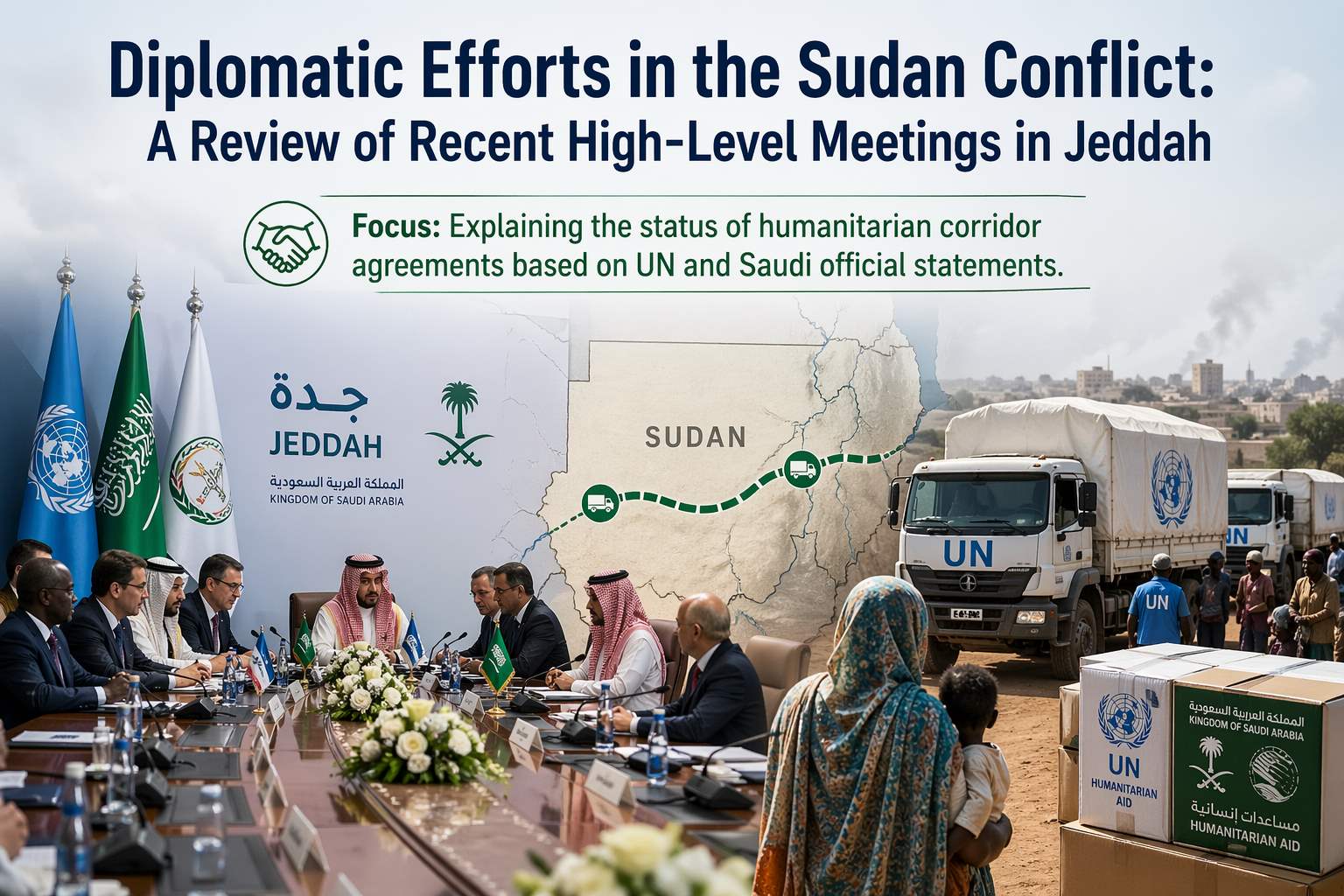
Humanitarian corridor agreements remain the centerpiece of diplomatic friction as the world’s largest displacement crisis enters its third year
April 24, 2026
Last Updated: 18:30 UTC
By Staff Writer, Global War News
Three years into a conflict that has reshaped the Horn of Africa, the Kingdom of Saudi Arabia continues to serve as the primary diplomatic venue for mediation between the Sudanese Armed Forces (SAF) and the Rapid Support Forces (RSF). According to official statements from the Saudi Ministry of Foreign Affairs and the United Nations, a high-level meeting took place in Jeddah on April 20, 2026, between Saudi Crown Prince Mohammed bin Salman and Sudan’s Sovereign Council chief, General Abdel Fattah al-Burhan.
While the discussions reportedly touched on Red Sea security and regional stability, the primary focus for the international community remains the “Jeddah Declaration” framework, a series of commitments designed to protect civilians and facilitate the delivery of humanitarian aid. Despite the high-profile nature of these talks, UN officials have expressed growing concern that the implementation of safe passage corridors remains largely stalled on the ground.
The Jeddah Framework and Corridor Agreements
The Jeddah Declaration, originally facilitated by Saudi Arabia and the United States in May 2023, remains the only formal document signed by both warring parties that mandates the protection of non-combatants. According to recent briefings from the UN Office for the Coordination of Humanitarian Affairs (OCHA), the status of these corridors as of late April 2026 is as follows:
- Cross-Border Routes: Success has been noted in the expansion of cross-border assistance through the Farchana hub in eastern Chad. According to the International Organization for Migration (IOM), this route has become a critical lifeline for the Darfur region.
- Cross-Line Obstacles: Within Sudan, “cross-line” aid—moving supplies across active battlefields—is frequently blocked. Saudi official readouts from the April 20 meeting emphasized the “necessity of preserving Sudan’s sovereignty,” which analysts interpret as a nod to the SAF’s insistence on controlling aid distribution through government-held hubs like Port Sudan.
- The El Fasher Siege: Reports from UN field teams indicate that corridors into El Fasher, North Darfur, remain effectively severed by siege tactics, despite the Jeddah commitments to vacate urban centers.
Official Statements and Diplomatic Pressure
The diplomatic narrative in Jeddah has shifted toward a more pragmatic, though restricted, focus on “humanitarian truces” rather than a comprehensive peace deal.
- Saudi Arabia’s Stance: In a readout from the Saudi Press Agency following the April 20 meeting, the Kingdom reaffirmed its commitment to “Sudan’s security and stability.” However, observers note that Riyadh has recently sought to distance itself from the appearance of proxy involvement, notably by reportedly requesting the cancellation of external arms deals to the SAF to maintain its “neutral mediator” status.
- The UN Position: Speaking at a press stakeout on April 14, UN Secretary-General António Guterres described the disregard for humanitarian obligations in Sudan as a “wholesale assault on international law.” UN Envoy Jean Arnault, currently visiting Saudi Arabia, stated that the UN is seeking a “comprehensive settlement” but emphasized that aid alone cannot solve a crisis driven by “regional rivalries and vested interests.”
Economic and Humanitarian Context
The urgency of the Jeddah meetings is driven by a domestic economic collapse that has now affected nearly every household in Sudan. According to the 2026 Sudan Humanitarian Needs and Response Plan, approximately 33.7 million people—roughly 10% of the global total—require immediate assistance.
- Agricultural Disruption: Fighting hasSubsistence and commercial farming in the Al Jazirah scheme has been severely disrupted, though the regional governor claimed in late April that activity had reached 85% of capacity.
- Funding Gaps: The World Food Programme (WFP) estimates it needs over $600 million to sustain operations through the next six months. Current aid delivery is reportedly down 14% compared to early 2025 due to a lack of resources and physical access barriers.
Analysis: The Quad and the “New Peace Plan”
Analysts have suggested that the diplomatic efforts in Jeddah are currently being managed by a “Quad” grouping consisting of Saudi Arabia, the UAE, the United States, and Egypt. This group is reportedly finalizing a new peace roadmap, according to the International Institute for Strategic Studies (IISS).
The central challenge for this plan is the “existential” nature of the conflict for both the SAF and RSF leaders. Observers note that while Saudi Arabia has intensified its role as a diplomatic host, the warring parties appear to be utilizing these high-level meetings more for political legitimacy than for genuine tactical de-escalation. It remains unclear whether the international monitoring mechanism proposed by EU diplomats on April 21 will be integrated into the Jeddah framework to ensure that corridors, once opened, stay open.
Closing Summary
The recent high-level meetings in Jeddah represent a continued international effort to manage the world’s most severe humanitarian crisis. While the diplomatic rhetoric emphasizes sovereignty and civilian protection, the reality on the ground remains one of restricted access and systematic violations of the Jeddah Declaration. As the conflict approaches its third year, the focus of Saudi and UN mediators appears to be shifting toward the localization of aid and the securing of temporary truces to prevent further famine.
Sources: This article is based on official statements from the Saudi Press Agency (SPA), briefings from the UN Secretary-General’s spokesperson, and the April 2026 Sudan Humanitarian Needs and Response Plan by OCHA. Additional context was provided by reports from the Sudan Tribune, Al-Monitor, and the International Organization for Migration (IOM).
This article is based on publicly available reporting from named international news agencies and attributed official statements. All claims about ongoing events are attributed to their original sources. Analysis sections represent the editorial interpretation of reported facts and do not constitute advocacy for any party to the described conflict. AI tools may be utilized for image generation to assist in explaining complex concepts, as well as for refining grammar, spelling, and other linguistic enhancements. However, all original content is produced, fact-checked, and revised by the editorial team. This publication does not take political positions on active military conflicts.