
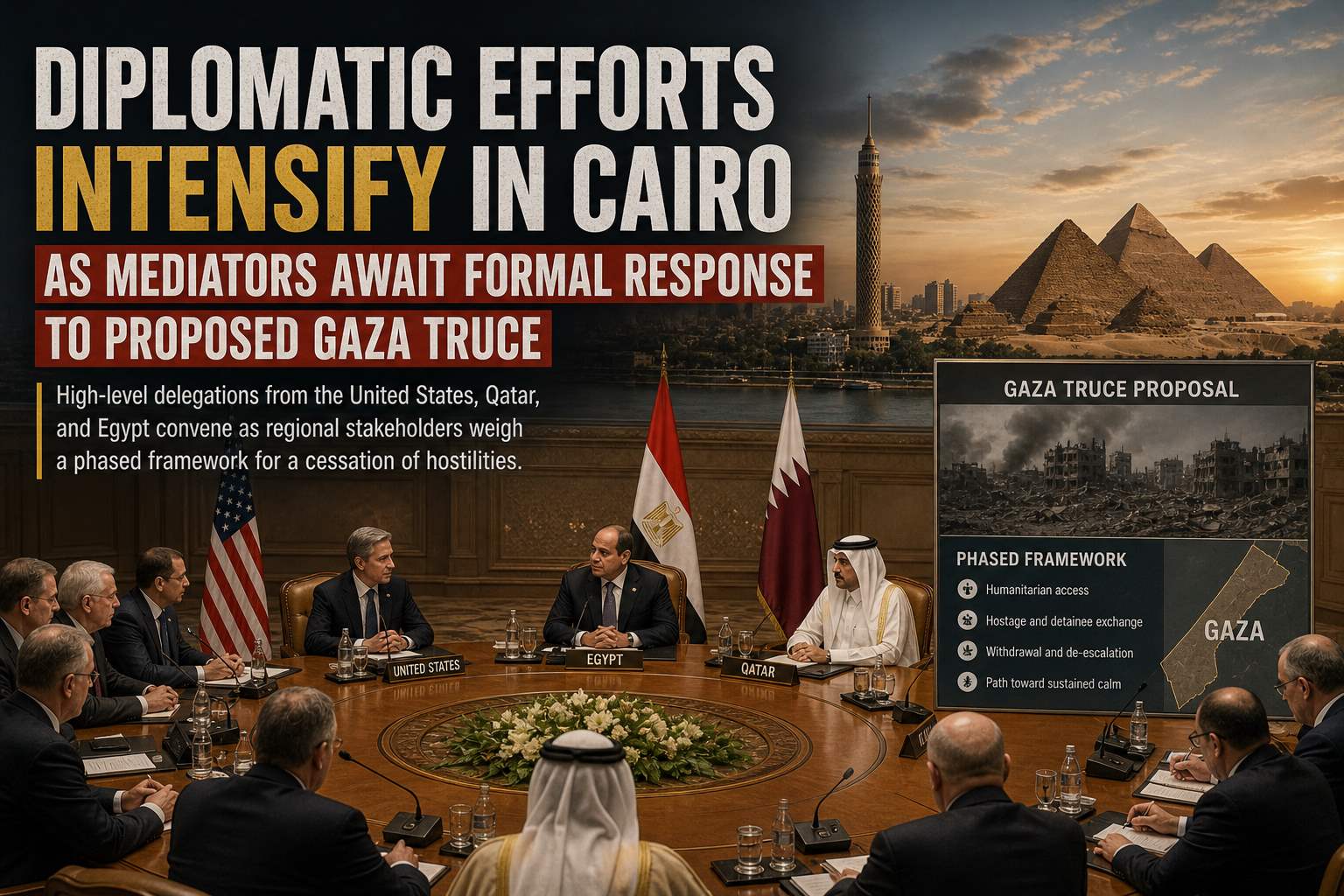
High-level delegations from the United States, Qatar, and Egypt convene as regional stakeholders weigh a phased framework for a cessation of hostilities.
May 5, 2026
By Global War News Editorial
Diplomatic activity in Cairo has reached a critical juncture this week as international mediators await a formal response to a refined proposal for a truce in the Gaza Strip. According to reports from Reuters and the Associated Press, senior officials from Egypt and Qatar, supported by U.S. Central Intelligence Agency (CIA) Director William Burns, have held continuous sessions with representative delegations to bridge remaining gaps in a three-phased ceasefire framework.
The current proposal reportedly involves a six-week initial pause in combat operations, the exchange of specific categories of detainees for Palestinian prisoners, and a significant increase in humanitarian aid flow to the northern districts. Egyptian state-affiliated media reported that the atmosphere in the talks has been “cautiously optimistic,” though official spokespersons for the negotiating parties have refrained from declaring a breakthrough.
Context and Background
The Cairo negotiations represent the most sustained diplomatic effort to halt the conflict since the collapse of a brief pause in late 2024. The human and economic costs of the current escalation have created immense pressure for a resolution. According to World Bank data, the economic damage in Gaza has exceeded $20 billion, while the broader regional impact has seen a contraction in tourism and trade for neighboring states.
Historically, negotiations have stalled over the definition of a “permanent” versus “temporary” cessation of hostilities. The current “phased” approach is designed to build confidence by addressing immediate humanitarian needs before tackling the more complex issues of long-term governance and security arrangements.
Analysis: The “Phased” Framework and Domestic Pressures
The intensification of talks in Cairo highlights a shift in mediator strategy toward a modular agreement. Analysts suggest that by separating the humanitarian exchange from the broader political settlement, mediators are attempting to create a “cooling-off period” that makes a return to high-intensity combat politically difficult for both sides.
However, significant hurdles remain. Observers note that domestic political pressures in both Israel and within the Palestinian leadership continue to dictate the boundaries of acceptable concessions. For the Israeli government, the primary objective remains the verifiable return of all remaining captives and the assurance that the northern border remains secure. For Palestinian representatives, the unconditional return of displaced families to northern Gaza and a clear timeline for the withdrawal of forces are central demands. It remains unclear whether the “language of ambiguity” used in the current draft, intended to allow both sides to claim a strategic victory, will survive the scrutiny of their respective hardline factions.
Current Status and Outlook
As of May 5, the technical teams in Cairo remain in session. Reports from the Associated Press suggest that a formal response from the Hamas leadership is expected within the next 48 to 72 hours. While the U.S. State Department has described the current offer as “extraordinarily generous,” the actual implementation depends on the resolution of specific “red lines” regarding military corridors. Until a signed agreement is announced, military operations in the southern districts of Gaza are expected to continue, with both parties seeking to maximize their tactical leverage before a potential pause takes effect.
Source Disclosure: This report is based on briefings from Reuters and the Associated Press, official statements from the Egyptian State Information Service, and economic assessments from the World Bank and the IMF.
This article is based on publicly available reporting from named international news agencies and attributed official statements. All claims about ongoing events are attributed to their original sources. Analysis sections represent the editorial interpretation of reported facts and do not constitute advocacy for any party to the described conflict. AI tools may be utilized for image generation to assist in explaining complex concepts, as well as for refining grammar, spelling, and other linguistic enhancements. However, all original content is produced, fact-checked, and revised by the editorial team. This publication does not take political positions on active military conflicts.