
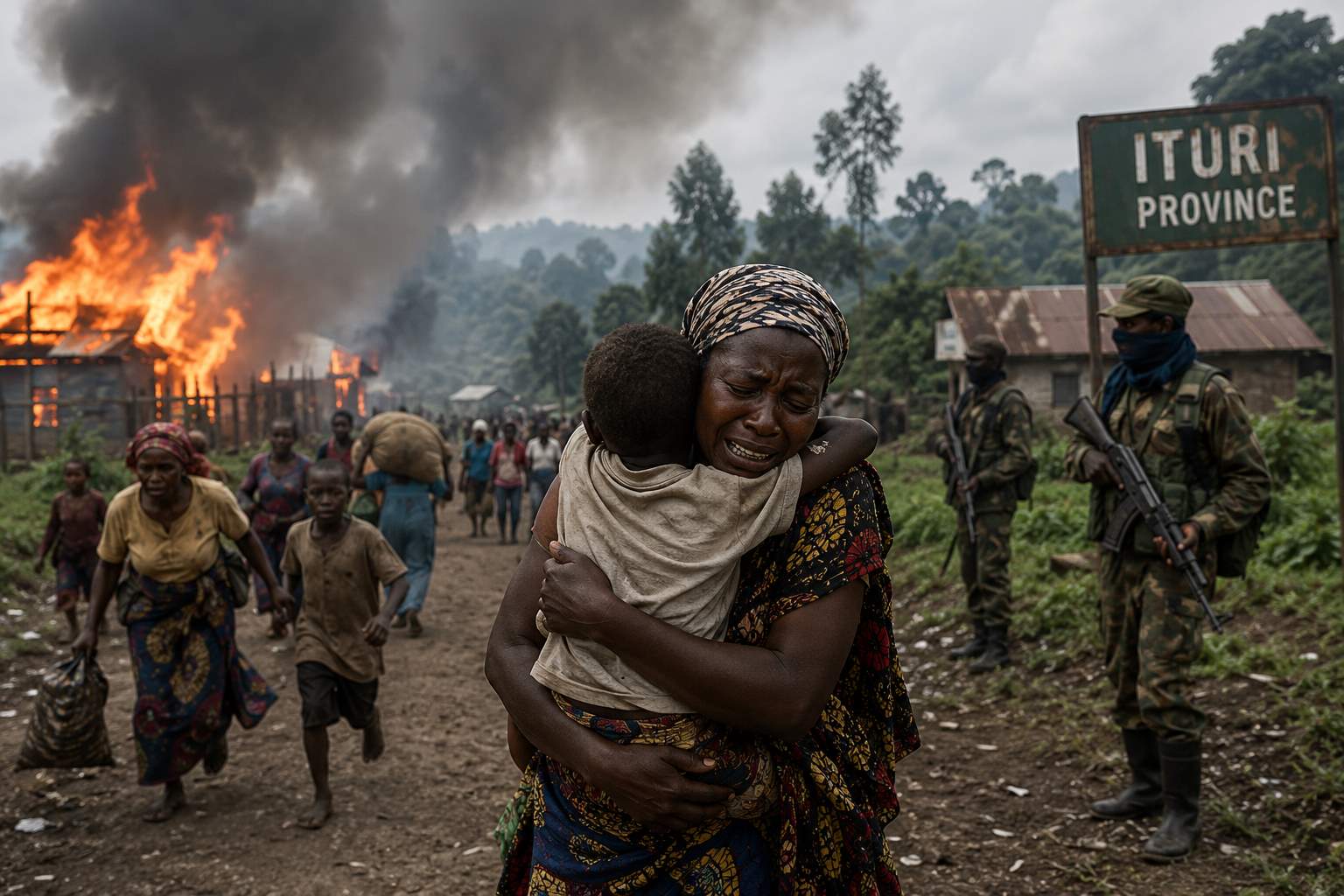
Intensifying violence in Ituri province leaves local communities reeling as security forces struggle to contain non-state armed groups
May 13, 2026
Last updated: 11:30 GMT
By Global War News Editorial
Authorities in the Democratic Republic of the Congo (DRC) have reported a significant loss of life following a series of coordinated attacks on villages in the country’s volatile eastern region. According to local government officials in Ituri province, at least 34 civilians were killed during raids carried out late Monday and early Tuesday. The attacks have been attributed to the Cooperative for the Development of the Congo (CODECO), a loose association of various Lendu militias.
The United Nations Joint Human Rights Office (UNJHRO) in the DRC stated that the attackers targeted residential areas in the Djugu territory, reportedly burning homes and looting livestock. While the DRC military (FARDC) has confirmed that operations are underway to secure the affected villages, the scale of the displacement following these latest incursions remains unclear.
Eastern DRC has faced decades of cyclical violence, but observers note that the frequency of militia activity has increased in the first half of 2026. This surge in conflict continues to complicate both humanitarian aid delivery and the regional economic stability of the mineral-rich highlands.
Details of the Incursions
Local civil society leaders in Ituri reported that the attackers entered the villages of Mabindi and Kilo-State under the cover of darkness. According to a statement provided to Reuters by a local administrator, the victims included several children and elderly residents who were unable to flee when the militias arrived.
The FARDC spokesperson for the region, Lieutenant Jules Ngongo, said that the military responded to the distress calls and engaged in a firefight with the militants. While Ngongo claimed that “several rebels were neutralized,” the military has not yet provided a specific count of militia casualties. Independent verification of these figures remains difficult due to the remote nature of the terrain and ongoing security risks for journalists and international monitors.
CODECO, the group accused of the massacre, has not issued a formal statement. The group claims to protect the interests of the Lendu ethnic community against rival Hema groups, but it has been frequently accused by the UN of carrying out indiscriminate killings of civilians regardless of ethnic background.
Context and Regional Stability
The violence in Ituri is part of a broader pattern of instability involving over 120 armed groups operating across eastern DRC, including the M23 rebels and the Allied Democratic Forces (ADF). These groups often compete for control over the region’s vast natural resources, which include significant deposits of gold, coltan, and tin.
Analysis suggests that the inability of the central government in Kinshasa to establish a permanent security presence in these remote borderlands allows militias to operate with relative impunity. Despite the presence of the MONUSCO peacekeeping mission, which is currently in the process of a phased withdrawal, civilian protection remains a primary challenge for the international community.
Analysis: The Economic Cost of Instability
Observers note that the persistent insecurity in eastern DRC serves as a major deterrent to long-term infrastructure investment. While the DRC is a global leader in the production of minerals essential for the green energy transition, the “conflict gold” trade often funds the very militias responsible for the violence reported this week.
Economists focusing on Central Africa have suggested that the displacement of agricultural communities in Ituri will likely lead to localized food price inflation. As farmers abandon their fields to seek safety in larger urban centers or UN-protected camps, the regional supply chain for staples like cassava and maize is being systematically dismantled.
Furthermore, the volatility of the region complicates the implementation of the Luanda and Nairobi peace processes. These regional diplomatic initiatives aim to de-escalate tensions between the DRC and its neighbors, particularly Rwanda, which Kinshasa accuses of supporting the M23 rebels. While the CODECO attacks are largely considered an internal militia issue, they add to the general atmosphere of lawlessness that makes regional diplomatic breakthroughs increasingly difficult to maintain.
What to Watch For
The DRC government is expected to face renewed pressure from the African Union and Western partners to accelerate security sector reforms. In the coming weeks, the focus will likely shift to whether the FARDC can maintain a holding force in the Djugu territory to prevent retaliatory attacks. Additionally, humanitarian organizations are monitoring the potential for a new wave of internal displacement toward the provincial capital, Bunia, which could further strain already limited aid resources.
Source Disclosure Note: This report is based on official statements from the DRC military (FARDC), reporting from the United Nations Joint Human Rights Office (UNJHRO), and coverage from international wire services including Reuters and Agence France-Presse (AFP). Information regarding militia history and regional dynamics was sourced from the Kivu Security Tracker and the UN Security Council’s Group of Experts on the DRC.
This article is based on publicly available reporting from named international news agencies and attributed official statements. All claims about ongoing events are attributed to their original sources. Analysis sections represent the editorial interpretation of reported facts and do not constitute advocacy for any party to the described conflict. AI tools may be utilized for image generation to assist in explaining complex concepts, as well as for refining grammar, spelling, and other linguistic enhancements. However, all original content is produced, fact-checked, and revised by the editorial team. This publication does not take political positions on active military conflicts.