
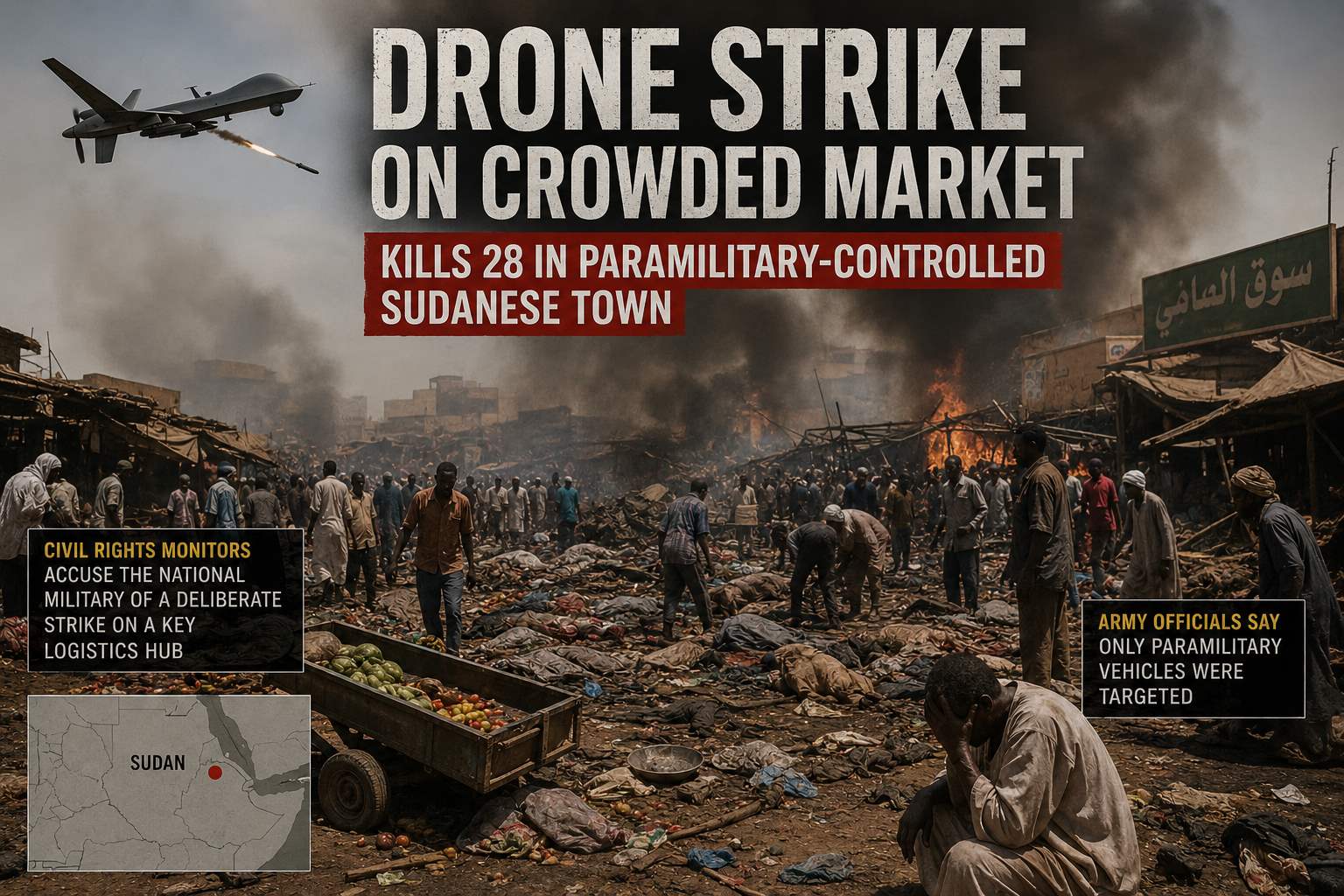
Civil rights monitors accuse the national military of a deliberate strike on a key logistics hub, while army officials state that only paramilitary vehicles were targeted.
Published: May 21, 2026
By: Global War News Editorial
A drone strike on a crowded marketplace in the town of Ghubaysh, located in Sudan’s southern West Kordofan State, has killed at least 28 people and wounded dozens of others. The incident represents one of the deadliest single aerial bombardments affecting civilians since the regional conflict escalated earlier this spring.
Local medical personnel and independent rights monitors report that the attack occurred on Tuesday morning, hitting a commercial center packed with hundreds of shoppers. The town of Ghubaysh is currently under the operational control of the paramilitary Rapid Support Forces, which has been engaged in a full-scale civil war against the Sudanese Armed Forces since April 2023.
Contradictory Accounts of the Strike
Witnesses and local advocacy groups have provided conflicting details regarding the exact sequence of the bombardment, though all confirm a high civilian casualty toll. According to three local witnesses interviewed by Agence France-Presse, the strike directly impacted a busy restaurant located within the main marketplace.
One witness described what appeared to be a two-stage attack. The initial detonation reportedly struck an active paramilitary combat vehicle parked near the commercial stalls, killing three personnel on board. Moments later, a secondary blast hit the adjacent restaurant, where the majority of civilian casualties occurred. Videos circulating on social media networks following the explosion confirmed the presence of damaged paramilitary logistics vehicles in the immediate vicinity of the destroyed restaurant structure.
The Emergency Lawyers, an independent Sudanese legal advocacy group that monitors human rights violations, issued a formal statement placing full responsibility on the Sudanese national military. The group characterized the bombardment as part of a systematic campaign targeting public infrastructure to exert collective pressure on populations living under paramilitary administration.
Officials within the Sudanese Armed Forces have strongly denied allegations of targeting non-combatants. Speaking to the Associated Press on the condition of anonymity, a military official stated that the national army does not direct operations against civilian infrastructure. A separate military source told reporters that an army drone successfully targeted and destroyed two paramilitary transport vehicles while they were refueling near the market perimeter. The source maintained that the operation killed the combatants inside the vehicles without inflicting civilian casualties. The paramilitary forces have not issued an official public response to the strike.
The Strategic Importance of the Ghubaysh Market
The targeting of the Ghubaysh market carries significant economic implications for the civilian population of West Kordofan. According to data compiled by regional humanitarian networks, the market serves as the primary commercial hub for several hundred thousand people across the province and adjacent sectors of North Kordofan.
Due to prolonged blockades on major highways, local populations rely entirely on this specific market for basic food commodities, grain supplies, and imported necessities. Regional monitors note that physical damage to the marketplace, combined with the fear of subsequent aerial attacks, threatens to severely disrupt local supply chains. This disruption occurs at a time when food scarcity is already rising and basic commodity prices have inflated by over 150 percent across central Sudan.
Analysis: The Rise of Unmanned Aerial Warfare in Sudan
The tragedy in Ghubaysh highlights a broader, highly lethal shift in the tactical landscape of the Sudanese civil war. Unmanned aerial vehicles, or drones, have rapidly become the primary instrument of long-range engagement for both the national military and paramilitary factions.
According to a formal briefing delivered by United Nations High Commissioner for Human Rights Volker Türk, drone operations have become the single largest cause of documented civilian casualties in the country. United Nations data shows that between January and April, drone strikes killed at least 880 civilians across Sudan. This figure accounts for more than 80 percent of all conflict-related civilian fatalities recorded during that four-month window.
The rapid proliferation of these systems has drawn sharp criticism from international observers. UN reports indicate that both warring factions continue to receive steady shipments of drone technology, spare parts, and remote-guidance systems from external state actors in North Africa and West Asia. Despite repeated calls from the UN Security Council for a strict arms embargo, the continuous influx of foreign military hardware has allowed both sides to sustain high-intensity operations across a widening geographic front.
What to Watch Next
The escalation of drone strikes in Kordofan follows a strategic shift in the war’s geography. Following the paramilitary capture of several key areas in western Darfur late last year, the Kordofan region has become the primary contested zone. The province is highly valued by both factions due to its domestic oil deposits, strategic transit routes connecting Khartoum to the western borders, and vital agricultural lands.
Humanitarian organizations warn that if aerial bombardments of agricultural infrastructure and rural markets persist, the region’s fragile food distribution network could collapse entirely. The United Nations estimates that the ongoing war has already claimed at least 59,000 lives, displaced roughly 13 million people, and pushed multiple provinces toward systematic famine conditions. Observers will be watching whether international diplomatic bodies can successfully implement specific anti-drone tracking mechanisms or if regional supply lines will continue to degrade under unchecked aerial warfare.
Source Disclosure Note: This report is based on verified field data published by the international news agencies Associated Press, Agence France-Presse, and Xinhua. Additional source material includes official public statements from the Sudanese Emergency Lawyers association, public security briefings from United Nations High Commissioner for Human Rights Volker Türk, and data collected by the Sudan Tribune network.
This article is based on publicly available reporting from named international news agencies and attributed official statements. All claims about ongoing events are attributed to their original sources. Analysis sections represent the editorial interpretation of reported facts and do not constitute advocacy for any party to the described conflict. AI tools may be utilized for image generation to assist in explaining complex concepts, as well as for refining grammar, spelling, and other linguistic enhancements. However, all original content is produced, fact-checked, and revised by the editorial team. This publication does not take political positions on active military conflicts.