
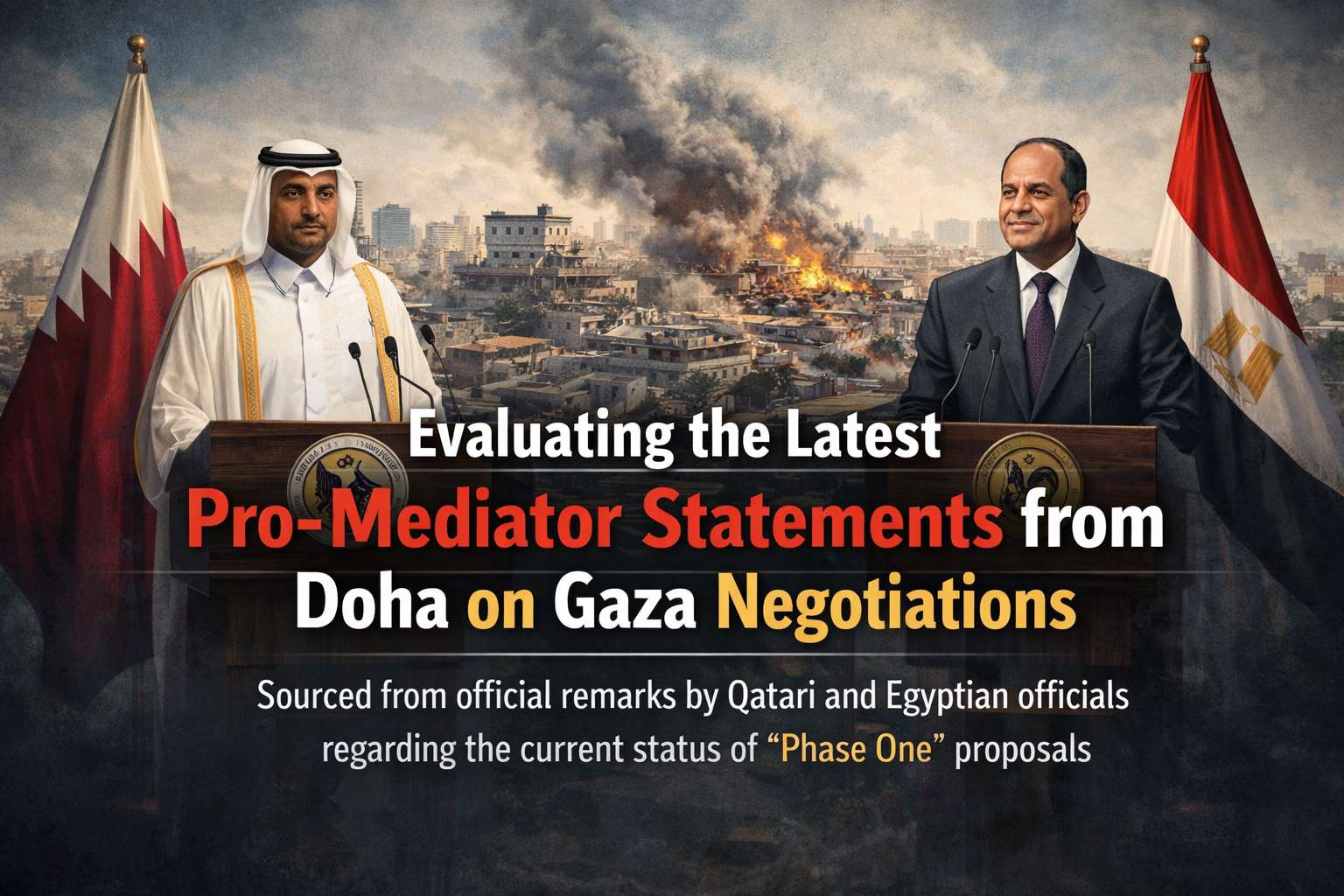
Sourced from official remarks by Qatari and Egyptian officials regarding the current status of “Phase One” proposals.
Publication date: April 17, 2026
Last updated: April 17, 2026
Byline: Editor, Global War News
Diplomatic efforts to secure a cessation of hostilities in Gaza have reached a critical juncture this week as mediators from Qatar and Egypt issued rare public statements regarding the viability of the current “Phase One” proposal. Following a high-level summit in Doha, officials expressed a cautious optimism, while simultaneously warning that the window for a structured transition to regional stability is narrowing.
The focus remains on a three-stage framework intended to facilitate an initial six-week pause in fighting, the exchange of specific cohorts of detainees, and the surge of humanitarian assistance into the northern Gaza Strip. According to official remarks carried by the Qatar News Agency (QNA), the mediation team is currently awaiting formal responses to “refined language” concerning the permanent cessation of military operations.
The “Phase One” Framework: Current Status
The Egyptian Ministry of Foreign Affairs, in a statement released late Wednesday, clarified that the “Phase One” proposals are designed as a confidence-building measure. According to Egyptian officials, the primary hurdle remains the “operational definition” of a sustainable calm.
As reported by Al Jazeera, the mediators have proposed a structured sequence:
- Initial 42-Day Pause: A total cessation of aerial and ground movements in densely populated areas.
- Humanitarian Surge: The entry of approximately 600 aid trucks per day, contingent on the opening of additional northern crossings.
- Category-Based Exchange: The release of elderly, wounded, and female detainees in exchange for a specified number of Palestinian prisoners.
Qatari Prime Minister Sheikh Mohammed bin Abdulrahman Al Thani stated publicly that the “bridging proposal” currently on the table addresses the logistical concerns of both parties more directly than previous iterations. However, he noted that “gaps in the timeline” for the withdrawal of forces from the central corridor remain a subject of active technical debate.
Official Remarks from Doha and Cairo
The rhetoric from the mediating capitals has shifted toward a more direct call for “political courage.” According to a Reuters report on the Doha briefings, Qatari mediators have emphasized that the proposal is no longer a draft but a “finalized path” that requires only executive approval.
In Cairo, officials briefed regional journalists on the “technical guarantees” being offered. According to these reports, Egypt has proposed an international monitoring mechanism to oversee the distribution of aid, intended to alleviate security concerns regarding the diversion of supplies. “We are at the closest point to an agreement that we have seen in months,” a senior Egyptian diplomat was quoted as saying, though they added that “the final mile is always the most treacherous.”
Analysis: The Gap Between Rhetoric and Reality
While the public statements from Doha and Cairo suggest progress, observers note that a significant disconnect remains between the mediators’ optimism and the situation on the ground. Analysts suggest that the “Phase One” focus is an attempt to bypass the more difficult “Phase Two” discussions—specifically the permanent end to the war—by securing a temporary reprieve first.
This raises questions about whether a short-term pause can realistically transition into a long-term settlement. It remains unclear whether either side is prepared to accept the “Phase One” terms without a guaranteed link to the subsequent stages. Editorially, the current surge in pro-mediator statements can be interpreted as a strategic move to place the burden of failure on the combatants rather than the process. If an agreement is not reached by the end of the current month, the “bridging proposal” risks becoming obsolete as military realities on the ground shift further.
Context and Background: Two Years of Mediation
The role of Qatar and Egypt as primary mediators is established by their unique regional positions. Qatar hosts the political bureau of the Palestinian movement, while Egypt shares a direct border with Gaza and maintains a long-standing security relationship with the Israeli defense establishment.
Since 2024, the mediation process has survived multiple collapses. The current framework is a direct evolution of the “Paris Principles” established earlier in the conflict. The significance of the current moment lies in the specific “Phase One” terminology, which seeks to decouple immediate humanitarian relief from the broader, more contentious political future of the territory.
Looking Ahead
The coming 72 hours are viewed by regional analysts as a “make or break” period for the Doha track. Mediators are expected to hold a final technical session to address the “Central Corridor” withdrawal schedule.
While the statements from Qatari and Egyptian officials provide a roadmap for peace, they do not yet constitute a signed agreement. Until both parties formally signify their acceptance of the Phase One language, the Donbas and Red Sea escalations continue to exert outside pressure on the Gaza negotiations, reminding all parties that the conflict remains inextricably linked to wider regional stability.
Sources: This article is based on official statements from the Qatari Ministry of Foreign Affairs, the Egyptian Ministry of Foreign Affairs, the Qatar News Agency (QNA), and reporting from Reuters, Al Jazeera, and the Associated Press.
This article is based on publicly available reporting from named international news agencies and attributed official statements. All claims about ongoing events are attributed to their original sources. Analysis sections represent the editorial interpretation of reported facts and do not constitute advocacy for any party to the described conflict. AI tools may be utilized for image generation to assist in explaining complex concepts, as well as for refining grammar, spelling, and other linguistic enhancements. However, all original content is produced, fact-checked, and revised by the editorial team. This publication does not take political positions on active military conflicts.