
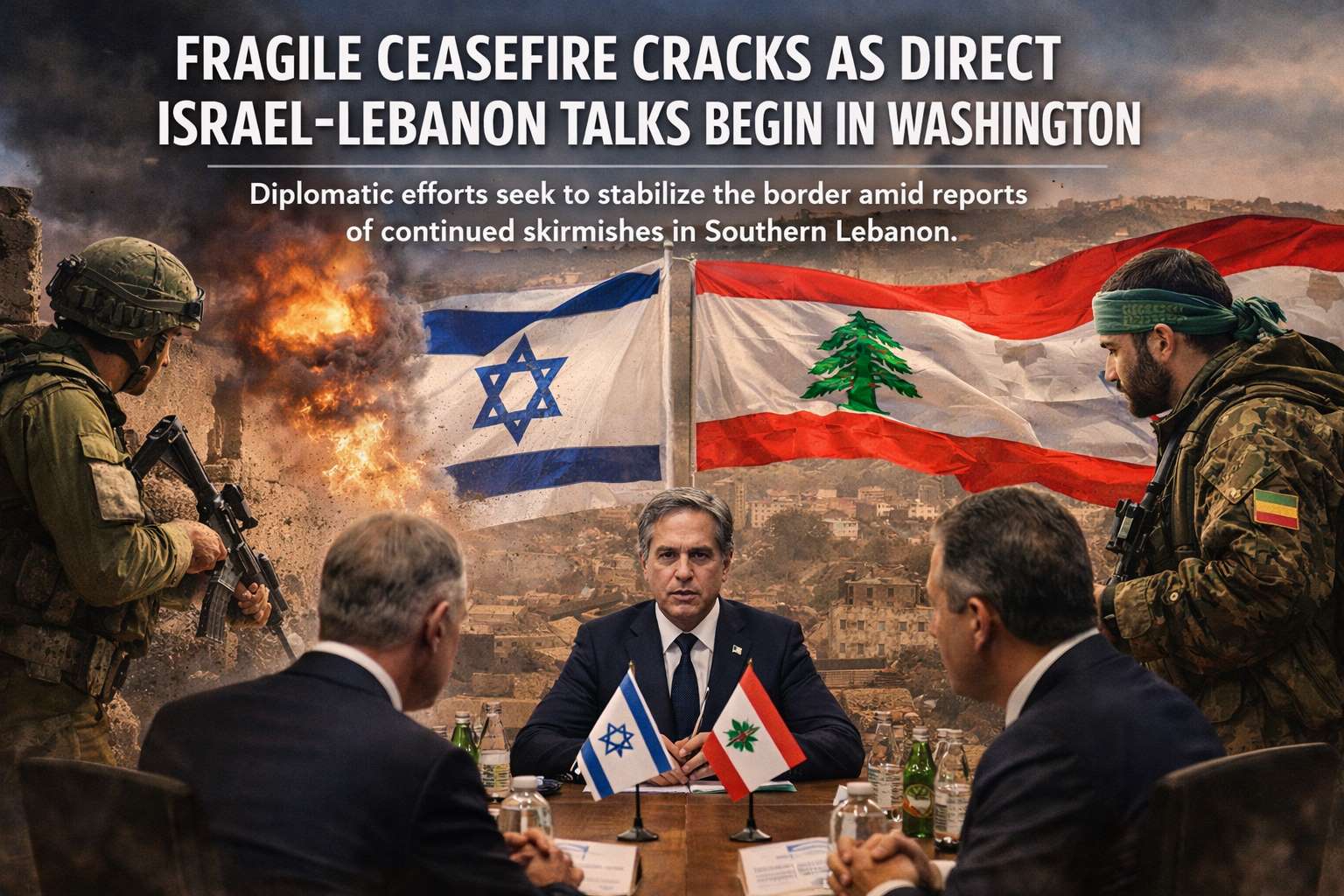
Diplomatic efforts seek to stabilize the border amid reports of continued skirmishes in Southern Lebanon.
April 15, 2026
Last Updated: 10:40 AM
By Global War News Editorial
Direct talks between high-level Israeli and Lebanese delegations began yesterday in Washington D.C., marking a significant, if tenuous, diplomatic opening intended to secure a permanent cessation of hostilities. The US-mediated negotiations are occurring as a recently brokered ceasefire faces its severest test, with reports of renewed clashes along the Blue Line.
According to a public statement issued by the US State Department, the discussions are focused on establishing a sustainable mechanism for de-escalation and addressing long-standing border disputes. However, the diplomatic progress is sharply contrasted by volatile conditions on the ground.
While the talks proceed in the US capital, the situation in Southern Lebanon remains precarious. Reports differ on the scale and nature of recent incidents, but both sides have alleged violations since the ceasefire nominally began three days ago.
Diplomatic Engagement in Washington
The negotiations, taking place at an undisclosed location in Washington, involve senior national security officials from both nations, marking the first direct diplomatic contact on security matters in nearly two years. The US Special Envoy to the region emphasized the “critical importance” of these talks in preventing a wider regional conflict.
In a brief address before the first session, the US Secretary of State said, “This is a pivotal moment for both Israel and Lebanon to choose stability over chaos. The presence of both delegations here in Washington demonstrates a willingness to engage, but the true measure of success will be the restoration of calm on the border.”
Sources close to the negotiations reported that the initial discussions centered on establishing a joint military commission to oversee the ceasefire. However, core issues, including the delineation of key maritime and land borders, remain significant obstacles.
Instability on the Ground
According to a Reuters report, unverified sources in Southern Lebanon claim that small-arms fire and mortar exchange occurred near the border village of Alma al-Shaab late Tuesday. The Israeli Defense Forces (IDF) stated that they responded to “provocations” on the border, while Lebanese state media alleged an “Israeli violation” of the truce, though this could not be independently confirmed.
The United Nations Interim Force in Lebanon (UNIFIL) confirmed “reports of sporadic firing” but stated that the overall level of hostilities has decreased significantly compared to the weeks preceding the ceasefire. In a statement, UNIFIL urged all parties to “exercise maximum restraint” to avoid derailing the diplomatic efforts in Washington.
Analysis: A High-Stakes Balancing Act
The decision by both governments to send high-level delegations to Washington suggests a recognition of the limits of a purely military strategy. The protracted nature of the conflict has strained economies and displaced populations on both sides. Observers note that the talks, even if ultimately unsuccessful, serve a de-escalation function by providing a channel for communication.
However, analysts have suggested that the current diplomatic push may be a fragile one, heavily reliant on the US administration’s commitment and the degree of control both governments exert over forces on the ground. The persistence of skirmishes underscores the difficulty of enforcing a truce in a complex security environment. If the violence escalates, the political will sustaining the talks in Washington could evaporate quickly.
It remains unclear whether either side is ready to make the substantive concessions required for a durable peace. The talks are currently seen as a trust-building exercise focused on managing the immediate ceasefire rather than resolving the fundamental political differences.
What to Watch
The talks in Washington are expected to continue throughout the week, with a specific focus on establishing a buffer zone along the border. Security experts will be closely monitoring whether the reported skirmishes in Southern Lebanon remain isolated incidents or signal a broader collapse of the ceasefire. International observers are also watching the domestic political reactions within both Israel and Lebanon, as any negotiated settlement will require significant internal consensus.
Sources: US State Department (Official Statement), Israeli Defense Forces (IDF) Statement, Lebanese State Media (Official Release), Reuters, AP News, United Nations Interim Force in Lebanon (UNIFIL) Statement.
This article is based on publicly available reporting from named international news agencies and attributed official statements. All claims about ongoing events are attributed to their original sources. Analysis sections represent the editorial interpretation of reported facts and do not constitute advocacy for any party to the described conflict. AI tools may be utilized for image generation to assist in explaining complex concepts, as well as for refining grammar, spelling, and other linguistic enhancements. However, all original content is produced, fact-checked, and revised by the editorial team. This publication does not take political positions on active military conflicts.