
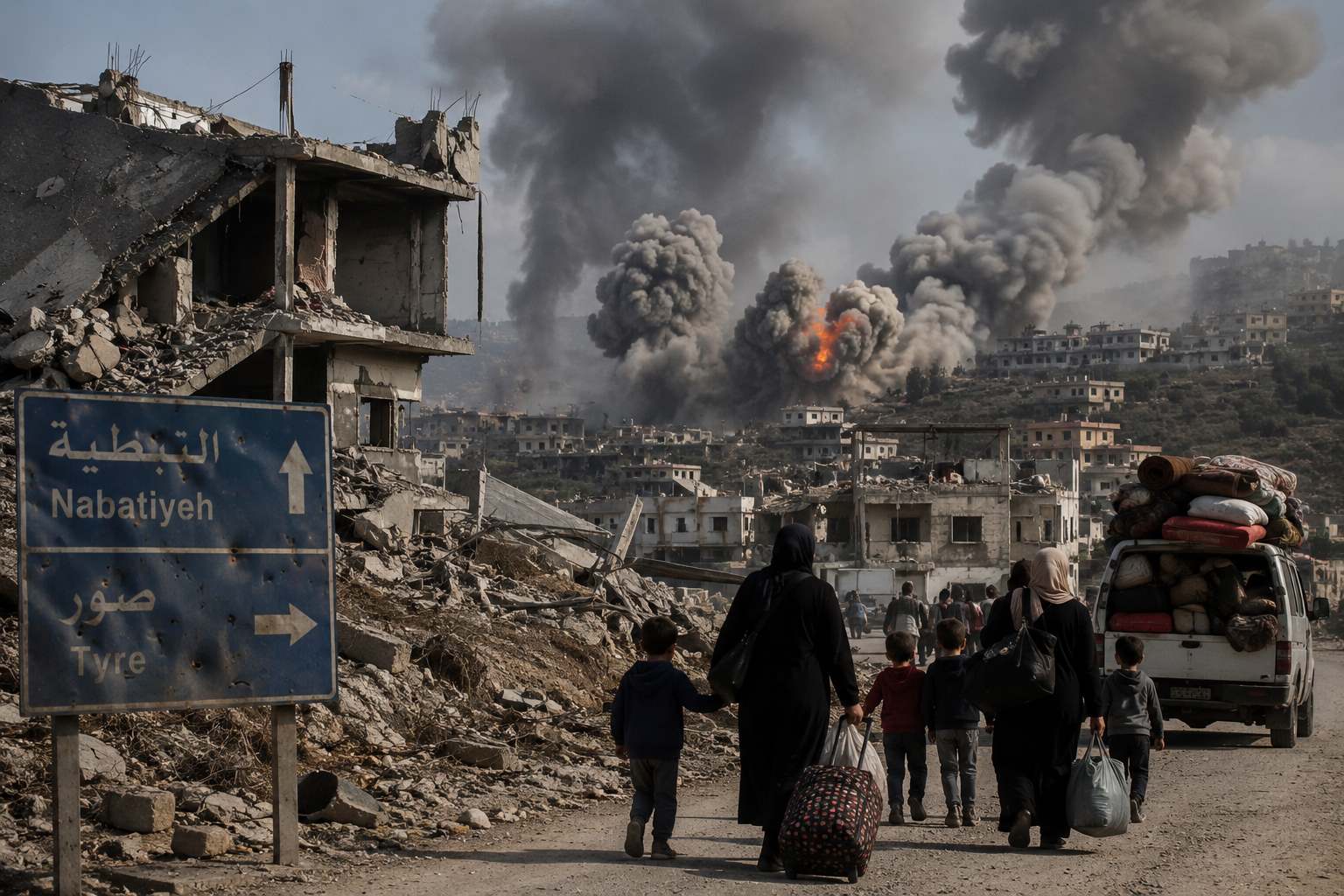
Bombardments hit residential sectors and municipal centers in Tyre and Nabatiyeh provinces, compounding a humanitarian crisis that has displaced over one million people.
Published: May 21, 2026
By: Global War News Editorial
A wave of Israeli airstrikes targeting multiple towns across southern Lebanon has killed at least 19 people, including four women and three children, according to official data released by the Lebanese Ministry of Public Health.
The bombardments, which hit several residential neighborhoods and municipal infrastructure corridors on Tuesday, represent the latest escalation in a highly volatile cross-border conflict. The renewed kinetic activity occurs despite the official 45-day extension of a United States-brokered ceasefire agreement that originally took effect on April 17, 2026. While both sides have formally agreed to the truce framework, near-daily exchanges of fire, drone incursions, and aerial bombardments have persisted throughout the region.
Direct Impacts on Deir Qanoun al-Nahr and Nabatiyeh
According to official updates compiled by Lebanon’s state-run National News Agency, the deadliest single engagement occurred in the village of Deir Qanoun al-Nahr, located within the coastal Tyre province. A single aerial bombardment flattened a residential home, killing 10 people. Emergency rescue teams, operating under the Lebanese Civil Defense, spent hours clearing heavy structural rubble to recover the bodies of the victims, who included three women and three children. Three additional individuals were reported wounded, including a young child who remains under intensive medical supervision.
Separate, simultaneous strikes were recorded across the southern provincial hub of Nabatiyeh. The health ministry confirmed that an airstrike within Nabatiyeh city killed four people and wounded 10 others.
Moments later, a third strike hit the nearby rural locality of Kfar Sir, killing five individuals, including one woman. Local administrative coordinators reported that the strikes primarily targeted built-up urban zones, damaging adjacent commercial shops and civilian transit paths.
The Israel Defense Forces did not issue immediate comments regarding the specific civilian casualty figures published by Beirut. However, in a standardized military update, the IDF command stated that between Monday and Tuesday afternoons, its air forces successfully struck more than 25 separate sites containing active Hezbollah infrastructure, operating complexes, and hidden weapon storage units throughout southern Lebanon.
Escalating Humanitarian Toll and Sector Collapsed
The latest fatalities have pushed the cumulative death toll from the 2026 Lebanon war past a critical threshold. According to data maintained by the Lebanese Ministry of Public Health, Israeli operations since the war expanded on March 2, 2026, have killed 3,073 people and wounded 9,362 others.
The human cost is deeply tied to a massive internal displacement crisis. United Nations humanitarians reported this week that the ongoing hostilities have forced more than 1.2 million people, accounting for roughly 20 percent of Lebanon’s total population, to flee their homes.
Many families remain scattered in temporary tent encampments along public roads and beaches in Beirut, while others crowd into underfunded state-managed schools turned shelters. This displacement has been compounded by explicit military directives; since March, the IDF has issued repeated evacuation warnings affecting dozens of distinct border localities.
| Strategic Metric (Since March 2, 2026) | Documented Impact Tally | Primary Reporting Authority |
| Total Fatalities | 3,073 deaths | Lebanese Ministry of Public Health |
| Total Injuries | 9,362 injuries | Lebanese Ministry of Public Health |
| Internal Displacement | 1.2 million+ individuals | United Nations OCHA / WHO |
| Healthcare Workers Killed | 116 personnel | Lebanese Ministry of Public Health |
The localized impact on public health infrastructure has reached emergency levels. Speaking at the World Health Assembly in Geneva on Wednesday, Lebanese Health Minister Rakan Nasreddine stated that continuous strikes have severely damaged the country’s medical safety net. Nasreddine verified that 116 healthcare workers have been killed, 16 hospitals physically damaged, 147 emergency ambulances struck, and 45 specialized healthcare centers forced to suspend operations entirely over the last 11 weeks.
Context: The Roots of the Spring Escalation
The current war between Israel and Hezbollah represents a major horizontal expansion of the broader Middle Eastern conflict. Direct hostilities flared on March 2, 2026, when Hezbollah launched an extensive volley of rockets and loitering munitions into northern Israeli border towns. This action followed two days after joint military actions executed by the United States and Israel against state targets within Iran.
In response, Israel launched a multi-phased military campaign, commencing ground operations inside southern Lebanon on March 16, accompanied by intensive aerial bombardment campaigns targeting the capital city of Beirut, the Bekaa Valley, and southern border districts. Israeli Defence Minister Israel Katz announced that residents living south of the Litani River would be barred from returning indefinitely until specific, verified security corridors are established.
Concurrently, the IDF has carried out large-scale demolition and controlled detonation operations across border villages such as Blida and Mays al-Jabal, aimed at dismantling underground tunnel networks and offensive firing positions used by Hezbollah. Despite these measures, the IDF has faced persistent challenges in completely halting Hezbollah’s frequent drone and anti-tank missile attacks, which claimed the life of another Israeli soldier in southern Lebanon on Tuesday, raising the verified Israeli military death toll to 21 since ground operations began.
What to Watch Next
The preservation of the current ceasefire agreement remains highly uncertain. Lebanese Prime Minister Nawaf Salam addressed the Cabinet on Wednesday, reiterating that a negotiated diplomatic solution is the only viable path to halting national destruction. Salam emphasized that all domestic weapons must eventually be brought under the exclusive control of state security forces to guarantee long-term sovereign stability.
However, with the United Nations flash appeal for Lebanon currently funded at just over 50 percent, receiving $158 million of its required target, humanitarian agencies lack the resources to sustain the massive displaced population. If the unverified daily breaches of the truce continue to intensify, observers warn that the regional landscape could quickly revert from a fragile, managed ceasefire to unconstrained, high-intensity urban warfare.
Source Disclosure Note: This report is compiled using official casualty and infrastructure statistics from the Lebanese Ministry of Public Health, press releases from the state-run National News Agency, and humanitarian situation updates from the United Nations Office for the Coordination of Humanitarian Affairs and the World Health Organization. Operational tracking details were drawn from formal statements by the Israel Defense Forces, public addresses by Lebanese Prime Minister Nawaf Salam, and field dispatches from the Associated Press, Agence France-Presse, and Xinhua.
This article is based on publicly available reporting from named international news agencies and attributed official statements. All claims about ongoing events are attributed to their original sources. Analysis sections represent the editorial interpretation of reported facts and do not constitute advocacy for any party to the described conflict. AI tools may be utilized for image generation to assist in explaining complex concepts, as well as for refining grammar, spelling, and other linguistic enhancements. However, all original content is produced, fact-checked, and revised by the editorial team. This publication does not take political positions on active military conflicts.