
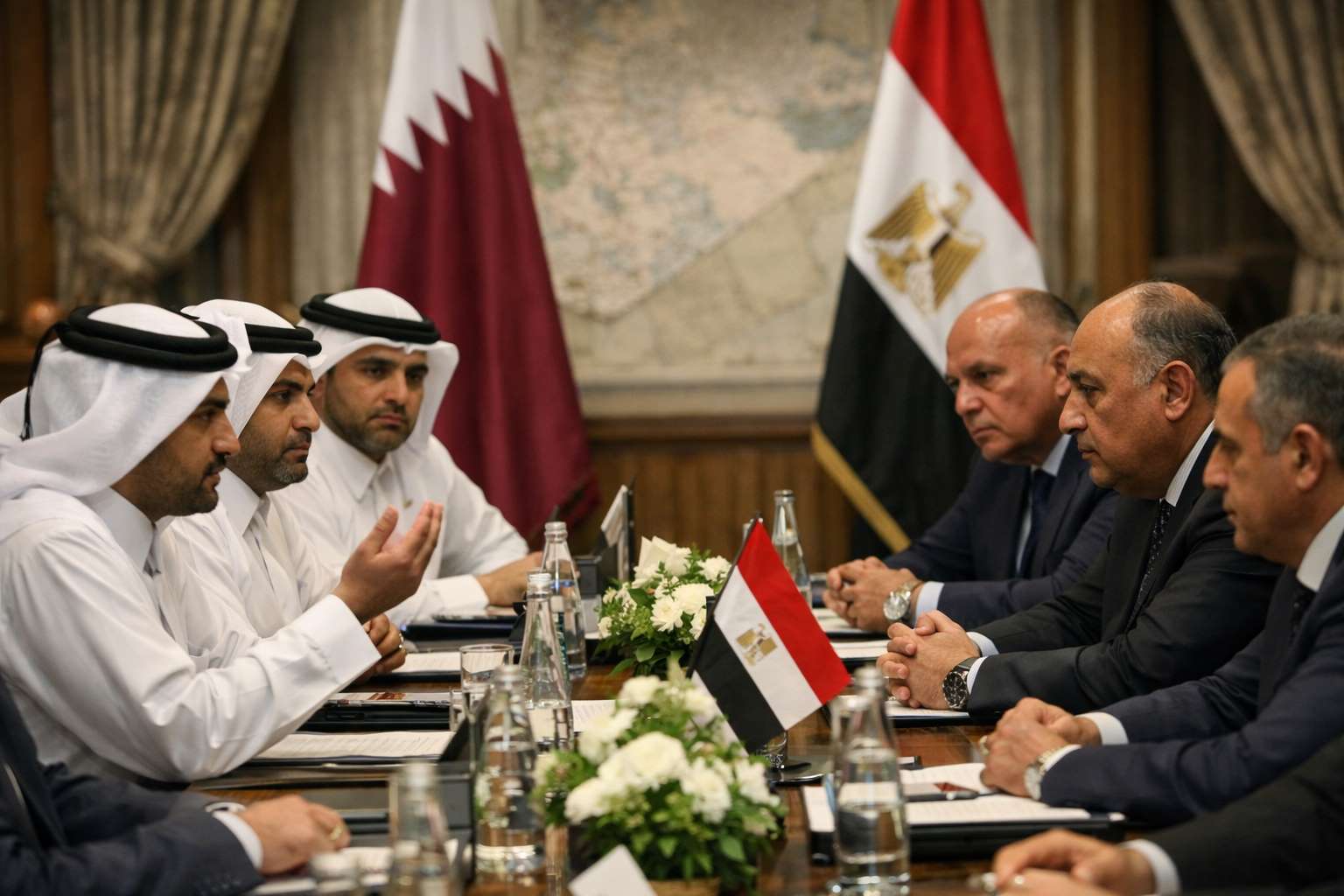
Qatari and Egyptian officials host intensive meetings to address ceasefire violations and the disarmament deadlock.
April 16, 2026
Last Updated: 03:30 PM
By Global War News Editorial
High-level mediation efforts in Cairo have reached a critical juncture this week as Qatari and Egyptian negotiators attempt to preserve the fragile Gaza ceasefire established in October 2025. According to official statements from the Egyptian State Information Service and reports from the Qatari Foreign Ministry, the current round of talks is focused on two primary tracks: addressing a spike in “Yellow Line” border violations and facilitating the transition into the second phase of the US-backed “Comprehensive Plan to End the Gaza Conflict.”
While the first phase of the agreement successfully secured the release of all living Israeli hostages and approximately 2,000 Palestinian prisoners, the transition to the second phase—intended to include a full Israeli military withdrawal and the disarmament of militant factions—remains heavily contested. According to mediators, the primary bottleneck is a disagreement over the timeline and mechanism for decommissioning weapons in exchange for reconstruction guarantees.
The Disarmament Deadlock
According to a report by Egypt Today, a Hamas delegation led by Dr. Khalil al-Hayya met with Egyptian intelligence officials on Sunday to discuss the implementation of the peace framework. The delegation reportedly reaffirmed its commitment to the signed terms but raised serious concerns over what it described as “constant Israeli violations” of the truce.
A central point of friction is the disarmament proposal presented by the international Board of Peace (BoP), chaired by US High Representative Nickolay Mladenov. According to a diplomat familiar with the talks who spoke to The Times of Israel, mediators are exerting significant pressure on Palestinian factions to accept a staged decommissioning of heavy weaponry. In a social media statement on April 10, Mladenov warned that those who do not “cross the river” of diplomacy risk being left behind as the region’s focus shifts toward broader escalations with Iran.
Hostage Remnants and Prisoner Laws
The status of the “hostage-for-prisoner” exchange has entered a grim final stage. According to the Council on Foreign Relations, all living hostages were released by January 2026. Current negotiations in Cairo are now focused on the repatriation of the remains of those who died in captivity in exchange for the release of further Palestinian detainees.
However, the climate of the talks has been further strained by a new Israeli law passed in early April. According to reports from Xinhua, Hamas negotiators have raised objections to a law that allows for the execution of Palestinian prisoners convicted of killing Israelis with “intent to harm the state.” Qatari mediators noted that such legislative moves complicate the “goodwill” atmosphere required to finalize the exchange of remains and the release of high-profile prisoners.
Verification of Ceasefire Violations
Both Israel and Hamas have traded accusations of breaching the US-backed truce. According to data from the UN Office for the Coordination of Humanitarian Affairs (OCHA), at least 750 Palestinians have been killed in localized strikes since the ceasefire began in October. Conversely, the IDF reported the death of five soldiers in Gaza during the same period, citing “responses to armed cells” approaching the de facto boundary known as the Yellow Line.
- Hamas Allegations: According to a Hamas official who spoke to AFP, the group is demanding that Israel dismantle newly established military positions and halt the reported westward movement of the Yellow Line markers, which allegedly encroaches on civilian zones.
- Israeli Allegations: Israeli officials maintain that strikes are precision-based and directed only at militant cells attempting to regroup or breach the buffer zone.
Analysis: A Ceasefire in Name Only?
Observers note that while the large-scale bombardment of 2023-2024 has ceased, the current “truce” is characterized by a high-intensity war of position. Analysts from the International Crisis Group suggest that the peace plan is currently failing on humanitarian grounds. A recent scorecard released by five major aid organizations, including Oxfam and the Norwegian Refugee Council, indicates that aid deliveries have dropped to just 38% of the agreed-upon levels.
The transition to the second phase—which envisions a 20,000-strong International Stabilization Force—is stalled by a “trust deficit.” Israel is reluctant to withdraw fully without verified disarmament, while Hamas refuses to disarm without a guaranteed, irreversible pathway to Palestinian governance and a total cessation of strikes.
What to Watch For
Negotiators are expected to remain in Cairo through the weekend. The key indicator of success will be whether a “verification committee” can be established to monitor the Yellow Line and if a compromise can be reached on the technicalities of weapons decommissioning. Without a breakthrough, there is a growing risk that the fragile ceasefire will collapse entirely as regional tensions elsewhere in the Middle East continue to mount.
Sources: This article is based on reporting and official statements from the Egyptian State Information Service, the Qatari Foreign Ministry, the United Nations Office for the Coordination of Humanitarian Affairs (OCHA), Reuters, AFP, The Times of Israel, and the Council on Foreign Relations.
This article is based on publicly available reporting from named international news agencies and attributed official statements. All claims about ongoing events are attributed to their original sources. Analysis sections represent the editorial interpretation of reported facts and do not constitute advocacy for any party to the described conflict. AI tools may be utilized for image generation to assist in explaining complex concepts, as well as for refining grammar, spelling, and other linguistic enhancements. However, all original content is produced, fact-checked, and revised by the editorial team. This publication does not take political positions on active military conflicts.