
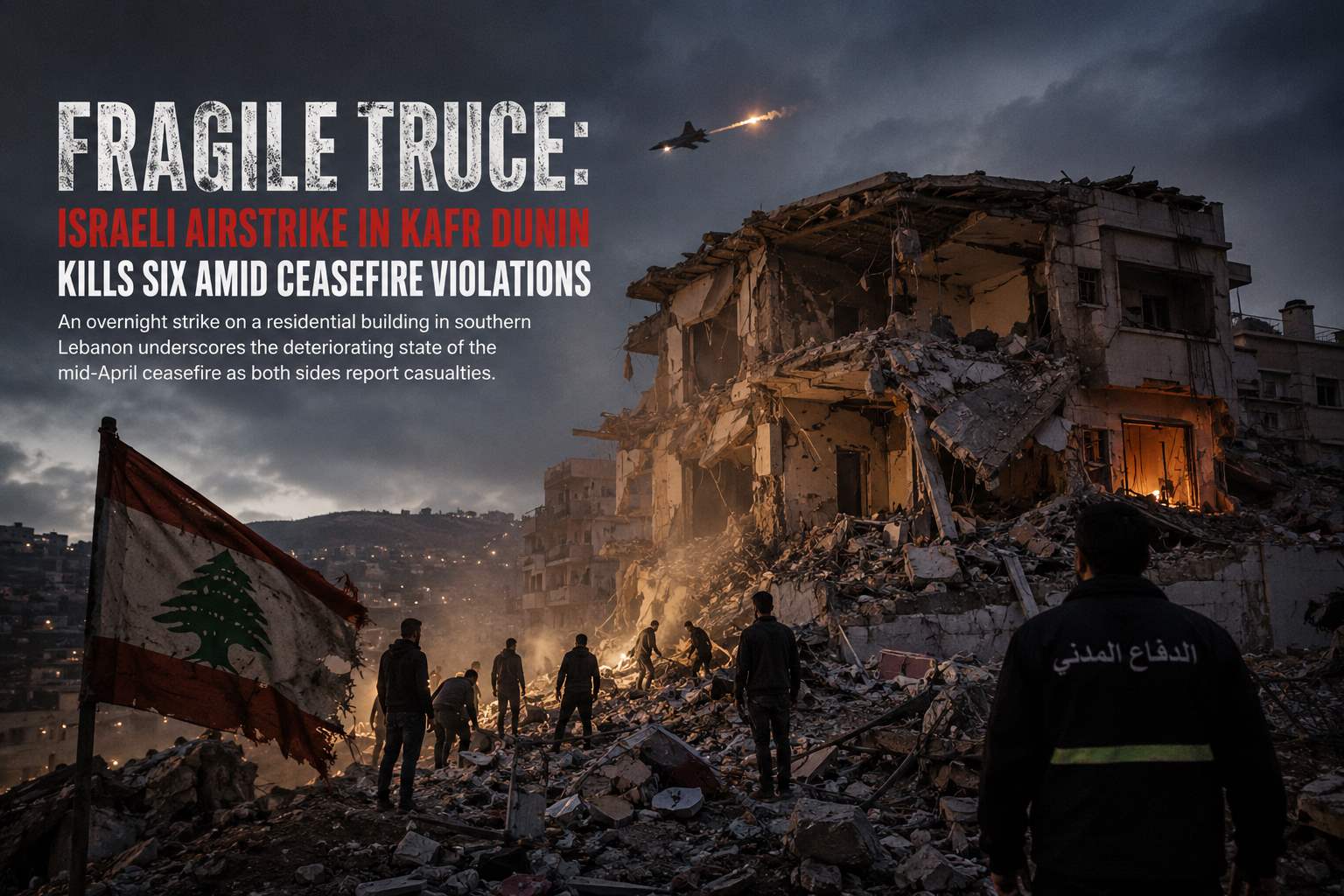
An overnight strike on a residential building in southern Lebanon underscores the deteriorating state of the mid-April ceasefire as both sides report casualties.
May 12, 2026
Global War News Editorial
An Israeli airstrike reportedly killed six people and wounded seven others in the town of Kafr Dunin in southern Lebanon overnight. According to Lebanon’s state-run National News Agency (NNA), the strike targeted an inhabited house, prompting emergency rescue operations that continued into Tuesday morning.
The incident is the latest in a series of escalations that have largely undermined a ceasefire first announced on April 16 and later extended into mid-May. While the truce initially brought a brief lull to the intensive conflict that began in early March, daily violations by both the Israel Defense Forces (IDF) and Hezbollah have increasingly normalized cross-border violence once again.
Escalation Despite Diplomacy
The strike in Kafr Dunin follows a particularly violent 48-hour window. On Monday, Lebanese media reported that nine people were killed in separate drone and artillery strikes across the south, including attacks in Nabatieh and Bint Jbeil. Meanwhile, the IDF announced on Monday that an Israeli master sergeant was killed in northern Israel following a Hezbollah drone attack on Sunday.
These events occur just days before the United States is set to host a third round of ambassador-level talks between Israeli and Lebanese representatives in Washington, DC, scheduled for May 14 and 15. For the first time, these talks are expected to include military representatives to discuss technical measures for disarming militant groups south of the Litani River.
Human and Economic Toll
The humanitarian impact of the renewed fighting remains severe. According to the Emergency Operations Center of the Lebanese Ministry of Public Health, the total death toll in Lebanon since March 2 has risen to 2,869, with over 8,700 injured.
The conflict has also triggered a massive displacement crisis. Data from international agencies indicates that approximately 1.05 million people, or 18% of Lebanon’s population, have been forced to flee their homes. Most remain displaced as the security buffer zone established by the IDF, extending 8 to 10 kilometers into southern Lebanon, prevents civilians from returning to border villages.
ANALYSIS: The “Buffer Zone” Strategy
Observers note that the persistence of Israeli strikes, despite the technical existence of a ceasefire, aligns with Israel’s stated objective of maintaining a “security zone.” By targeting Hezbollah infrastructure and operatives within this belt, the IDF aims to prevent a return to the status quo that existed before March.
However, analysts suggest that the high frequency of strikes on residential areas and the resulting civilian casualties provide Hezbollah with a justification for continued “retaliatory” drone and rocket launches. This cycle suggests that neither side is currently willing or able to enforce the strict terms of the April agreement. The inclusion of military officials in the upcoming Washington talks indicates an awareness that diplomatic rhetoric alone is insufficient without a practical, monitored withdrawal mechanism on the ground.
What to Watch
- Washington Peace Talks (May 14-15): The outcome of these discussions will determine if the ceasefire is formally abandoned or if new enforcement mechanisms are introduced.
- IDF Buffer Zone Operations: Whether Israeli ground forces expand their current 10-kilometer footprint in response to the latest drone casualties.
- Humanitarian Aid Access: Continued strikes on health facilities, such as the reported attack on a clinic in Srifa, may further complicate international relief efforts.
Source Disclosure: Reports from Middle East Eye, National News Agency (Lebanon), Anadolu Agency, Associated Press, and The Times of Israel. Casualties and health data sourced from the Lebanese Ministry of Public Health and IDF official announcements.
This article is based on publicly available reporting from named international news agencies and attributed official statements. All claims about ongoing events are attributed to their original sources. Analysis sections represent the editorial interpretation of reported facts and do not constitute advocacy for any party to the described conflict. AI tools may be utilized for image generation to assist in explaining complex concepts, as well as for refining grammar, spelling, and other linguistic enhancements. However, all original content is produced, fact-checked, and revised by the editorial team. This publication does not take political positions on active military conflicts.