
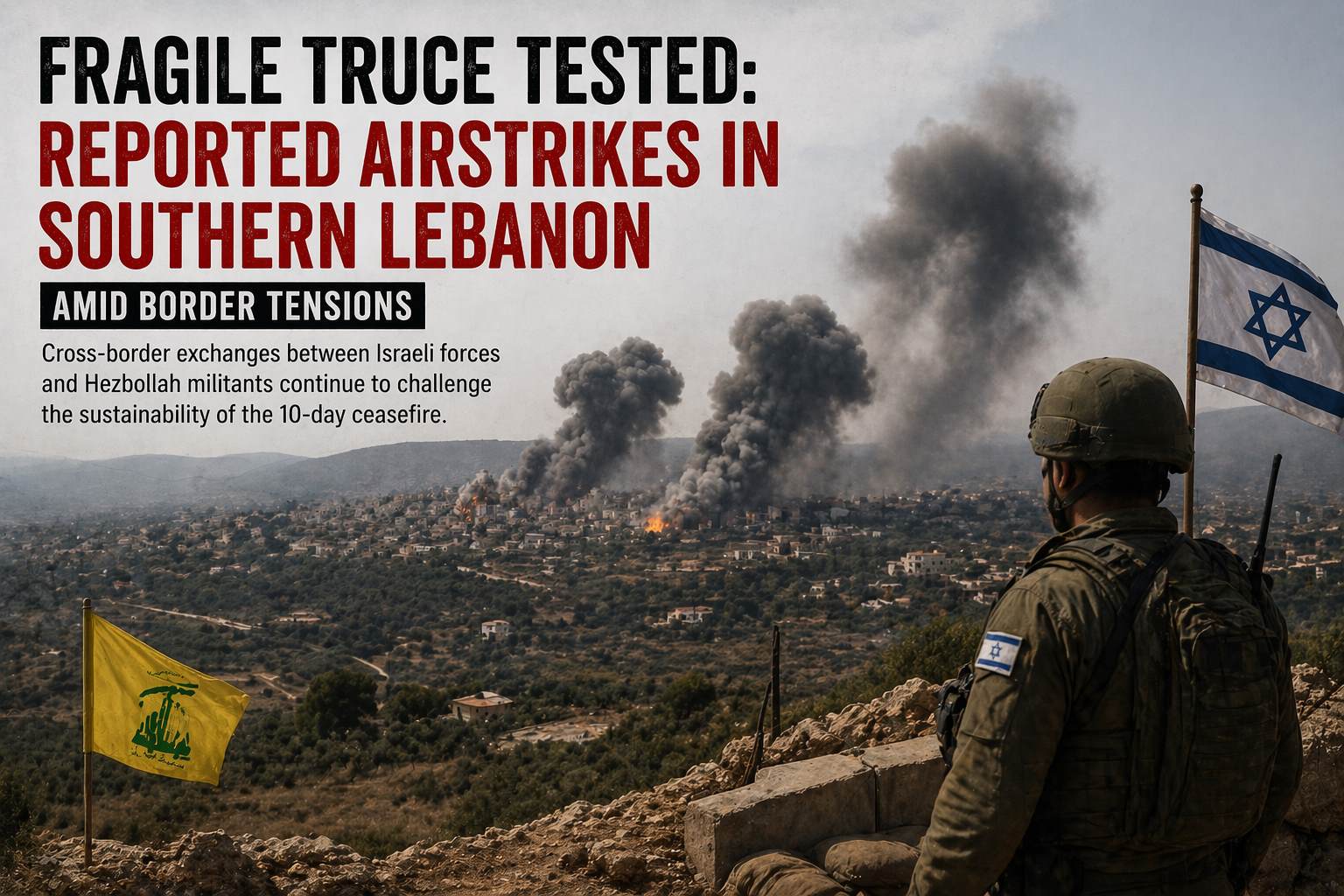
Cross-border exchanges between Israeli forces and Hezbollah militants continue to challenge the sustainability of the 10-day ceasefire.
April 23, 2026
Last Updated: 16:00 GMT
By Global War News Editorial
The ten-day ceasefire established between Israel and Lebanon on April 16 faces its most significant challenge following a series of kinetic exchanges across the Blue Line. Over the last 24 hours, both the Israel Defense Forces (IDF) and Lebanese authorities have reported airstrikes and shelling in southern Lebanon, marking what observers describe as the deadliest period since the truce was implemented.
Reports of Cross-Border Strikes
According to official statements from the IDF, Israeli aircraft conducted targeted strikes on Wednesday after identifying what it termed “violations of the truce.” The military stated that it hit a rocket launcher in the Rab Thalathin area and intercepted a drone launched toward northern Israel. The IDF maintains that its forces remain deployed in southern Lebanon to ensure the security of northern Israeli communities and will respond to any perceived threats.
In contrast, Lebanese state media and local officials reported that Israeli strikes targeted civilian infrastructure and vehicles. According to Lebanon’s National News Agency (NNA), a strike on a car in the town of Al-Tayri resulted in two fatalities. Lebanese authorities have accused Israel of a “scorched-earth policy” aimed at creating an uninhabited buffer zone along the border villages.
Impact on Media and Civilians
The escalation has resulted in civilian and professional casualties. According to reports from the Union of Journalists in Lebanon and the International Federation of Journalists (IFJ), Lebanese journalist Amal Khalil was killed on Wednesday in an Israeli strike on a building in southern Lebanon where she had reportedly taken shelter. A freelance photographer accompanying her was also injured.
The Lebanese Ministry of Health reported that the total death toll from Wednesday’s exchanges reached five people. Humanitarian partners, including the UN, have expressed concern that these incidents are discouraging the return of displaced families. Despite the ceasefire, roughly 1.1 million people remain uprooted, and many areas in the south are still considered high-risk due to ongoing military presence and unexploded ordnance.
Analysis: The Complexity of “Active Defense”
Military analysts note that the ceasefire is inherently unstable because Hezbollah was not a formal signatory to the agreement, although the group initially indicated it would abide by the pause. The current friction stems from differing interpretations of “defensive posture.”
The IDF asserts that any movement of personnel or equipment near its forward positions justifies a kinetic response. Conversely, Hezbollah has publicly stated that it views the continued presence of Israeli troops on Lebanese soil as a violation, asserting a right to “retaliate” against what it calls Israeli aggression. This cycle of “retaliation for retaliation” raises the risk of the ten-day truce collapsing before a more permanent diplomatic solution can be negotiated.
Economic Context and Supply Chains
The stability of the Lebanon-Israel border is closely linked to broader regional economic indicators. According to data from the International Monetary Fund (IMF), the 2026 conflict has already caused a sharp contraction in Lebanon’s GDP, with agricultural output in the south nearly halted. Furthermore, the reopening of the Strait of Hormuz by Iran was conditioned on the cessation of hostilities in Lebanon; any full-scale return to war could prompt a renewed naval blockade, affecting global oil prices.
What to Watch
Diplomatic efforts led by the United States and regional mediators are currently focused on extending the ceasefire beyond its initial ten-day window, which is set to expire shortly. Observers are monitoring whether the Lebanese government can assert more effective sovereignty in the south to provide the “field realities” required by Israel for a permanent withdrawal.
Sources: This report is based on official statements from the Israel Defense Forces (IDF), the Lebanese National News Agency (NNA), and the Lebanese Ministry of Health. Supplemental reporting on journalist casualties was sourced from the International Federation of Journalists (IFJ) and Reuters. Economic context was provided by the IMF and the World Bank.
This article is based on publicly available reporting from named international news agencies and attributed official statements. All claims about ongoing events are attributed to their original sources. Analysis sections represent the editorial interpretation of reported facts and do not constitute advocacy for any party to the described conflict. AI tools may be utilized for image generation to assist in explaining complex concepts, as well as for refining grammar, spelling, and other linguistic enhancements. However, all original content is produced, fact-checked, and revised by the editorial team. This publication does not take political positions on active military conflicts.