
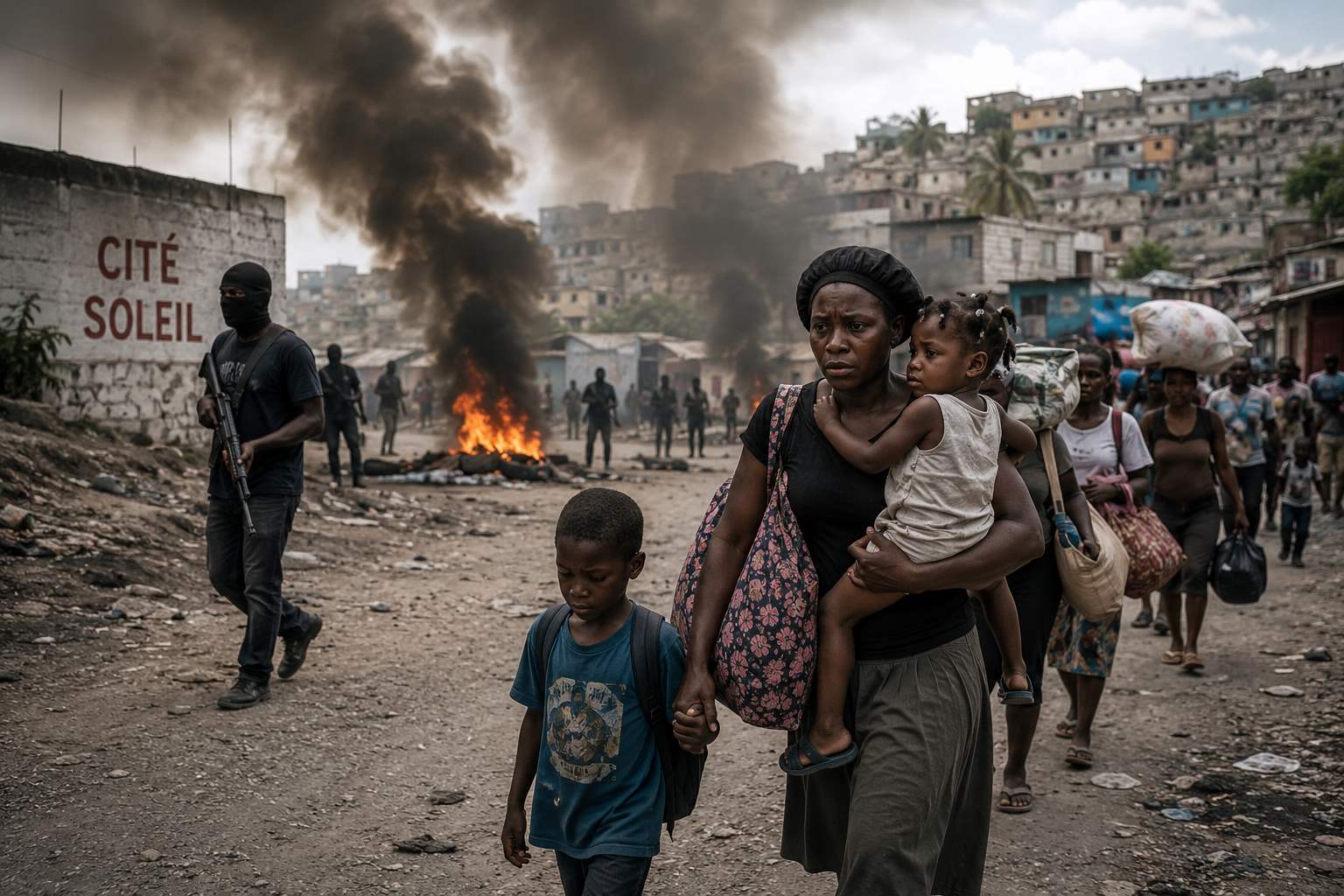
Escalating clashes between armed groups disrupt aid corridors and trigger a new wave of internal migration
May 13, 2026
Last updated: 19:30 GMT
By Global War News Editorial
Authorities in Haiti and international monitors report that hundreds of residents have been forced to flee their homes in the Cité Soleil district of Port-au-Prince following a sharp increase in violence between rival gang coalitions. According to reports from the United Nations Integrated Office in Haiti (BINUH), the fighting intensified over the last 48 hours, trapped civilians in their homes and severed several key supply routes into the capital.
Local human rights organizations have stated that the clashes involve the “G9” and “G-Pep” alliances, which have long fought for territorial control over the city’s industrial and port areas. While the Haitian National Police (PNH) has reportedly deployed additional units to the perimeter of the district, residents told local media that many neighborhoods remain under the de facto control of armed groups.
The displacement occurs amid a broader humanitarian crisis in the Caribbean nation. The International Organization for Migration (IOM) indicated that this latest wave of movement adds to the more than 360,000 people already displaced nationwide due to insecurity.
Deteriorating Security in the Capital
According to reporting from Agence France-Presse (AFP), the current flare-up in Cité Soleil began after a period of relative, albeit fragile, calm. Witnesses reported that armed individuals utilized heavy weaponry and incendiary devices, leading to the destruction of numerous makeshift dwellings.
In a statement, the humanitarian group Médecins Sans Frontières (MSF) noted that its facilities in the area have received a high volume of patients with gunshot wounds. The organization warned that the insecurity is preventing its teams from reaching those in the most severely affected “red zones.”
The Haitian government, currently operating under a transitional council, has publicly appealed for the expedited deployment of the Multinational Security Support (MSS) mission. While a small contingent of international personnel is present in the country, the mission has not yet reached the operational capacity required to reclaim large urban districts like Cité Soleil from gang control.
Economic and Humanitarian Implications
The violence in Cité Soleil has immediate consequences for the national economy. The district is strategically located near the Terminal Varreux, the country’s primary fuel entry point. Analysts have noted that when fighting intensifies in this corridor, fuel distributions are often halted, leading to a ripple effect of price increases for transportation and electricity across the country.
Observers note that the “taxation” imposed by gangs at roadblocks further inflates the cost of basic goods. For a population where a significant percentage already faces acute food insecurity, these supply chain disruptions are catastrophic. The World Food Programme (WFP) recently reported that nearly half of Haiti’s population is experiencing “crisis” levels of hunger, a situation exacerbated by the inability to move agricultural products safely from rural areas to the capital’s markets.
Analysis: The Governance Gap
This latest displacement highlights the persistent gap between the government’s stated security goals and the reality on the ground. Analysts suggest that until the transitional council can establish a more robust and permanent police presence in Cité Soleil, the cycle of displacement will continue.
The reliance on international security assistance remains a point of contention. While some local civil society groups view the MSS mission as a necessary intervention, others raise concerns about long-term sovereignty and the historical legacy of foreign military presence in Haiti. It remains unclear whether the mission will have the specific training and resources required for high-intensity urban combat in densely populated slums.
What to watch for in the coming days is whether the gang coalitions will attempt to extend their control toward the nearby port facilities, which would represent a significant escalation and a major blow to the country’s limited remaining commercial infrastructure.
Source Disclosure Note: This report is based on statements from the United Nations Integrated Office in Haiti (BINUH), the International Organization for Migration (IOM), and Médecins Sans Frontières (MSF). Supplemental reporting was provided by Agence France-Presse (AFP) and local media monitored by the Kivu Security Tracker equivalent in the region.
This article is based on publicly available reporting from named international news agencies and attributed official statements. All claims about ongoing events are attributed to their original sources. Analysis sections represent the editorial interpretation of reported facts and do not constitute advocacy for any party to the described conflict. AI tools may be utilized for image generation to assist in explaining complex concepts, as well as for refining grammar, spelling, and other linguistic enhancements. However, all original content is produced, fact-checked, and revised by the editorial team. This publication does not take political positions on active military conflicts.